
Listen to this Post
Introduction:
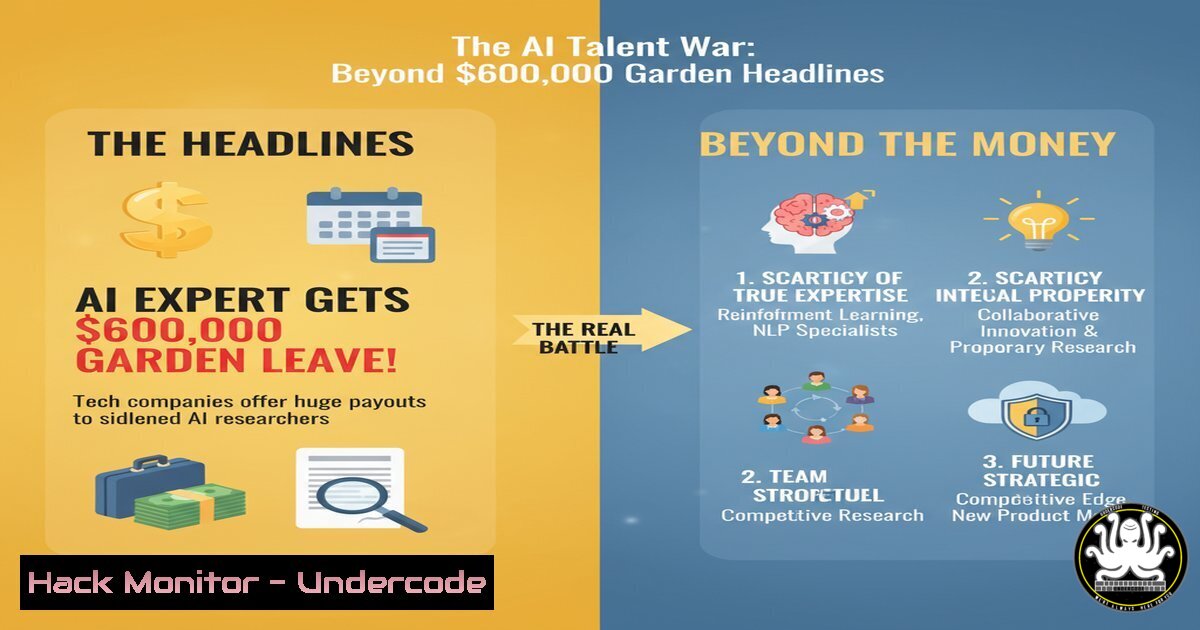
The recent headlines about Google paying senior AI engineers vast sums to sit on “garden leave” highlight a critical inflection point in the technology landscape. This is not merely a retention strategy; it is a defensive maneuver in a high-stakes war for intellectual property and specialized knowledge. For cybersecurity and IT professionals, this trend underscores the immense value and associated risks of concentrated AI expertise within an organization, where the departure of a key individual can constitute a significant threat to both competitive advantage and security posture.
Learning Objectives:
- Understand the cybersecurity implications of concentrated AI talent and knowledge management.
- Learn practical commands for securing AI development environments and data pipelines.
- Develop strategies for mitigating insider threats and protecting critical AI intellectual property.
You Should Know:
1. Securing the AI Development Environment
The foundation of AI security begins with the integrity of the development environment. Unauthorized access here can lead to model poisoning, data exfiltration, or the insertion of backdoors.
Verified Commands & Configurations:
Container Security Scan (using Trivy):
`trivy image your-ai-model-registry.com/tensorflow:latest`
This command scans a Docker image for known vulnerabilities (CVEs). Regularly scanning base images used for AI/ML workloads prevents deploying inherently vulnerable containers.
Git Repository Security Audit:
`git log -p –follow config/secrets.yml`
Review the history of a sensitive file to check for accidental commits of credentials or API keys into version control, a common vector for compromising AI data sources.
Linux Access Control (Preventing Unauthorized Execution):
`chmod 750 /opt/ai-scripts/training_job.py`
This changes the permissions on a critical training script so that only the owner and group can read and execute it, while others have no access.
Python Environment Integrity Check:
`pip-audit`
A tool that audits Python environments for packages with known vulnerabilities, crucial for ensuring the AI software supply chain is not compromised.
Step‑by‑step guide:
To harden your AI development workstation, start by implementing a strict least-privilege model. Use `sudo` privileges sparingly. Regularly run `trivy` against your development and production container images as part of your CI/CD pipeline. Furthermore, configure pre-commit hooks in Git to scan for secrets and credentials before code is even committed, preventing sensitive AI model data from leaking.
2. Hardening Data Pipeline Access
AI models are only as good and secure as their data. Protecting the data pipeline is paramount to ensuring model integrity and confidentiality.
Verified Commands & Configurations:
AWS S3 Bucket Policy (Preventing Public Read):
{
"Version": "2012-10-17",
"Statement": [
{
"Effect": "Deny",
"Principal": "",
"Action": "s3:GetObject",
"Resource": "arn:aws:s3:::your-ai-training-data-bucket/",
"Condition": {"Bool": {"aws:SecureTransport": false}}
}
]
}
This bucket policy denies all access to objects if the request is not made over SSL/TLS (HTTPS).
Linux Encrypted Filesystem (LUKS) for On-Prem Data:
`cryptsetup luksFormat /dev/sdb1`
This command initializes a partition for encryption using LUKS, ensuring that sensitive training datasets are protected at rest.
Database Access Audit (PostgreSQL):
`SELECT usename, client_addr, query FROM pg_stat_activity WHERE datname = ‘ai_training_db’;`
This SQL query monitors current connections to your AI training database, helping to identify unauthorized access attempts.
Step‑by‑step guide:
Begin by classifying your AI data based on sensitivity. For highly sensitive datasets, enforce encryption both in transit and at rest. Use cloud provider tools like AWS KMS or Azure Key Vault to manage encryption keys. For on-premise storage, use `LUKS` or similar full-disk encryption. Regularly audit access logs for your data stores using cloud-native logging (e.g., AWS CloudTrail) or database-specific queries to detect anomalous patterns that could indicate data scraping or exfiltration.
3. Monitoring for Model and Data Exfiltration
When a key AI expert is leaving, the risk of intellectual property theft increases. Proactive monitoring can detect data and model exfiltration attempts.
Verified Commands & Configurations:
Network Traffic Monitoring (using tcpdump):
`tcpdump -i any -A host 192.168.1.100 and port 443`
This captures and displays traffic to/from a specific host on the HTTPS port, which can be analyzed for large, suspicious data transfers.
Data Loss Prevention (DLP) with `clamav` and custom signatures:
`clamscan -r –detect-pua –alert-encrypted /data/ai-models/`
Scans the model directory for potentially unwanted applications and encrypted archives, which are common tactics for hiding exfiltrated data.
API Call Monitoring (Generic):
`grep “model/export” /var/log/ai-api-server.log | tail -n 50`
Searches the API server logs for requests to export or download AI models, which should be a highly audited and restricted operation.
Linux Process and File Access Audit (using auditd):
`auditctl -w /opt/proprietary-model.pkl -p war -k proprietary_ai_model`
This `auditd` rule watches the specified model file for any write, attribute change, or read access and logs the event with the key “proprietary_ai_model”.
Step‑by‑step guide:
Implement a robust logging and monitoring strategy. Configure your `auditd` rules to monitor access to critical model files and source code directories. Centralize these logs in a SIEM (Security Information and Event Management) system. Create alerts for events such as large outbound data transfers during unusual hours or access to model export APIs by users who do not typically use them. This creates a defensive tripwire around your most valuable AI assets.
4. Implementing Zero Trust for AI Infrastructure
The “garden leave” scenario is a classic zero-trust problem: trust should not be assumed, even for internal experts. Access must be explicitly verified.
Verified Commands & Configurations:
Service-to-Service Authentication (mTLS snippet):
 Example in a Kubernetes Pod spec
spec:
containers:
- name: ai-service
image: ai-service:latest
volumes:
- name: istio-certs
secret:
secretName: istio.ai-service-credential
This Kubernetes pod specification mounts a secret containing mutual TLS (mTLS) certificates, ensuring that only authenticated services can communicate with your AI microservice.
Just-In-Time (JIT) Access Request (PAM Command):
`sudo -u admin — /bin/bash`
The use of `sudo` should be logged and require justification. In a mature JIT system, this command would only succeed after an access request is approved.
Step‑by‑step guide:
Adopt a zero-trust architecture for your AI platform. Enforce network segmentation, ensuring that training environments are isolated from general corporate networks. Implement mutual TLS (mTLS) for all service-to-service communication to prevent lateral movement. Utilize a Privileged Access Management (PAM) solution to vault credentials and require elevated, time-bound access to be explicitly granted and justified, rather than having permanent admin privileges.
5. Mitigating Insider Threat with Behavioral Analytics
The most valuable asset walking out the door is knowledge. Technical controls must be paired with behavioral oversight.
Verified Commands & Configurations:
User Session Recording (via `script` command):
`script -a /var/log/sessions/user_${USER}_$(date +%Y%m%d_%H%M%S).log`
This command starts a session recording for the current user, appending all terminal activity to a timestamped log file. This is a basic form of session auditing.
CloudTrail Log Analysis for Anomalous Behavior:
`aws cloudtrail lookup-events –start-time 2023-10-01T00:00:00Z –end-time 2023-10-02T00:00:00Z –lookup-attributes AttributeKey=Username,[email protected]`
This AWS CLI command retrieves all API calls made by a specific user in a 24-hour period for audit and analysis.
Step‑by‑step guide:
While session recording is a powerful tool, it must be implemented with careful regard for privacy laws and policies. A more scalable approach is to use cloud-native tools like AWS CloudTrail or Azure Activity Logs, feeding them into a UEBA (User and Entity Behavior Analytics) system. The UEBA can establish a baseline of normal activity for an AI researcher (e.g., typical data access patterns, working hours) and alert on significant deviations, such as accessing large volumes of data they’ve never needed before or logging in from unusual locations.
What Undercode Say:
- The $600K Price Tag is a Symptom of a Deeper Security Debt. The extreme measure of “garden leave” reveals a failure to institutionalize knowledge and secure IP through robust technical and process controls. Companies are paying to quarantine risk they failed to mitigate.
- AI Talent Concentration Creates a Single Point of Failure. From a cybersecurity perspective, a handful of engineers holding critical, undocumented knowledge is analogous to a system relying on a single, poorly protected root password. The compromise or departure of that “human asset” can cripple the entire AI initiative.
The analysis suggests that the frenzy over AI talent is not just a HR challenge but a core cybersecurity and business continuity issue. Organizations must shift from a reactive posture of buying silence to a proactive one of building resilient systems. This involves systematic knowledge sharing, strict access controls, comprehensive auditing, and a zero-trust framework that minimizes the damage any single individual, malicious or not, can cause. The goal is to make the organization’s AI capabilities resilient to talent churn, transforming human capital from a vulnerability into a distributed, scalable asset.
Prediction:
The current practice of using financial incentives to lock down talent is unsustainable. We predict a rapid evolution towards “AI Governance and Security” as a standard executive role, mirroring the rise of the CISO. Future valuation of companies will increasingly factor in their “AI IP Security Posture.” Technologies for automated knowledge capture, secure model collaboration, and provable IP non-leakage will become billion-dollar markets. The hack won’t be a single breach, but a gradual erosion of competitive advantage through unmanaged talent turnover, forcing a fundamental re-architecting of how we secure not just systems, but the human expertise that builds them.
🎯Let’s Practice For Free:
IT/Security Reporter URL:
Reported By: Michaelyoung08 Aileadership – Hackers Feeds
Extra Hub: Undercode MoN
Basic Verification: Pass ✅


