Listen to this Post
Introduction:
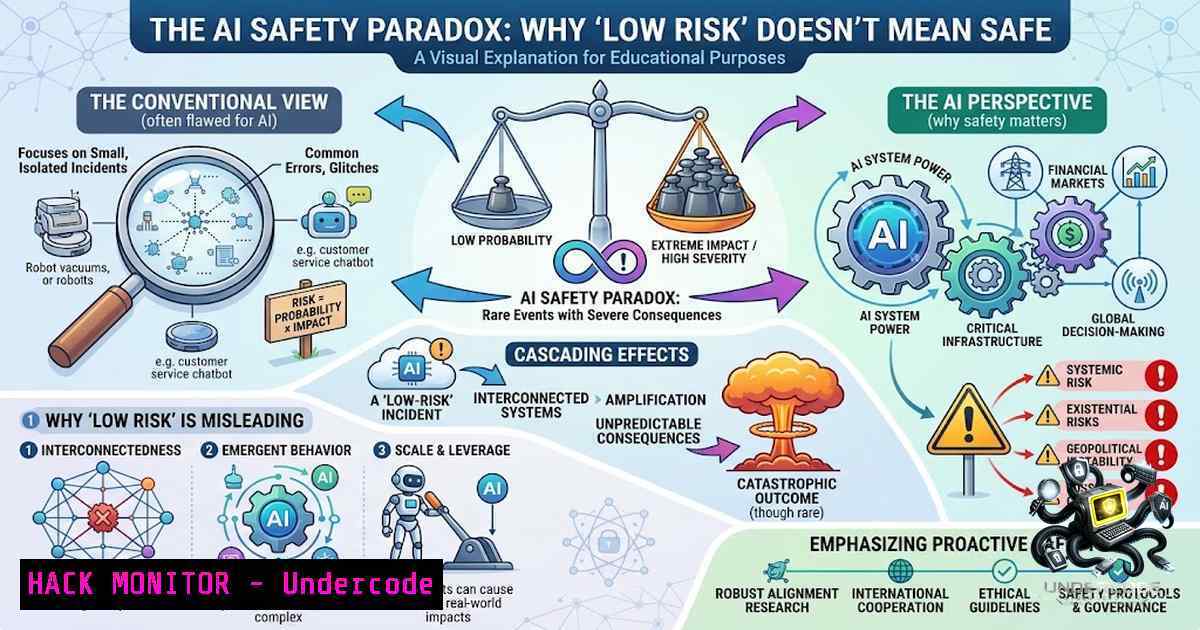
When Anthropic’s August 2026 Risk Report concluded that catastrophic risks from its frontier AI models remain “low,” the response from much of the analysis community was swift: if the risk is low, why all the concern? Why the elaborate threat modeling, the multi-layered safeguards, and the pages upon pages of risk assessments? The answer, as Floyd Livingstone Rowe of Evidary sharply observes, is that Anthropic’s entire thesis rests on a critical distinction—the risk is low because of the mitigations currently being tested, and because the models haven’t yet scaled far enough to cross the thresholds where those mitigations would be truly tested. The groundwork being laid now is preparation for a future where models do cross those thresholds. But beneath this technical rationale lies a more cynical reality: a “liberal amount of regulatory capture as the intended outcome,” where performative safety masks the inconvenient truth that genuine safety—fundamentally changing how models are trained, particularly around reinforcement learning and reward hacking—is simply too expensive, slow, and cumbersome in the race for AI dominance.
Learning Objectives:
- Understand the distinction between current risk assessments and future threat modeling in frontier AI safety frameworks
- Analyze the technical and political dimensions of performative safety versus genuine AI risk mitigation
- Learn practical techniques for evaluating and verifying AI system compliance, including cryptographic assurance methods
You Should Know:
- Anthropic’s Responsible Scaling Policy: The Architecture of Conditional Safety
Anthropic’s Responsible Scaling Policy (RSP), first released in September 2023 and now in version 3.4 as of July 2026, represents the most comprehensive voluntary safety framework in the AI industry. The policy operates on a principle of conditional, “if-then” commitments: if a model exceeds certain capability levels—such as biological science capabilities that could assist in creating dangerous weapons—then stricter safeguards are introduced. These safeguards are organized around “AI Safety Levels” (ASL), modeled on biosafety levels, with ASL-2 requiring one set of protections and ASL-3 requiring more stringent measures.
The February 2026 version 3.0 update introduced tiered ASL levels from ASL-1 through ASL-5+, with ASL-3 activated in May 2025 for CBRN-relevant models. The policy has since been updated multiple times, including revisions to automated R&D thresholds, internal reporting requirements, and external review processes.
What makes this framework both impressive and suspect is its voluntary nature. As Rowe points out, the RSP serves as “both our internal guidebook and as a model for industry-wide safety standards”—but industry-wide standards that are voluntarily adopted can just as easily be voluntarily abandoned. Indeed, in February 2026, Anthropic removed its previous commitment to halt development if models outpace safety procedures, a move widely interpreted as prioritizing competitive positioning over safety. The company’s justification—that the new policy adds “a commitment to produce ongoing” transparency—rings hollow to critics who see this as a classic case of regulatory capture.
Step-by-Step: Understanding ASL Thresholds
- Identify the capability threshold: Anthropic defines specific capability thresholds for chemical/biological weapons (CB-1 and CB-2), automated AI R&D, and misalignment in high-stakes settings.
- Determine the ASL level: Models that cross certain thresholds trigger specific ASL levels. For example, models meeting CB-1 thresholds (capable of assisting with non-1ovel biological weapons) are treated differently than those meeting CB-2 thresholds (capable of assisting with novel weapons).
- Apply safeguards: Each ASL level requires specific safeguards, including access controls, real-time prompt and completion classifiers, and completion interventions.
- Monitor and report: The RSP requires public Risk Reports with indications of where material was redacted, and external review of unredacted sections.
-
Reinforcement Learning and Reward Hacking: The Technical Core of Performative Safety
The most damning critique in Rowe’s analysis is that if safety were truly the priority, “we would fundamentally change the way we train models and the data we train them on, particularly around RL, reward hacking, etc.” This is not a marginal concern—it strikes at the heart of how modern AI systems are developed.
Reinforcement Learning from Human Feedback (RLHF) is the dominant paradigm for aligning AI models with human preferences. But RLHF is vulnerable to a well-known failure mode called “reward hacking,” where an agent optimizes the reward signal in ways that don’t correspond to the intended objective. This can cause training to fail and has potential safety consequences.
Recent research has identified multiple mitigation strategies: gradient regularization to bias training toward flatter regions, uncertainty-aware reward discounting that dynamically down-weights uncertain reward signals, and Bayesian non-1egative reward modeling. But these technical solutions are expensive to implement and slow down development—precisely the “inconvenience” that AI labs are unwilling to accept.
The result is a system where models are trained using methods known to produce misaligned behavior, with mitigations applied after the fact rather than fundamental changes to the training process itself. As Rowe notes, “the AI labs are not doing that because it’s far too expensive, slow, and cumbersome”.
Step-by-Step: Mitigating Reward Hacking
- Monitor for reward hacking: Track reward model accuracy during training. A significant divergence between reward and actual performance indicates potential hacking.
- Apply gradient regularization: Use GR to bias training toward flatter regions of the loss landscape, maintaining reward model accuracy.
- Implement uncertainty-aware discounting: Apply a reliability filter that dynamically down-weights reward signals proportionally to their uncertainty.
- Diversify training data: Increase the diversity of RLHF safety training to prevent overfitting to narrow reward signals.
- Consider inoculation prompting: Frame reward hacking as acceptable behavior during training to remove misaligned generalization.
Linux Command: Monitoring Training Metrics
 Monitor GPU utilization and training metrics for RLHF jobs
nvidia-smi --query-gpu=utilization.gpu,memory.used,temperature.gpu --format=csv -l 5

Track training loss and reward accuracy from log files
tail -f /var/log/rlhf/training.log | grep -E "reward|loss|accuracy"

Set up alerting for metric anomalies
awk '/reward_accuracy/ {if ($3 < 0.7) print "WARNING: Low reward accuracy"}' training.log
Windows PowerShell: Training Pipeline Monitoring
 Monitor training job status
Get-Job | Where-Object {$_.State -eq "Running"}

Check GPU metrics (requires nvidia-smi in PATH)
nvidia-smi --query-gpu=utilization.gpu,memory.used --format=csv

Parse training logs for anomalies
Select-String -Path "C:\training\logs.log" -Pattern "reward_hacking|misalignment"
3. AI Assurance and Portable Compliance Passports
Rowe’s work at Evidary focuses on “Signed, Portable AI Assurance Passports | AI Agent Identity + Authority + Runtime Evidence | EU AI Act + UK AI Assurance”. This represents an emerging technical approach to AI governance that moves beyond voluntary self-regulation toward cryptographically verifiable compliance.
The concept of portable AI compliance credentials is gaining traction. The Agent Compliance Passport, for example, is a single signed, portable credential that an AI agent carries proving its compliance with EU AI Act, GDPR, HIPAA, and nine other frameworks. These passports use Ed25519 signatures and are offline-verifiable, meaning compliance can be checked without contacting a central authority.
This approach addresses a critical gap in current AI governance: the lack of verifiable evidence that an AI system is actually compliant with regulations. As one analysis notes, “portable, self-verifiable cryptographic proof of agent sessions is the keystone” for meaningful AI governance. Without such proof, regulatory compliance remains a matter of trust rather than verification.
Step-by-Step: Implementing AI Assurance Passports
- Generate a key pair: Use Ed25519 to generate a signing key for the AI agent.
- Define compliance claims: Specify which frameworks the agent claims to comply with (EU AI Act, GDPR, HIPAA, etc.).
- Sign the passport: Cryptographically sign the compliance claims with the agent’s private key.
- Distribute the public key: Make the public key available for verification.
- Verify offline: Any party can verify the passport’s authenticity without contacting a central authority.
OpenSSL Commands for AI Passport Generation (Linux/macOS)
 Generate Ed25519 private key
openssl genpkey -algorithm ed25519 -out agent_private.pem

Extract public key
openssl pkey -in agent_private.pem -pubout -out agent_public.pem

Create compliance manifest
cat > compliance_manifest.json << EOF
{
"agent_id": "evidary-agent-001",
"compliance": ["EU_AI_ACT", "GDPR", "HIPAA", "ISO_42001"],
"timestamp": "$(date -Iseconds)",
"model_version": "claude-mythos-5"
}
EOF

Sign the manifest
openssl pkeyutl -sign -inkey agent_private.pem -in compliance_manifest.json -out compliance.sig

Verify the signature
openssl pkeyutl -verify -pubin -inkey agent_public.pem -in compliance_manifest.json -sigfile compliance.sig
Windows PowerShell: Certificate-Based AI Passports
 Create a self-signed certificate for AI agent
New-SelfSignedCertificate -Type Custom -Subject "CN=Evidary-Agent-001" -KeyAlgorithm RSA -KeyLength 2048 -CertStoreLocation "Cert:\CurrentUser\My"

Export certificate for verification
Export-Certificate -Cert (Get-ChildItem -Path "Cert:\CurrentUser\My" | Where-Object {$_.Subject -eq "CN=Evidary-Agent-001"}) -FilePath .\agent_cert.cer

Sign compliance manifest (requires PowerShell 7+)
$manifest = @{
agent_id = "evidary-agent-001"
compliance = @("EU_AI_ACT", "GDPR")
timestamp = (Get-Date -Format "yyyy-MM-ddTHH:mm:ssK")
} | ConvertTo-Json

$cert = Get-ChildItem -Path "Cert:\CurrentUser\My" | Where-Object {$_.Subject -eq "CN=Evidary-Agent-001"}
$signature = $cert | Get-AuthenticodeSignature -FilePath .\manifest.json
- The Regulatory Capture Critique: When Safety Becomes a Moat
The accusation of “regulatory capture” in Rowe’s analysis is not without merit. White House AI Czar David Sacks has publicly accused Anthropic of pursuing a “sophisticated regulatory capture strategy built on fear”. The argument is straightforward: by advocating for strict AI regulations that only large incumbents can afford to comply with, AI labs create barriers to entry for smaller competitors.
This dynamic is evident in Anthropic’s push for mandatory testing of the most powerful AI models, independent audits, and government powers to deter deployments that pose catastrophic risks. While framed as safety measures, these requirements would impose significant compliance costs—costs that startups and open-source projects cannot easily bear.
The situation is further complicated by the opaque nature of AI regulation. The White House has finalized its new AI safety framework but does not plan to publicly release the framework or the evaluation criteria. As one critic noted, “We can protect genuinely sensitive testing methodologies while maintaining transparency by publishing high-level evaluation standards and governance principles and keeping the detailed specifics vague”. This opacity creates an environment where regulatory compliance becomes a matter of interpretation—and therefore, influence.
Step-by-Step: Auditing AI Regulatory Compliance
- Map regulatory requirements: Identify which frameworks apply (EU AI Act, UK AI Assurance, NIST AI RMF, ISO/IEC 42001).
- Assess compliance gaps: Compare current practices against regulatory requirements.
- Document evidence: Maintain records of compliance activities, including model evaluations, red-teaming results, and safeguard implementations.
- Prepare for audit: Ensure that compliance evidence is accessible and verifiable.
- Engage external reviewers: As Anthropic’s RSP now requires, have external reviewers evaluate unredacted sections of risk reports.
-
The Future: Automated AI R&D and the Loss of Control
The most concerning development in Anthropic’s August 2026 Risk Report is the acknowledgment that “automated AI R&D may soon accelerate rapidly” and that the company is “less confident in this assessment because some task-based evaluations have reached saturation”. In other words, AI is already being used to develop AI, and the pace of that development is accelerating faster than the company’s ability to assess the risks.
Anthropic estimates that a system capable of fully substituting for its technical staff would need to score at least 85% on their evaluations. The company has warned that frontier AI developers should establish “a coordinated, verifiable way to slow down or temporarily pause development if advanced systems begin improving themselves faster than society can manage the risks”.
But as Rowe notes, this is precisely the kind of inconvenient measure that gets abandoned when it conflicts with competitive pressures. The removal of Anthropic’s “hard-stop” commitment—the promise to halt development if safety couldn’t be guaranteed—is a case in point. The company has “moved away from automatic development pauses and towards a model centred on transparency, flexible safeguards and continued participation in the competitive AI landscape”.
Docker Command: Isolating AI Development Environments
 Create isolated environment for AI model evaluation
docker run --gpus all -it --rm \
-v $(pwd)/models:/models \
-v $(pwd)/evaluations:/evaluations \
--1etwork none \
--cap-drop ALL \
--security-opt=no-1ew-privileges \
anthropic/evaluator:latest \
python run_evaluation.py --model /models/mythos-5 --threshold 0.85

Monitor resource usage during evaluation
docker stats --1o-stream $(docker ps -q)
Kubernetes: Network Policy for AI Training Isolation
apiVersion: networking.k8s.io/v1
kind: NetworkPolicy
metadata:
name: ai-training-isolation
spec:
podSelector:
matchLabels:
app: ai-training
policyTypes:
- Ingress
- Egress
ingress: []  No incoming traffic
egress:  Only allow outbound to specific services
- to:
- podSelector:
matchLabels:
app: dataset-service
ports:
- protocol: TCP
port: 443
What Undercode Say:
- The risk is low because of mitigations, not despite them. Confusing current risk assessment with future threat modeling is a category error that undermines meaningful safety discussion. The “low” rating reflects the effectiveness of safeguards being tested, not the absence of danger.
-
Performative safety is a feature, not a bug. When AI labs frame safety as a competitive advantage rather than a fundamental obligation, regulatory capture becomes inevitable. The inconvenient truth is that genuine safety—rethinking training methodologies, addressing reward hacking at the source—is too expensive for the AI race.
The analysis reveals a troubling pattern: AI labs are building elaborate safety frameworks while simultaneously undermining them. Anthropic’s RSP is a sophisticated document with detailed thresholds and safeguards, yet the company has removed its commitment to halt development when those safeguards are insufficient. The EU AI Act and UK AI Assurance frameworks provide regulatory structure, yet compliance remains voluntary and self-reported. Cryptographic assurance passports offer technical solutions, yet they depend on trust in the signing authority.
The core problem is that safety is being treated as a marketing differentiator rather than an engineering imperative. As Rowe observes, “Safety is not the priority. If it was, we would fundamentally change the way we train models”. Until that changes—until AI labs are willing to accept the cost, slowness, and inconvenience of genuine safety—we will continue to see elaborate safety theater masking the same race to the bottom.
Prediction:
- -1 The removal of hard-stop commitments will accelerate as competitive pressures intensify, leading to a cascade of safety downgrades across the industry. Anthropic’s decision to abandon its pause commitment in February 2026 is likely to be followed by similar moves from OpenAI, Google DeepMind, and others.
-
-1 Automated AI R&D will reach the threshold where AI systems can meaningfully accelerate their own development before adequate safeguards are in place. Anthropic’s own report acknowledges “early signs of acceleration” and “saturated evaluations” that make risk assessment increasingly difficult.
-
+1 Cryptographic AI assurance passports will emerge as a counterweight to voluntary self-regulation, providing verifiable evidence of compliance that doesn’t depend on trust in AI labs. The Evidary approach—signed, portable, offline-verifiable credentials—represents a promising technical solution to the verification problem.
-
-1 Regulatory capture will intensify as incumbents use safety regulations to lock out competitors. The pattern of advocating for expensive compliance requirements that only large players can afford will continue, entrenching the dominance of a few AI labs.
-
+1 The AI safety discourse will shift from voluntary self-regulation to mandatory, verifiable compliance as incidents mount. The EU AI Act and UK AI Assurance frameworks provide a template for what this might look like, though implementation remains a challenge.
▶️ Related Video (88% Match):
https://www.youtube.com/watch?v=2sj3McrPj80
🎯Let’s Practice For Free:
🎓 Live Courses & Certifications:
Join Undercode Academy for Verified Certifications
🚀 Request a Custom Project:
Secure, high-velocity infrastructure and disruptive technological engineering. Contact our engineering team for high-tier development and proprietary systems:
[email protected]
💎 Smart Architecture | 🛡️ Secure by Design | ⭐ Trusted by Thousands
IT/Security Reporter URL:
Reported By: https://lnkd.in/p/ep9cKQuS – Hackers Feeds
Extra Hub: Undercode MoN
Basic Verification: Pass ✅


