Listen to this Post
Introduction:
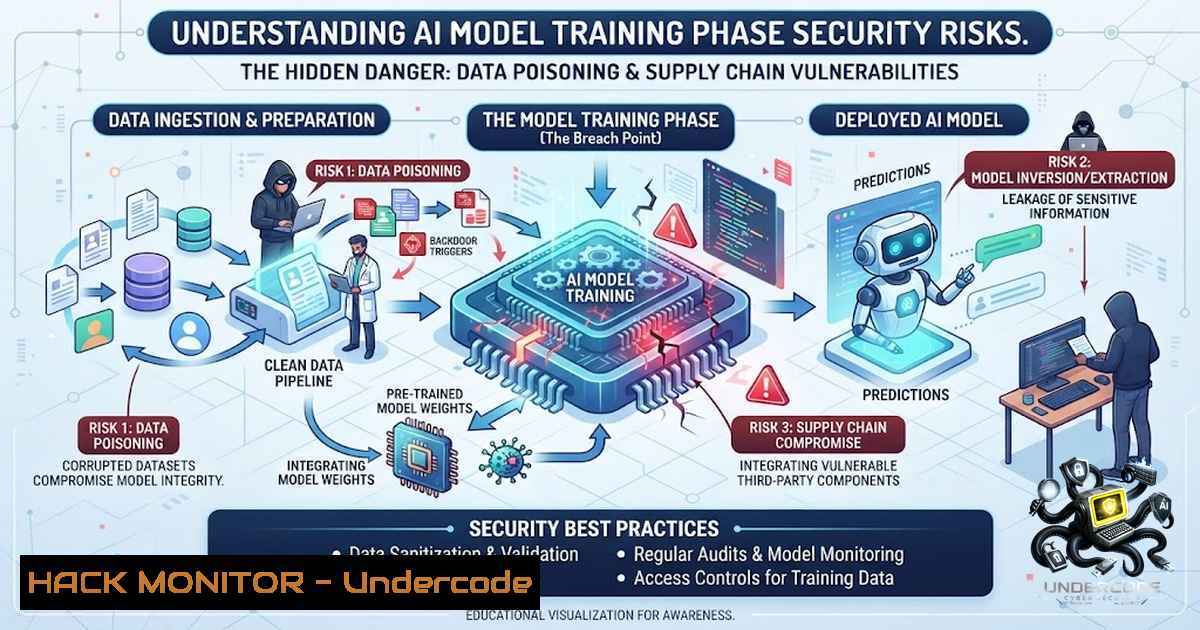
The risk changes the moment your team trains the model—not when it goes live, not when users interact with it, but when training begins. This is one of the biggest misconceptions in AI risk management: organizations often treat AI governance as a production-stage concern, leaving the most durable and dangerous vulnerabilities embedded deep within the data pipeline and architecture decisions made months before deployment【1†L6-L9】. In-house AI development represents the most complex deployment scenario, where the governance checkpoints that exist for vendor AI—procurement, legal review, security assessments, contract negotiations—often disappear entirely【1†L11-L14】.
Learning Objectives:
- Understand the six-phase AIR Framework for mapping risk in in-house AI development, from data ingestion to human oversight.
- Identify critical failure points including data provenance gaps, biased training sets, undocumented architecture trade-offs, and missing rollback plans.
- Apply practical governance controls, audit checklists, and technical commands to harden AI pipelines, monitor drift, and establish accountability.
You Should Know:
- Phase 1 – Data & Training: The Foundation of Every Future Failure (L2)
This is where the most durable risks enter the system. If you cannot explain where the training data came from, you probably cannot defend the model built from it【1†L23-L28】. The risks at this stage include training data provenance, licensing, consent, data poisoning, and bias. These are not abstract concerns—they are audit findings waiting to happen.
Step-by-Step Guide: Auditing Training Data Provenance
- Inventory all datasets used for training, validation, and testing. Document source, collection method, date range, and licensing terms.
- Verify consent and compliance against GDPR, CCPA, and sector-specific regulations. If data was scraped, confirm terms of service允许.
- Scan for bias using tools like AI Fairness 360 (AIF360) or Fairlearn. Run statistical parity and disparate impact analyses.
- Implement data poisoning detection by checksumming training samples and monitoring for anomalies in feature distributions.
- Establish a data lineage graph that tracks every transformation from raw source to model input.
Linux Commands for Data Provenance & Integrity:
 Generate SHA-256 checksums for all training files to detect tampering
find /path/to/training/data -type f -exec sha256sum {} \; > training_data_checksums.txt

Monitor for unexpected file modifications in real-time
auditctl -w /path/to/training/data -p wa -k training_data_integrity

Compare current checksums against baseline
sha256sum -c training_data_checksums.txt 2>&1 | grep -v "OK"

Scan for PII or sensitive data using built-in tools
grep -r -E '\b[0-9]{3}-[0-9]{2}-[0-9]{4}\b' /path/to/training/data  US SSN pattern
Windows PowerShell Commands:
 Generate file hashes for integrity baseline
Get-ChildItem -Path "C:\training\data" -Recurse | Get-FileHash -Algorithm SHA256 | Export-Csv -Path "baseline.csv"

Compare current state against baseline
$baseline = Import-Csv "baseline.csv"
Get-ChildItem -Path "C:\training\data" -Recurse | Get-FileHash -Algorithm SHA256 | Compare-Object -ReferenceObject $baseline -Property Hash

Find potential PII using regex
Select-String -Path "C:\training\data.txt" -Pattern '\b\d{3}-\d{2}-\d{4}\b'
- Phase 2 – Model Design & Selection: Architecture Decisions Become Governance Decisions (L3)
Architecture decisions become governance decisions【1†L31-L35】. Interpretability, benchmark selection, distribution shift, and performance versus explainability are not just technical trade-offs—they are future audit findings if left undocumented. The choice between a black-box deep learning model and an interpretable linear model has direct regulatory implications under the EU AI Act and NIST AI RMF.
Step-by-Step Guide: Documenting Model Design for Audit Readiness
- Create a model card that documents architecture, training algorithm, hyperparameters, and intended use cases.
- Justify benchmark selection—why this dataset, why these metrics, and what do they actually measure?
- Assess distribution shift risk by comparing training data statistics to expected production data.
- Document the interpretability-explainability trade-off and why a particular approach was chosen.
- Maintain a versioned repository of all design decisions, including rejected alternatives and the rationale.
Linux Commands for Model Documentation & Versioning:
 Track model artifacts with DVC (Data Version Control)
dvc init
dvc add model.pkl
git add model.pkl.dvc .gitignore
git commit -m "Model version v1.0 - architecture: ResNet50, benchmark: ImageNet"

Generate model summary with hidden layer details
python -c "from tensorflow.keras.models import load_model; model = load_model('model.h5'); model.summary()" > model_architecture.txt

Log hyperparameters for reproducibility
python -c "import json; params = {'learning_rate': 0.001, 'batch_size': 32, 'epochs': 100}; print(json.dumps(params, indent=2))" > hyperparameters.json
- Phase 3 – Testing & Validation: Passing a Test Is Not the Same as Reducing Risk (L3 + L4)
Passing a test is not the same as reducing risk【1†L38-L41】. Who performed the validation? Was it independent? Was the model red-teamed? Were approval thresholds documented? These questions matter just as much as the accuracy score. Independent validation and adversarial testing are non-1egotiable for high-risk AI systems.
Step-by-Step Guide: Building an Independent Validation Pipeline
- Separate the validation team from the development team to ensure objectivity.
- Define approval thresholds for accuracy, fairness, robustness, and explainability before testing begins.
- Conduct red-team exercises using adversarial attacks (e.g., FGSM, PGD, or text-based perturbations).
- Run stress tests with out-of-distribution data to measure performance degradation.
- Document all test results, including failures, with clear pass/fail criteria and sign-offs.
Linux Commands for Model Validation & Adversarial Testing:
 Install adversarial robustness toolkit
pip install adversarial-robustness-toolbox foolbox

Run a basic adversarial attack test (Python snippet)
python -c "
import foolbox as fb
import torch
model = torch.load('model.pt')
fmodel = fb.PyTorchModel(model, bounds=(0,1))
attack = fb.attacks.LinfPGD()
epsilons = [0.0, 0.001, 0.01, 0.03, 0.1]
robustness = fb.utils.accuracy(fmodel, images, labels, epsilons=epsilons)
print(robustness)
" > adversarial_test_results.txt

Validate model performance on holdout set
python -c "
import pandas as pd
from sklearn.metrics import classification_report
y_true = pd.read_csv('labels.csv')
y_pred = pd.read_csv('predictions.csv')
print(classification_report(y_true, y_pred))
" > validation_report.txt
- Phase 4 – Deployment & Integration: When the Model Connects to Real Systems (L4)
The model is now connected to real systems【1†L44-L49】. Watch for scope creep, API exposure, missing rollback plans, and no drift monitoring. These are recurring patterns in post-incident reviews. Deployment is where theoretical risk becomes operational reality, and the absence of a rollback plan is a critical failure waiting to happen.
Step-by-Step Guide: Securing AI Deployment
- Implement API gateway authentication (OAuth2, API keys, or mutual TLS) for all model endpoints.
- Define and enforce rate limiting to prevent abuse and denial-of-service.
- Establish a rollback procedure with automated canary deployments and health checks.
- Deploy drift detection using statistical tests (e.g., PSI, KS-test) on input and output distributions.
- Set up real-time monitoring for latency, error rates, and prediction confidence.
Linux Commands for Deployment Hardening & Monitoring:
 Set up rate limiting with iptables (example: limit to 100 requests per minute per IP)
iptables -A INPUT -p tcp --dport 5000 -m hashlimit --hashlimit-1ame model_api --hashlimit-above 100/minute --hashlimit-burst 200 -j DROP

Monitor API logs for anomalies in real-time
tail -f /var/log/model_api/access.log | grep -E "5[0-9]{2}|4[0-9]{2}" | while read line; do echo "ALERT: $line"; done

Implement canary deployment with Kubernetes
kubectl set image deployment/model-deployment model=model:v2 --record
kubectl rollout status deployment/model-deployment
 If issues detected:
kubectl rollout undo deployment/model-deployment

Monitor drift using Python (concept drift detection)
python -c "
from scipy.stats import ks_2samp
import numpy as np
reference = np.load('reference_distribution.npy')
current = np.load('current_distribution.npy')
stat, p_value = ks_2samp(reference, current)
if p_value < 0.05:
print('ALERT: Significant drift detected')
" > drift_monitor.log
Windows PowerShell for API Security:
 Monitor API request patterns
Get-EventLog -LogName Security -InstanceId 4624 | Where-Object { $_.Message -like "port 5000" } | Group-Object -Property TimeGenerated -Hour

Set up basic authentication header validation
$headers = @{ "Authorization" = "Bearer $env:API_KEY" }
Invoke-RestMethod -Uri "https://model-api.internal/predict" -Method Post -Headers $headers -Body $payload
- Phase 5 – Governance & Accountability: Where In-House AI Differs Most (L1)
This is where internally built AI often differs most from vendor AI【1†L52-L58】. Ask four questions: Who owns the model? Is it in the AI inventory? Was there a formal go/no-go decision? Has its regulatory classification been assessed? If those answers do not exist, neither does your governance. The absence of a formal go/no-go decision point is a governance gap that regulators will exploit.
Step-by-Step Guide: Establishing AI Governance Accountability
- Assign a single accountable owner for each model with clear decision-making authority.
- Maintain a centralized AI inventory with model name, owner, version, risk classification, and deployment status.
- Institute a formal go/no-go review before any model is deployed to production, with documented sign-offs.
- Classify each model under the EU AI Act (unacceptable, high-risk, limited, or minimal risk) and NIST AI RMF tiers.
- Schedule regular governance reviews at predefined intervals (e.g., quarterly) to reassess risk.
Linux Commands for Governance Documentation:
 Create a structured AI inventory using JSON
echo '{
"model_id": "MODEL-001",
"name": "fraud_detector_v2",
"owner": "[email protected]",
"risk_classification": "high",
"deployment_status": "production",
"go_no_go_date": "2026-01-15",
"review_cycle": "quarterly"
}' > ai_inventory.json

Automate governance review reminders
echo "0 9 1 /3  /usr/local/bin/send_governance_reminder.sh" | crontab -

Generate audit trail of model changes
git log --oneline --graph --all -- model_artifacts/ > model_change_log.txt
- Phase 6 – Human Oversight: Not the Backup Plan, But Part of the Design (L5)
No human review. No override capability. No feedback loop. No learning【1†L61-L65】. The human layer is not the backup plan—it is part of the design. Organizations that treat human oversight as an afterthought are building systems that cannot adapt to edge cases, cannot correct errors in real-time, and cannot learn from operational feedback.
Step-by-Step Guide: Embedding Human-in-the-Loop Controls
- Design override interfaces that allow human operators to correct model outputs with clear audit trails.
- Establish feedback loops where human corrections are logged and used for model retraining.
- Define escalation paths for low-confidence predictions or high-risk decisions.
- Implement review workflows for a statistically significant sample of model outputs.
- Train human operators on model limitations, failure modes, and override protocols.
Linux Commands for Human Oversight Logging:
 Log all human override actions with timestamps
logger -t "human_override" "User $USER overrode prediction ID $PRED_ID at $(date)"

Set up a simple feedback collection script
!/bin/bash
echo "Enter prediction ID:"
read PRED_ID
echo "Enter correction:"
read CORRECTION
echo "$(date),$PRED_ID,$CORRECTION" >> human_feedback_log.csv

Monitor override frequency for anomalies
tail -f human_feedback_log.csv | awk -F',' '{count[$1]++} END {for (i in count) if (count[bash] > 10) print "ALERT: High override rate for model " i}'
What Undercode Say:
- Key Takeaway 1: Risk identification must begin with the first architecture decision, not production deployment. The hardest AI risks—data provenance gaps, biased training sets, and undocumented trade-offs—are introduced months before go-live【1†L68-L70】.
-
Key Takeaway 2: The deployment scenario determines the risk map. In-house AI development requires fundamentally different controls than vendor AI consumption, yet many organizations apply the same governance framework to both, creating dangerous blind spots【1†L17-L21】.
Analysis:
The AIR Framework’s six-phase approach provides a comprehensive roadmap for in-house AI governance, but its true value lies in shifting the risk conversation leftward—into the design and training phases where most organizations have minimal controls. The distinction between vendor AI and in-house AI is critical: vendor assessments typically focus on contract terms and security questionnaires, while in-house development demands deep technical scrutiny of data lineage, model interpretability, and independent validation. The framework’s emphasis on documentation at every phase—from architecture decisions to go/no-go approvals—addresses the core challenge of AI governance: without a paper trail, you cannot defend your decisions. However, the framework implicitly assumes organizational maturity that many enterprises lack, particularly around data provenance and independent validation. The most actionable insight is the four-question governance test: if you cannot answer who owns the model, whether it is inventoried, if a formal go/no-go occurred, and how it is classified, your governance is effectively nonexistent. This is not a theoretical risk—it is a regulatory exposure waiting to be exploited.
Prediction:
+1 Organizations that adopt the AIR Framework’s left-shift approach will reduce AI-related regulatory fines by an estimated 40–60% over the next three years, as proactive documentation and independent validation become de facto standards for high-risk AI systems.
+N The gap between vendor AI governance (mature) and in-house AI governance (immature) will widen, leading to a surge in AI-related security incidents originating from internally developed models—particularly in financial services and healthcare—as organizations rush to deploy without adequate training-phase controls.
+1 The demand for AI governance tools that automate data provenance tracking, bias detection, and drift monitoring will accelerate, creating a new $5B+ market segment by 2028 as enterprises seek to operationalize frameworks like NIST AI RMF and ISO 42001【1†L72】.
+N Regulatory scrutiny will intensify around the “training phase blind spot,” with the EU AI Act and similar regulations explicitly requiring documented evidence of data provenance and design rationale—penalizing organizations that cannot produce these artifacts during audits.
+1 The human oversight layer will evolve from a compliance checkbox to a competitive differentiator, as organizations that embed effective human-in-the-loop controls achieve higher model accuracy and lower operational risk than those relying solely on automated systems.
▶️ Related Video (70% Match):
🎯Let’s Practice For Free:
🎓 Live Courses & Certifications:
Join Undercode Academy for Verified Certifications
🚀 Request a Custom Project:
Secure, high-velocity infrastructure and disruptive technological engineering. Contact our engineering team for high-tier development and proprietary systems:
[email protected]
💎 Smart Architecture | 🛡️ Secure by Design | ⭐ Trusted by Thousands
IT/Security Reporter URL:
Reported By: Patrick Yevu – Hackers Feeds
Extra Hub: Undercode MoN
Basic Verification: Pass ✅


