
Listen to this Post
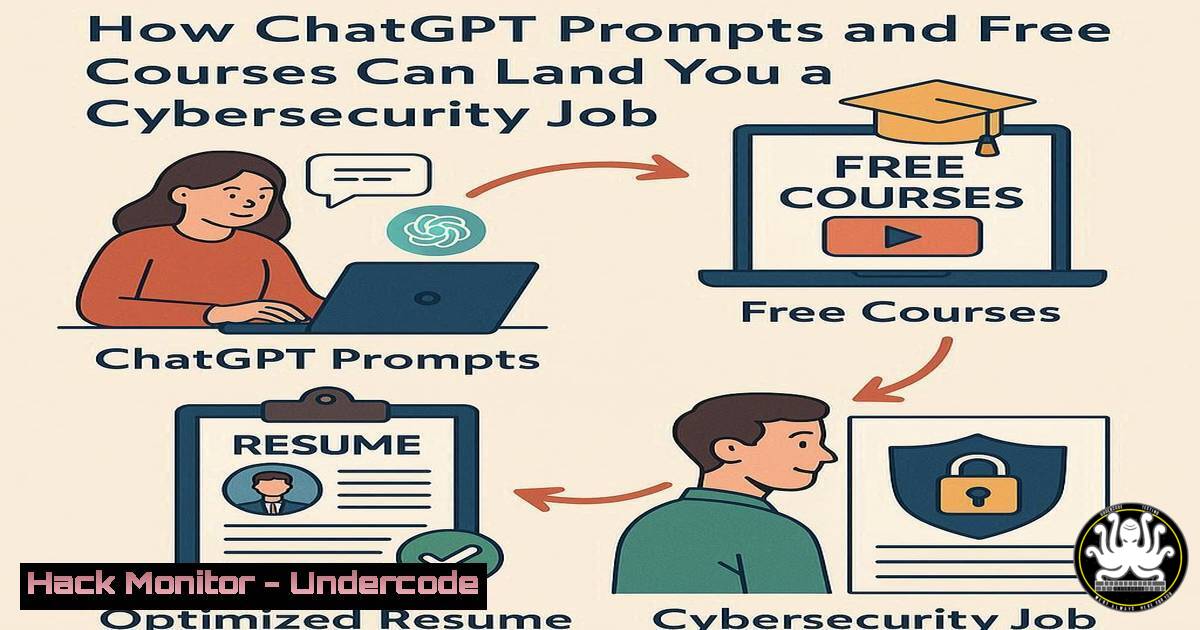
Introduction:
The competitive landscape of cybersecurity hiring demands more than just technical skills; it requires a resume that can pass both automated Applicant Tracking Systems (ATS) and capture the attention of a human recruiter. Leveraging AI, specifically through targeted ChatGPT prompts, has emerged as a powerful method to engineer a compelling application. This article provides a technical blueprint for optimizing your resume for the cybersecurity and IT job market, complete with actionable commands and links to critical upskilling resources.
Learning Objectives:
- Learn how to use specific AI prompts to deconstruct and rebuild a resume for technical roles.
- Understand the key components of an ATS-optimized resume for IT and cybersecurity positions.
- Identify free, high-value courses to acquire the skills mentioned in your newly crafted resume.
You Should Know:
1. Reconnaissance: Spotting Resume Flaws with AI
Before building a strong defense, you must identify the vulnerabilities. The first prompt acts as a vulnerability scanner for your resume.
AI
`Act as a recruiter for a [Senior Cybersecurity Analyst] role. Review my resume below and highlight weak areas, overused buzzwords, and missing metrics. Be brutally honest.`
Step-by-step guide:
- Copy and Prepare: Copy your entire resume text into a plain text editor (like Notepad or VS Code) to strip any problematic formatting.
- Craft the Replace `[Senior Cybersecurity Analyst]` with your target role. Paste your sanitized resume text below the prompt.
- Execute and Analyze: Submit this to ChatGPT. The AI will return a line-by-line critique, pointing out vague terms like “responsible for securing systems” and a lack of quantifiable results, such as “reduced incident response time by 30%.”
2. Weaponization: Rewriting for Impact with Action-Oriented Language
A strong cybersecurity resume demonstrates offensive and defensive capabilities through action and results.
AI
`Rewrite this resume to sound more results-driven, quantifiable, and compelling for a [Cloud Security Engineer] role. Focus on achievements, not just duties.`
Step-by-step guide:
- Input the Flawed Text: Use the original resume text or a specific section identified as weak from the previous step.
- Specify the Role: Ensure the target role is precise.
- Refine the Output: ChatGPT will transform passive duties into active achievements. For example, it will change “Maintained firewalls” to “Orchestrated the hardening of 50+ network firewall rules, blocking 99.9% of unauthorized ingress traffic and reducing the attack surface by 40%.”
3. Persistence: ATS Optimization with Technical Keywords
To ensure your resume is parsed correctly by automated systems, it must be saturated with industry-specific keywords.
AI
`Update this resume to be fully optimized for Applicant Tracking Systems (ATS) for the role of [SOC Analyst]. Use industry-specific keywords naturally.`
Step-by-step guide:
- Input the Revised Resume: Use the output from the “Rewriting for Impact” step.
- Execute the The AI will strategically insert relevant keywords. For a SOC Analyst, expect to see terms like `SIEM` (e.g., Splunk, ArcSight),
IDS/IPS, `EDR` (e.g., CrowdStrike, Carbon Black),threat hunting,incident response,MITRE ATT&CK, andvulnerability management. - Verify Formatting: Ensure the final output is in a clean, single-column format without tables, graphics, or unusual fonts that could confuse the ATS.
-
Command & Control: Leveraging Technical Skills in Your Resume
Your resume must reflect hands-on technical proficiency. Here are verified commands and tools you should be familiar with and mention.
Linux Command Line Proficiency:
`grep -r “password” /etc/ 2>/dev/null` (Example of finding plaintext passwords in a filesystem)
`ss -tuln` (Modern replacement for `netstat` to list listening ports)
`sudo journalctl -u ssh –since “1 hour ago”` (Review SSH logs for authentication attempts)
`find / -perm -4000 2>/dev/null` (Locate SUID binaries for privilege escalation checks)
`chmod 600 /etc/shadow` (Example of correcting critical file permissions)
`awk -F: ‘$3 == 0 {print $1}’ /etc/passwd` (List all UID 0 accounts)
Step-by-step guide for demonstrating Linux skills:
- In your resume’s “Skills” section, list specific tools and commands, e.g., “Linux System Hardening, Bash Scripting, Log Analysis.”
- In your “Experience” section, use these skills in context: “Authored a Bash script utilizing `grep` and `awk` to parse Apache logs for 5xx errors, reducing manual triage time by 2 hours per incident.”
-
Defense Evasion: Formatting for Human and Machine Readability
A poorly formatted resume is easily evaded by both ATS and recruiters.
AI
`Suggest a clean, modern resume format that works for both humans and ATS. No graphics, no columns. Just structured and effective.`
Step-by-step guide:
- Run the ChatGPT will describe or generate a template.
2. Implement the Structure: Follow this standard:
Font: Arial, Calibri, or Helvetica (10-12pt).
Sections: Name/Contact, Professional Summary, Technical Skills, Professional Experience, Education/Certifications.
File Type: Save and submit as a `.docx` or `.pdf` (ensure the PDF is text-based, not an image scan).
6. Credential Access: Upskilling with Free Technical Courses
To back up the skills on your resume, leverage these free, high-quality courses. Integrate completed courses into your “Education” or “Certifications” section.
Verified Course Links:
Google IT Support & Cybersecurity: https://lnkd.in/ghj2Wx6C, https://lnkd.in/gFGWDdFw
Microsoft Cybersecurity Analyst: https://lnkd.in/g_MW8YAN
IBM Data Science: https://lnkd.in/gG98UxQx
Google IT Automation with Python: https://lnkd.in/gCp3t8MU
Generative AI with Large Language Models: https://lnkd.in/dn9te9qk
Step-by-step guide for leveraging courses:
- Select Relevant Courses: Choose courses that align with your target job description (e.g., Python for automation, Cybersecurity foundations for analyst roles).
- Enroll and Complete: Add the course and its expected completion date to your “In Progress” section.
- Update Your Resume: Upon completion, move it to your “Education/Certifications” section and add any significant projects to your “Experience” section.
7. Exfiltration: Tailoring and the Final Application
The final step is to tailor your polished resume for a specific role and exfiltrate it to the recruiter via a compelling cover letter.
AI Prompts:
`Tailor this resume to fit this specific job description [paste JD]. Highlight matching experience and reword sections to match the language used.`
`Write a compelling cover letter based on this resume and job description. Keep it personal, enthusiastic, and under 200 words.`
Step-by-step guide:
- Paste the Job Description: Copy the entire job description into the first prompt along with your resume.
- Generate the Cover Letter: Use the tailored resume and the same job description in the second prompt.
- Final Review: Manually review both documents to ensure accuracy and a natural flow before submitting your application.
What Undercode Say:
- AI is a Force Multiplier, Not a Replacement: The prompts guide the AI to do the heavy lifting of formatting and keyword optimization, but the underlying experience and technical truth must be yours. Misrepresentation is easily uncovered in a technical interview.
- The Modern Job Hunt is a Penetration Test: Your resume is the initial payload. It must evade ATS filters (defenses), execute correctly in the mind of the recruiter (gain a foothold), and demonstrate clear value (achieve the objective).
The systematic use of AI transforms a generic resume into a targeted application weapon. It forces a level of clarity and results-oriented thinking that is often missing from technical resumes, which tend to focus on responsibilities over achievements. By combining this AI-driven resume engineering with verifiable skills from the listed courses, candidates can significantly increase their chances of moving from silence to callback.
Prediction:
The integration of generative AI into the job application process will become ubiquitous within two years, forcing a dual evolution. Recruiters will increasingly rely on AI-powered screening tools that can detect AI-generated content and assess deeper technical comprehension, moving beyond keyword matching. This will create an AI arms race between job seekers and hiring platforms. Consequently, the value of verifiable, hands-on skills—demonstrated through practical labs, GitHub portfolios, and scenario-based interviews—will skyrocket, becoming the primary differentiator in the cybersecurity hiring landscape.
🎯Let’s Practice For Free:
IT/Security Reporter URL:
Reported By: Shristi Mishra – Hackers Feeds
Extra Hub: Undercode MoN
Basic Verification: Pass ✅


