Listen to this Post
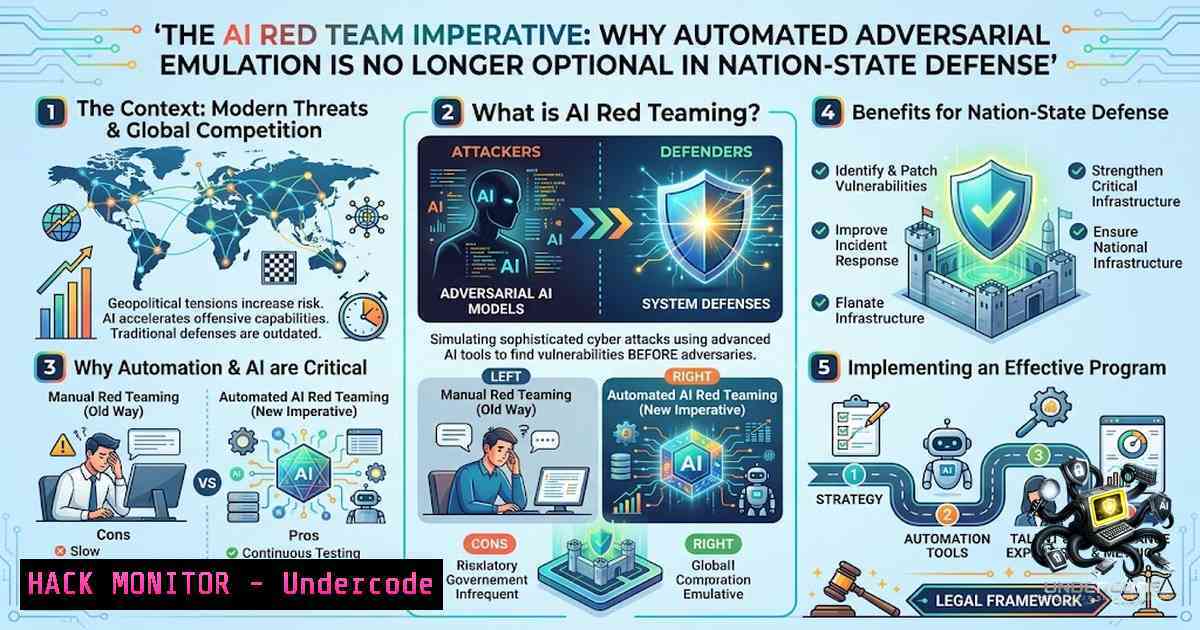
Introduction:
The paradigm of cyber warfare has irrevocably shifted. We have moved beyond scripted attacks and human-led penetration testing into an era where autonomous AI systems serve as digital strike teams, capable of researching targets, adapting strategies, and executing exploits with minimal human supervision. Recent confirmed attacks targeting Taiwan, utilizing near-autonomous hacking systems, underscore a terrifying reality: static defenses and human reaction times are obsolete against machines that learn and pivot in real time. The only viable countermeasure in this new theater of digital warfare is the deployment of automated AI red teaming—defensive AI that mirrors the offensive speed to build adaptive guardrails around critical infrastructure.
Learning Objectives:
- Understand the architecture and operational methodology of autonomous AI hacking systems and their implications for national security.
- Learn how to implement automated AI red teaming and deterministic guardrails to proactively defend against adaptive threats.
- Acquire practical, technical skills for deploying, configuring, and integrating AI security platforms within existing DevSecOps pipelines and cloud environments.
You Should Know:
- Building an Automated AI Red Team Pipeline (Linux/Cloud Focus)
The core of modern defense lies in emulating the adversary. To deploy an AI red team, you must move beyond static vulnerability scanners. A fully automated pipeline involves setting up a dedicated, sandboxed environment where offensive AI models can safely probe your systems. This requires configuration of network namespaces and container isolation to prevent escape. Begin by using `kubectl` to deploy a testing namespace in Kubernetes, isolating the red team tools. Below is a typical sequence to establish a controlled environment and initiate a baseline AI-driven scan against a test API endpoint. This simulates how an autonomous agent would research a target’s attack surface before pivoting.
 Create an isolated namespace and apply strict network policies
kubectl create ns ai-red-team
kubectl apply -f - <<EOF
apiVersion: networking.k8s.io/v1
kind: NetworkPolicy
metadata:
name: deny-all
namespace: ai-red-team
spec:
podSelector: {}
policyTypes:
- Ingress
- Egress
EOF

Deploy a model (e.g., using Ollama or a local LLM) to act as the decision engine
 The following pulls a small model to analyze Nmap scan results and suggest next moves
docker run -d --1ame red-team-ai --1etwork none ollama/ollama pull llama3.2
2. Setting Up Deterministic Guardrails for AI Agents
Researchers emphasize that strict, deterministic guardrails are the only way to safely deploy agentic systems. This means implementing a “policy as code” approach where the AI’s decision space is bounded by explicit rules. Using Open Policy Agent (OPA) or similar tools, you can define constraints that prohibit the AI from executing certain high-risk commands (e.g., dropping databases, modifying firewall rules without approval). Below is a Windows and Linux command set that demonstrates how to implement a simple allow-list for AI-generated commands, ensuring the model cannot accidentally or maliciously compromise the host. This process is critical to prevent the AI red team from causing collateral damage.
 Windows: Using PowerShell to enforce a command allow-list
 This script checks if a command is authorized before execution
$AllowedCommands = @("ping", "tracert", "nslookup", "Get-1etTCPConnection")
$AICommand = Read-Host "Enter AI suggested command"
if ($AICommand -in $AllowedCommands) {
Invoke-Expression $AICommand
} else {
Write-Host "ERROR: Command not allowed by deterministic guardrail" -ForegroundColor Red
}
 Linux: Using 'sudo' with a restricted shell or pattern matching to limit AI actions
 This ensures the AI cannot use 'rm -rf' or alter system files
if [[ "$AI_COMMAND" =~ ^(ls|cat|grep|ping|netstat)\ .$ ]]; then
eval "$AI_COMMAND"
else
echo "Blocked by guardrail: $AI_COMMAND" >> /var/log/ai_security.log
exit 1
fi
3. API Security Hardening Against AI-Driven Reconnaissance
Autonomous AI attack systems excel at API endpoint discovery and parameter fuzzing. To defend against this, you must implement robust API schema validation and rate limiting that adapts to behavioral anomalies. Using a Web Application Firewall (WAF) with machine learning capabilities, such as ModSecurity with the OWASP Core Rule Set (CRS) configured for anomaly scoring, is essential. Additionally, deploying an API gateway with JSON schema validation can reject malformed requests that AI models often generate during fuzzing. Below is a snippet for configuring NGINX Plus as an API gateway to enforce strict validation, effectively starving the AI of usable reconnaissance data.
 NGINX Configuration to block AI-generated fuzzing payloads
location /api/ {
if ($http_user_agent ~ (python-requests|curl|wget|ai-scanner)) {
return 403;
}
 Enforce strict JSON schema validation via a custom Lua script
access_by_lua_block {
local cjson = require "cjson"
local data = ngx.req.get_body_data()
if data then
local json = cjson.decode(data)
if json['id'] == nil or type(json['id']) ~= "number" then
ngx.exit(ngx.HTTP_BAD_REQUEST)
end
end
}
proxy_pass http://backend_service;
}
4. Cloud Hardening: Immutable Infrastructure and Zero-Trust
Given that AI strike teams target cloud environments for lateral movement, the defense must shift to immutable infrastructure and zero-trust networking. This involves using Infrastructure as Code (IaC) to deploy ephemeral instances that are destroyed and rebuilt on every change, preventing persistence. On AWS, this can be enforced via EC2 Auto Scaling groups with lifecycle hooks that terminate instances if a suspicious process is detected. Additionally, implementing strict Identity and Access Management (IAM) roles with the principle of least privilege is critical. Below is a Terraform snippet to deploy an S3 bucket with a strict bucket policy that denies all requests unless they originate from a specific VPC endpoint, effectively neutralizing attempts by an external AI to enumerate cloud storage.
resource "aws_s3_bucket_policy" "vpc_restricted" {
bucket = aws_s3_bucket.secure_bucket.id
policy = jsonencode({
Version = "2012-10-17"
Statement = [
{
Effect = "Deny"
Principal = ""
Action = "s3:"
Resource = "${aws_s3_bucket.secure_bucket.arn}/"
Condition = {
StringNotEquals = {
"aws:SourceVpce" = "vpce-12345678"
}
}
}
]
})
}
5. Implementing Adaptive Threat Detection with AIOps
To counter AI that “refuses to sit still,” your detection mechanisms must constantly adapt. This requires ingesting real-time network telemetry into a SIEM that utilizes machine learning for anomaly detection. Tools like the Elastic Stack (ELK) with its Machine Learning capabilities can automatically model normal network behavior and flag deviations. For a more proactive approach, deploy Zeek (formerly Bro) to generate rich logs and use a custom Python script to feed these logs into a local LLM to generate threat summaries. The following Linux command sets up a cron job to analyze Zeek logs and alert on patterns indicative of AI-driven scanning behavior, such as rapid, sequential port access.
 Install Zeek and monitor for aggressive scanning
sudo apt-get install zeek -y
sudo zeekctl deploy

Python script to analyze Zeek logs and alert on AI-like patterns
!/usr/bin/env python3
import pandas as pd
 Load Zeek conn.log and filter for high-volume connections
df = pd.read_csv('/var/log/zeek/conn.log', sep='\t')
high_freq = df[df['orig_p'] > 100]  Assuming high originator port count indicates scanning
if not high_freq.empty:
print("ALERT: Potential AI reconnaissance detected - High frequency connections from single host.")
- Vulnerability Exploitation and Mitigation: The Patch Management Cycle
AI strike teams will rapidly identify vulnerabilities, often from zero-day exploits or misconfigurations. Your defense must accelerate patch management to “AI speed.” This involves integrating security scanning into the CI/CD pipeline, using tools like Trivy or Snyk to scan containers for vulnerabilities before deployment. Furthermore, if a vulnerability is exploited, you must have an automated rollback mechanism. Below is a Windows PowerShell script that queries the Microsoft Update Catalog for critical patches and triggers an automated deployment, assuming the system is enrolled in Azure Automation. This reduces the window of exposure from days to minutes.
 Windows Script to Automate Critical Patch Identification and Deployment
 Requires Azure Automation Hybrid Worker
$Sessions = New-Object -ComObject Microsoft.Update.Session
$Searcher = $Sessions.CreateUpdateSearcher()
$Criteria = "IsInstalled=0 and Type='Software' and IsHidden=0 and IsAssigned=1 and IsCritical=1"
$SearchResult = $Searcher.Search($Criteria)
$Updates = $SearchResult.Updates
if ($Updates.Count -gt 0) {
Write-Host "Critical updates pending. Installing..." -ForegroundColor Yellow
$Downloader = $Sessions.CreateUpdateDownloader()
$Downloader.Updates = $Updates
$Downloader.Download()
$Installer = $Sessions.CreateUpdateInstaller()
$Installer.Updates = $Updates
$InstallationResult = $Installer.Install()
if ($InstallationResult.ResultCode -eq 2) {
Write-Host "Patches successfully installed. Rebooting." -ForegroundColor Green
Restart-Computer -Force
}
}
What Undercode Say:
- Key Takeaway 1: Static defenses are dead. The industry must pivot to deploying automated AI red teams to match the speed and adaptability of adversarial nation-state AI agents.
- Key Takeaway 2: Deterministic guardrails (policy-as-code) are the only safety mechanism preventing autonomous AI from causing catastrophic damage, both offensively and defensively.
Analysis: The announcement of Mindgard’s $30 million funding signifies a maturation in the cybersecurity market—venture capital is now betting heavily on AI-vs-AI warfare. This isn’t merely about patching software; it’s about building an immune system for digital infrastructure that can “learn” and “fight” independently. The human Security Engineer is evolving from a hands-on keyboard operator to a strategist who sets the rules for AI-driven automated battles. However, this raises a critical question: if we train AI to defend, we also teach it to attack more effectively. We are entering a dangerous arms race where the speed of the AI determines the victor, potentially leading to automated escalation that human operators can barely perceive, let alone control.
Prediction:
- -1: The deployment of autonomous AI offensive systems will lead to a “flash war” scenario where attacks are executed, exploited, and cause damage before human defenders can even issue a response, leading to significant physical infrastructure damage within the next 18 months.
- +1: The accelerated investment in AI defensive platforms (like Mindgard) will trigger a new wave of “Active Cyber Defense” strategies, where autonomous systems engage in counter-hacking and threat neutralization at machine speed, effectively creating a global, self-healing network immune to human error and lag time.
▶️ Related Video (76% Match):
🎯Let’s Practice For Free:
🎓 Live Courses & Certifications:
Join Undercode Academy for Verified Certifications
🚀 Request a Custom Project:
Secure, high-velocity infrastructure and disruptive technological engineering. Contact our engineering team for high-tier development and proprietary systems:
[email protected]
💎 Smart Architecture | 🛡️ Secure by Design | ⭐ Trusted by Thousands
IT/Security Reporter URL:
Reported By: https://lnkd.in/p/dscAJzZG – Hackers Feeds
Extra Hub: Undercode MoN
Basic Verification: Pass ✅


