Listen to this Post
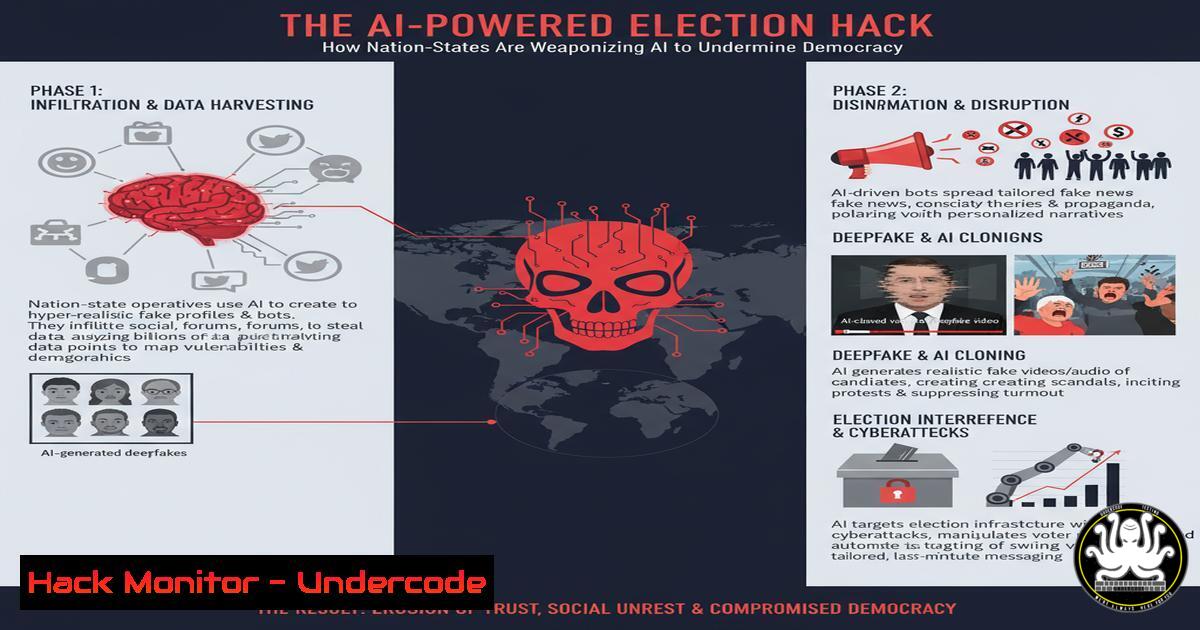
Introduction:
The integrity of democratic elections is facing an unprecedented threat from the convergence of artificial intelligence and sophisticated cyber operations. As highlighted by recent concerns from US senators, nation-state actors are now leveraging AI to create hyper-realistic disinformation campaigns and execute targeted cyber attacks on electoral infrastructure. This new era of digital warfare moves beyond simple hacking to encompass a full-spectrum assault on the very perception of reality, aiming to erode public trust and manipulate outcomes.
Learning Objectives:
- Understand the technical mechanisms of AI-powered disinformation and deepfake technology.
- Learn defensive strategies to secure electoral IT infrastructure, including voter registration databases and reporting systems.
- Identify and mitigate social engineering attacks amplified by AI-generated content.
You Should Know:
1. Securing Voter Registration Databases with SQL Hardening
A primary target for cyber-attacks is the backend database containing voter information. Compromise can lead to data theft or manipulation. Hardening your SQL server is a critical first line of defense.
-- 1. Check for and disable the 'sa' account or ensure it has a complex password.
SELECT name, is_disabled
FROM sys.sql_logins
WHERE name = 'sa';

-- 2. Enable auditing for failed and successful logins.
ALTER SERVER AUDIT SPECIFICATION ServerAuditSpec
WITH (STATE = ON);
-- (Requires a pre-defined Server Audit)

-- 3. Implement Column-Level Encryption for sensitive data like SSNs.
CREATE MASTER KEY ENCRYPTION BY PASSWORD = 'StrongPassword123!';
CREATE CERTIFICATE VoterCert WITH SUBJECT = 'Voter Data Encryption';
CREATE SYMMETRIC KEY VoterSSNKey WITH ALGORITHM = AES_256
ENCRYPTION BY CERTIFICATE VoterCert;

-- To encrypt/decrypt:
OPEN SYMMETRIC KEY VoterSSNKey DECRYPTION BY CERTIFICATE VoterCert;
UPDATE Voters SET SSN_Encrypted = EncryptByKey(Key_GUID('VoterSSNKey'), SSN);
SELECT CONVERT(VARCHAR, DecryptByKey(SSN_Encrypted)) AS DecryptedSSN FROM Voters;
This step-by-step guide ensures that even if an attacker gains access to the database, critical personally identifiable information (PII) remains protected through encryption and robust access controls.
- Detecting AI-Generated Deepfakes with Python and Metadata Analysis
AI-generated images and videos (deepfakes) are used for character assassination and spreading false narratives. Analysts can use Python to scrutinize media file metadata for signs of AI generation.
import exifread
from PIL import Image
import requests

def analyze_image_metadata(image_path):
"""Analyzes image metadata for AI generation artifacts."""
with open(image_path, 'rb') as f:
tags = exifread.process_file(f)
for tag, value in tags.items():
if 'software' in tag.lower() or 'model' in tag.lower():
print(f"{tag:25}: {value}")
 Check for consistency in JPEG quantization tables
img = Image.open(image_path)
if img.format == 'JPEG':
 AI generators often use different compression algorithms
print(f"Image mode: {img.mode}, Size: {img.size}")

Example usage
analyze_image_metadata('suspicious_image.jpg')
This script helps identify the software used to create an image. While sophisticated actors can remove metadata, its presence can be a clear indicator. Inconsistencies in compression and color profiles are also tell-tale signs of manipulation.
- Hardening Public-Facing Web Servers (NGINX) Against DDoS and Intrusion
Election reporting websites are high-value targets for DDoS attacks. Securing the web server is paramount to ensuring result transparency.
 1. Create a rate limiting configuration in /etc/nginx/nginx.conf
http {
limit_req_zone $binary_remote_addr zone=one:10m rate=10r/s;

server {
location /results {
limit_req zone=one burst=20 nodelay;
proxy_pass http://result_backend;
}
}
}

<ol>
<li>Hide server version to obscure information from attackers.
sudo nano /etc/nginx/nginx.conf
Add inside the 'http' block:
server_tokens off;</p></li>
<li><p>Set strong SSL/TLS protocols and ciphers.
ssl_protocols TLSv1.2 TLSv1.3;
ssl_ciphers ECDHE-RSA-AES256-GCM-SHA512:DHE-RSA-AES256-GCM-SHA512;</p></li>
<li><p>Test configuration and reload NGINX.
sudo nginx -t
sudo systemctl reload nginx
This configuration protects the server by limiting request rates from a single IP address, hiding sensitive version information, and enforcing modern encryption standards to prevent eavesdropping.
- Monitoring Network Traffic for Anomalies with Wireshark and TShark
Unusual network traffic can signal a breach or data exfiltration attempt. Command-line tools like TShark (Wireshark’s CLI version) are essential for continuous monitoring.
 1. Capture packets on a specific port (e.g., SSH port 22) and look for anomalies.
tshark -i eth0 -f "port 22" -w ssh_traffic.pcap

<ol>
<li>Analyze the capture file for failed login attempts (a sign of brute-forcing).
tshark -r ssh_traffic.pcap -Y "tcp.analysis.retransmission || tcp.analysis.duplicate_ack"</p></li>
<li><p>Look for large, sustained outbound transfers which could indicate data theft.
tshark -r suspicious_traffic.pcap -q -z io,stat,60,"SUM(ip.len)ip.src==192.168.1.50"</p></li>
<li><p>Filter for DNS queries to known malicious domains.
tshark -i eth0 -Y "dns.qry.name contains 'malicious-domain.com'"
This step-by-step process allows security teams to proactively identify brute-force attacks, data exfiltration, and communication with command-and-control servers.
- Implementing Multi-Factor Authentication (MFA) on Linux via PAM
Protecting administrative accounts on election infrastructure is non-negotiable. Enforcing MFA on Linux systems adds a critical layer of security beyond passwords.
 1. Install the Google Authenticator PAM module.
sudo apt update && sudo apt install libpam-google-authenticator -y

<ol>
<li>Run the authenticator for the user to generate a QR code.
google-authenticator</p></li>
<li><p>Edit the PAM configuration for SSH.
sudo nano /etc/pam.d/sshd
Add the following line:
auth required pam_google_authenticator.so</p></li>
<li><p>Edit the SSH daemon configuration to challenge for the verification code.
sudo nano /etc/ssh/sshd_config
Ensure these lines are set:
ChallengeResponseAuthentication yes
AuthenticationMethods publickey,password publickey,keyboard-interactive</p></li>
<li><p>Restart the SSH service.
sudo systemctl restart sshd
This guide ensures that accessing a critical server requires both a SSH key/password and a time-based one-time password (TOTP) from an authenticator app, drastically reducing the risk of account compromise.
6. Windows Active Directory Hardening Against Kerberoasting
Attackers often target Active Directory to move laterally across a network. Kerberoasting is a common technique to extract service account credentials.
 1. Identify accounts vulnerable to Kerberoasting (Accounts with SPNs)
Get-ADUser -Filter {ServicePrincipalName -like ""} -Properties ServicePrincipalName, PasswordLastSet, LastLogonDate | Select-Name, ServicePrincipalName, PasswordLastSet, LastLogonDate

<ol>
<li>Implement a strong password policy for these accounts using Group Policy.
Navigate to: Computer Configuration -> Policies -> Windows Settings -> Security Settings -> Account Policies -> Password Policy</p></li>
<li><p>Enable Advanced Auditing to log Kerberos TGS requests (Event ID 4769).
AuditPol /set /subcategory:"Kerberos Service Ticket Operations" /success:enable /failure:enable</p></li>
<li><p>Use a tool like ATA or Microsoft Defender for Identity to alert on suspicious Kerberos activity.
By identifying vulnerable accounts, enforcing strong passwords, and enabling detailed auditing, administrators can detect and prevent attempts to compromise service accounts through Kerberoasting attacks.
What Undercode Say:
- The Attack Surface Has Expanded Beyond Code. The threat is no longer just about SQL injection or buffer overflows; it’s about poisoning the information ecosystem with AI-generated content that is virtually indistinguishable from reality.
- Defense Requires a Fusion of IT and Cognitive Security. Technical hardening of servers and networks must be paired with public education and media literacy initiatives to create a resilient electoral process.
The senators’ warning is a stark reminder that the rules of engagement have changed. The integration of AI into influence operations represents a fundamental shift from disruptive hacking to persuasive manipulation. Defending against this requires a new paradigm in cybersecurity—one that blends deep technical controls with an understanding of human psychology and information dissemination. The integrity of future elections will depend on our ability to build systems that are not only technically sound but also trusted by a public capable of critical thinking.
Prediction:
The use of AI in electoral interference will evolve from creating fake content to automating personalized, real-time manipulation at scale. We will see AI-driven bots that can engage in nuanced, context-aware social media conversations to sway individual voters, and hyper-realistic deepfake audio used to impersonate officials during critical moments. The future battleground will be the personalized feed of every voter, with attacks tailored to their unique psychological profile, making defense a monumental challenge of AI vs. AI.
🎯Let’s Practice For Free:
IT/Security Reporter URL:
Reported By: Piveteau Pierre – Hackers Feeds
Extra Hub: Undercode MoN
Basic Verification: Pass ✅


