Listen to this Post
Introduction:
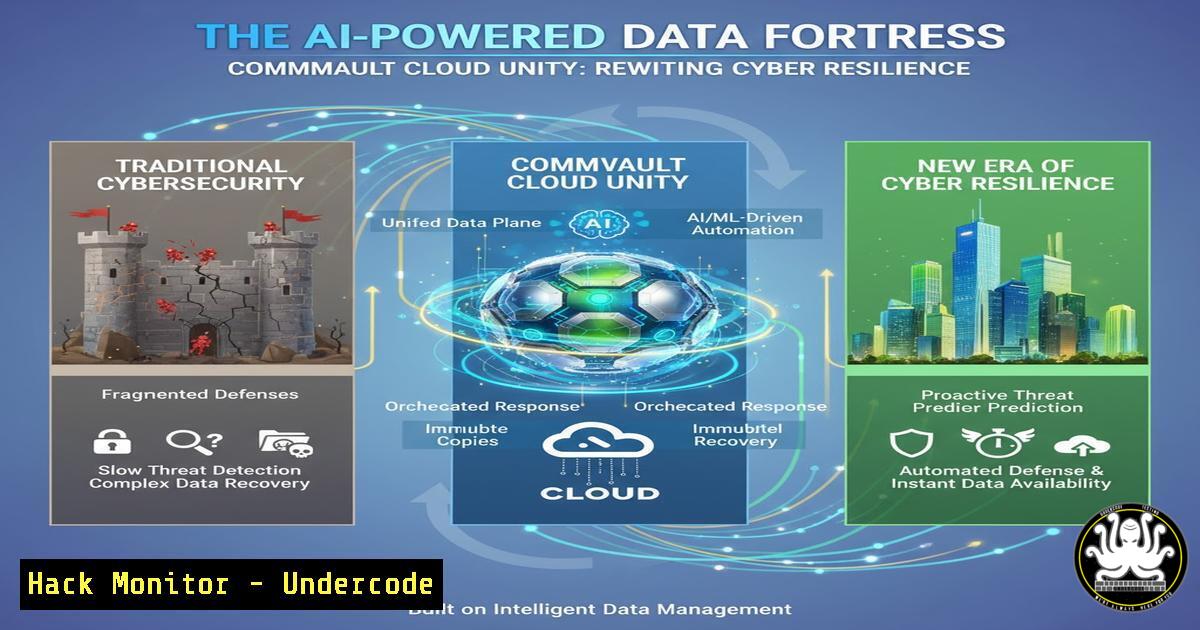
Enterprise data security is at a critical juncture, strained by the complexities of multi-cloud and hybrid environments. The Commvault Cloud Unity platform emerges as a response to this challenge, offering a unified, AI-driven approach to data protection, cyber recovery, and identity resilience. This integrated strategy is fast becoming essential infrastructure for businesses aiming to innovate safely in the AI era.
Learning Objectives:
- Understand the core challenges of fragmented data protection in multi-cloud environments.
- Learn how AI-driven policy enforcement and threat detection centralize cyber resilience.
- Explore the technical mechanisms that enable automated recovery and cost optimization across hybrid infrastructures.
You Should Know:
- The Problem: Fragmented Tools in a Multi-Cloud World
Enterprises no longer operate in a single environment. Data and applications are spread across AWS, Azure, Google Cloud, and on-premises data centers. Legacy backup and security tools, designed in isolation, create critical gaps in visibility and control. This fragmentation means a security incident in one cloud might go undetected by a tool protecting another, delaying response and increasing risk. The core problem is operational chaos, where IT teams spend more time managing disparate tools than implementing a cohesive security posture.
Step‑by‑step guide explaining what this does and how to use it.
Step 1: Identify Your Data Silos. Conduct a comprehensive audit of all data protection and security tools across your estate.
AWS CLI: `aws backup list-backup-plans` (to list AWS Backup plans)
Azure PowerShell: `Get-AzRecoveryServicesVault` (to list Azure Recovery Services vaults)
On-Premises: Document all backup agents, schedules, and storage locations for systems like Veeam or NetBackup.
Step 2: Map Data Flows. Understand how data moves between your environments. This highlights points of vulnerability where a unified policy could be applied.
Step 3: Assess Compliance Gaps. Compare the policies of each siloed tool. You will likely find inconsistencies in retention periods, encryption standards, and recovery time objectives (RTOs).
2. The Solution: Unified AI-Driven Policy Enforcement
Commvault Cloud Unity addresses fragmentation by centralizing control. Instead of configuring ten different policies across ten different consoles, administrators define a single, intelligent policy. AI and machine learning models work within this framework to analyze data access patterns, automatically classify sensitive information, and enforce protection rules consistently, regardless of where the data resides.
Step‑by‑step guide explaining what this does and how to use it.
Step 1: Define a Global Data Classification Policy. In the Unity dashboard, create rules to identify PII, financial data, and intellectual property. For example, a rule could scan for credit card number patterns using regex.
Step 2: Create Intelligent Service-Level Agreements (SLAs). Link your classification tags to protection SLAs. For instance, all data classified as “Confidential” could have a 15-minute RPO (Recovery Point Objective) and a 1-hour RTO, with immutable backups enabled.
Step 3: Automate Policy Application. The platform’s AI automatically discovers new workloads and applies the appropriate policy based on its classification. A new Azure VM tagged as “HR-Database” would instantly be protected according to the pre-defined “Confidential” SLA.
3. Proactive Threat Detection with AI Analytics
A unified data set allows for superior analytics. By ingesting and correlating metadata and logs from across the entire environment, the platform’s AI can establish a baseline of normal activity. It can then detect anomalies that indicate a potential ransomware attack, such as mass file encryption or unusual data access from a foreign IP address, often before the attack completes.
Step‑by‑step guide explaining what this does and how to use it.
Step 1: Enable Immutable Storage. Configure backup targets, whether in cloud object storage (e.g., AWS S3 with Object Lock) or on-premises hardened repositories, to be immutable. This prevents threat actors from deleting or encrypting your recovery points.
AWS CLI S3 Object Lock: `aws s3api put-object-lock-configuration –bucket my-bucket –object-lock-configuration ObjectLockEnabled=Enabled`
Step 2: Configure Anomaly Alerting. Within Unity, set thresholds for alerts. For example, trigger a critical alert if over 10,000 files are modified on a fileserver within a 5-minute window.
Step 3: Integrate with SIEM. Use APIs to send these high-fidelity alerts to a Security Information and Event Management (SIEM) system like Splunk or Azure Sentinel for a centralized security view.
4. Orchestrating Cyber Recovery with Confidence
When an attack is detected, recovery cannot be another fragmented process. Cloud Unity provides orchestrated recovery workflows that can restore services in a clean, isolated environment for validation before promoting them back to production. This reduces downtime and ensures you don’t accidentally restore infected data.
Step‑by‑step guide explaining what this does and how to use it.
Step 1: Create a Recovery Playbook. Document and then codify the steps to recover a critical application (e.g., a SQL Server database). This includes restoring the database, bringing application servers online, and re-establishing network connections.
Step 2: Leverage Air-Gapped and Isolated Recovery. Use the platform to spin up an isolated recovery environment in a separate, clean cloud VPC (Virtual Private Cloud). This is your “sandbox” for testing recovered systems.
Terraform for Isolated VPC: A basic Terraform script can define a new AWS VPC with no peering connections to your production network, creating a safe recovery zone.
Step 3: Validate and Promote. Once the application is verified as clean and functional in the isolated environment, use the platform’s orchestration to perform a controlled cut-over to the production network.
5. Achieving Cost Optimization Through Consolidation
Maintaining multiple data protection licenses, storage silos, and management overhead is expensive. A unified platform consolidates these costs. Furthermore, AI-driven features like deduplication across clouds and intelligent tiering of backup data to cheaper storage classes directly reduce TCO.
Step‑by‑step guide explaining what this does and how to use it.
Step 1: Analyze Current Spending. Use cloud provider cost management tools to get a baseline of your current data protection spending.
AWS Cost Explorer: Analyze costs for services like AWS Backup, EBS Snapshots, and S3 storage.
Azure Cost Management: Review spending on Recovery Services Vaults and storage accounts.
Step 2: Implement Global Deduplication. Ensure the platform’s global deduplication is enabled. This ensures a unique block of data is only stored once, even if it exists across 100 VMs, drastically reducing storage needs.
Step 3: Configure Tiering Policies. Set policies to automatically move older recovery points from expensive, high-performance storage to low-cost archive tiers (e.g., from Amazon S3 Standard to S3 Glacier Instant Retrieval).
What Undercode Say:
- The future of enterprise security is platform-based, not tool-based. Siloed solutions are a liability in a dynamically connected multi-cloud reality.
- True cyber resilience is not just about backing up data, but about having an intelligent, automated, and orchestrated system for detection, response, and recovery.
The announcement of Commvault Cloud Unity signifies a major market shift. It’s a direct response to the operational fatigue caused by tool sprawl and the escalating sophistication of AI-powered cyber threats. This platform doesn’t just add another feature; it re-architects the core philosophy of data protection around centralization and intelligence. For CIOs, the calculus is changing: the cost and risk of maintaining a patchwork of point solutions now outweigh the investment in a unified control plane. This approach is becoming non-negotiable for any enterprise that views its data as a strategic asset and wants a firm foundation for its own AI initiatives, ensuring that innovation is not stifled by security concerns.
Prediction:
The success of platforms like Commvault Cloud Unity will accelerate the consolidation of the cybersecurity and data management markets. Within five years, “best-of-breed” for point-in-time backups will be largely obsolete, replaced by integrated “Cyber Resilience Platforms” that natively combine data security, identity governance, and AIOps. These platforms will become the central nervous system for IT operations, autonomously managing risk posture and enabling self-healing infrastructure, making proactive resilience a standard expectation rather than a reactive goal.
🎯Let’s Practice For Free:
IT/Security Reporter URL:
Reported By: Jenstirrup Commvault – Hackers Feeds
Extra Hub: Undercode MoN
Basic Verification: Pass ✅


