Listen to this Post
Introduction:
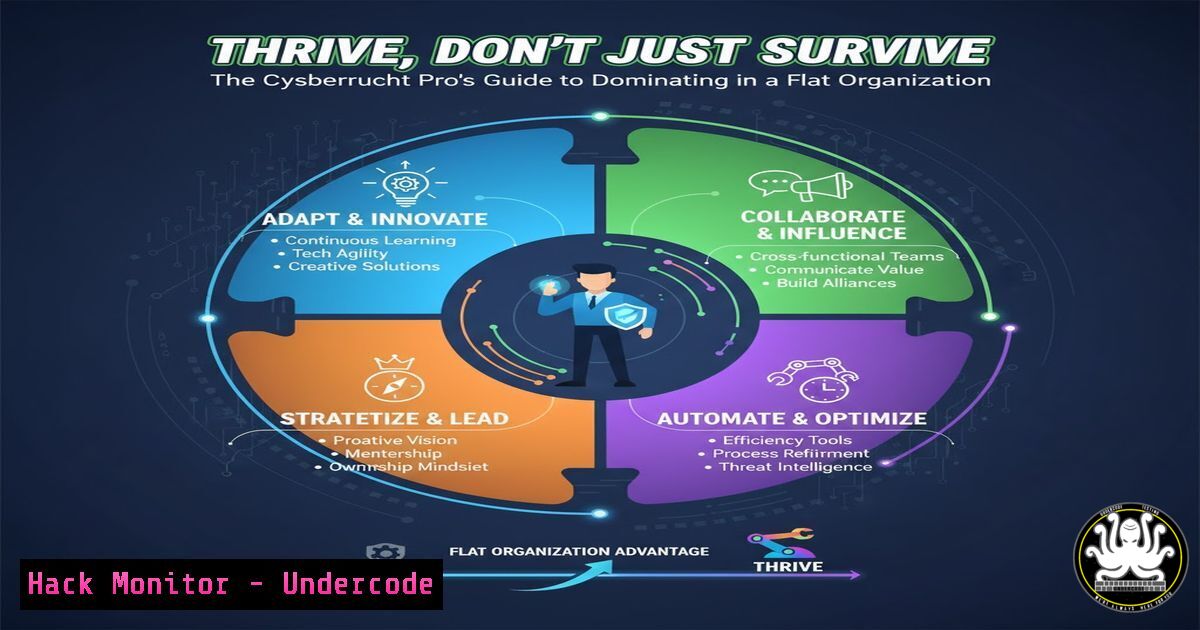
The corporate trend towards flat organizational structures is accelerating, driven by the need for agility and rapid decision-making in the face of evolving cyber threats. For cybersecurity and IT professionals, this shift dismantles traditional hierarchies, forcing a transition from waiting for tickets to proactively owning security outcomes. Mastering this new landscape requires a blend of technical initiative, strategic communication, and continuous skill development in high-impact areas like cloud security, AI, and automation.
Learning Objectives:
- Redefine your technical role by identifying and automating security gaps using modern scripting and tooling.
- Strengthen your peer network through collaborative security tooling and shared threat intelligence.
- Communicate security value by translating technical data into business-risk narratives for leadership.
You Should Know:
1. Redefine Your Role with Proactive Security Automation
In a flat org, the security team that only responds is a cost center; the one that automates is a strategic asset. Proactively identifying and owning security gaps, especially through automation, makes you indispensable. This means moving beyond predefined duties to scripting common tasks, hardening configurations, and integrating security into the DevOps pipeline.
Step‑by‑step guide explaining what this does and how to use it.
Step 1: Identify Repetitive Tasks. Audit your daily work. Are you repeatedly checking for insecure S3 buckets, reviewing the same logs, or manually provisioning user access?
Step 2: Select a Tool and Script the Task. For cloud misconfigurations, use AWS CLI with `jq` for parsing.
Command (Linux/macOS):
 Find all S3 buckets and check their public access block status
aws s3api list-buckets --query "Buckets[].Name" --output text | tr '\t' '\n' | while read bucket; do
echo "Checking bucket: $bucket"
aws s3api get-public-access-block --bucket "$bucket" 2>/dev/null || echo "Public access block not set on $bucket - SECURITY RISK"
done
What this does: This script lists all S3 buckets and checks if the critical `PublicAccessBlock` setting is enabled, quickly identifying buckets at risk of public exposure.
Step 3: Automate with Cron or CI/CD. Schedule this script to run daily via a cron job or integrate it into your CI/CD pipeline to fail builds if a misconfiguration is detected.
- Strengthen Your Peer Network with Shared Threat Intelligence
Your power in a flat organization is your network. For cybersecurity, this means creating shared channels for threat intelligence. Instead of hoarding data, build a system where your peers in IT, development, and operations can contribute to and benefit from collective security awareness.
Step‑by‑step guide explaining what this does and how to use it.
Step 1: Set Up a Shared Indicator of Compromise (IoC) Feed. Use a simple, accessible platform like a dedicated Slack channel or a shared document/dashboard.
Step 2: Automate IoC Ingestion. Use a Python script to pull from open-source threat feeds and post to your channel.
Code Snippet (Python):
import requests
import json
 Example using AlienVault OTX (requires free API key)
otx_api_key = "YOUR_OTX_KEY"
headers = {'X-OTX-API-KEY': otx_api_key}
pulse_id = "EXAMPLE_PULSE_ID"  ID of a known malware family pulse

response = requests.get(f'https://otx.alienvault.com/api/v1/pulses/{pulse_id}/indicators', headers=headers)
data = response.json()

for indicator in data['indicators']:
if indicator['type'] == 'IPv4':
print(f"Malicious IP: {indicator['indicator']} - Type: {indicator['type']}")
 Add code here to post this to Slack/Discord via a webhook
What this does: This script fetches known malicious IP addresses from a threat intelligence platform, which can then be distributed to peers for blocking at firewalls or web proxies.
Step 3: Encourage Peer Contribution. Train network and system admins to report anomalous traffic or suspicious logs to this channel, enriching the collective dataset.
3. Communicate Value with Security Data Visualization
Communicating “progress” in security means showing risk reduction, not just listing patched systems. You must translate technical findings into business-impact narratives. Data visualization is key.
Step‑by‑step guide explaining what this does and how to use it.
Step 1: Aggregate Key Metrics. Use tools like Azure Log Analytics, Splunk, or even `ELK Stack` to centralize logs.
Step 2: Create a KPI Dashboard. Track metrics like Mean Time to Detect (MTTD), Mean Time to Respond (MTTR), and Vulnerability Aging.
Step 3: Script a Weekly Executive Summary. Automate the generation of a top-level report.
PowerShell Command (Windows):
 Get a count of critical vulnerabilities older than 30 days from a hypothetical API
$VulnData = Invoke-RestMethod -Uri "https://internal-vuln-scanner/api/vulns?severity=critical" -Headers $headers
$OldCriticals = ($VulnData | Where-Object { (Get-Date $_.created) -lt (Get-Date).AddDays(-30) }).Count
Write-Output "Security Weekly Snapshot"
Write-Output "Critical Vulnerabilities unresolved for >30 days: $OldCriticals"
Write-Output "Trend: $(If ($OldCriticals -lt $LastWeeksCount) { 'Improving' } Else { 'Needs Attention' })"
What this does: This script queries an internal vulnerability management system to extract a single, powerful business metric that clearly communicates security posture and trend to non-technical leaders.
4. Focus on High-Impact Cloud Hardening
Prioritizing work tied to top goals means targeting the most critical attack surfaces. For modern businesses, this is the cloud. Proactively hardening cloud configurations demonstrates direct value.
Step‑by‑step guide explaining what this does and how to use it.
Step 1: Use Infrastructure as Code (IaC) for Security. Define your environment with Terraform or CloudFormation to ensure consistent, secure baselines.
Step 2: Implement Continuous Compliance Checks. Use `Prowler` or `Scout Suite` to scan your cloud environment.
Command (Linux, using Prowler):
 Run a comprehensive AWS security check
./prowler -g gdpr -g cis-2.0 -M mono
What this does: Prowler checks your AWS environment against best practices (like CIS benchmarks) and compliance frameworks (like GDPR), generating a detailed report of misconfigurations.
Step 3: Triage and Remediate. Focus first on findings labeled “critical,” such as unrestricted security group rules or lack of MFA on the root account.
5. Invest in AI-Powered Security Learning
“Learning” for a cybersecurity pro in a flat org must be strategic. Focus on skills that amplify your impact, particularly the application of AI in security (AI for defense) and understanding AI system vulnerabilities (security for AI).
Step‑by‑step guide explaining what this does and how to use it.
Step 1: Understand AI/ML Attack Vectors. Study prompt injection, model poisoning, and data leakage in ML systems.
Step 2: Experiment with Defensive AI Tools. Set up a lab to test AI-driven security tools.
Tutorial Snippet: Using a Python script to detect anomalous login behavior.
from sklearn.ensemble import IsolationForest
import pandas as pd

Sample login data: [hour_of_day, failed_attempts, country_code]
login_data = pd.DataFrame([[2, 3, 1], [14, 1, 1], [3, 15, 7], [15, 1, 1]])
model = IsolationForest(contamination=0.1)
model.fit(login_data)
predictions = model.predict(login_data)
 -1 indicates an anomaly
login_data['anomaly'] = predictions
print(login_data)
What this does: This simplistic example uses an Isolation Forest algorithm to flag unusual login patterns (e.g., high failed attempts from an unusual country), demonstrating how AI can automate threat detection.
Step 3: Formalize Training. Enroll in courses from platforms like SANS (SEC595: AI Security Essentials) or Coursera (AI For Everyone) to build credentialed expertise.
What Undercode Say:
- Own Your Security Stack: In a flat organization, your influence is defined by the systems you proactively build and manage, not the title you hold. Automation is your primary lever for scalability and impact.
- Communication is a Technical Skill: The ability to distill a critical vulnerability or a complex attack chain into a single slide with a clear business risk and recommended action is as valuable as knowing how to exploit it.
The shift to flat structures is not a temporary trend but a permanent recalibration of the corporate world towards efficiency and agility. For cybersecurity professionals, this is a net positive. It strips away the bureaucratic insulation that often separates technical teams from business consequences. The professionals who will thrive are those who embrace the entrepreneurial mindset: they see a problem, build a solution, communicate its value, and continuously adapt. This environment will ruthlessly expose those who wait for direction but generously reward those who possess both deep technical skills and the initiative to apply them strategically. The future of cybersecurity leadership is being forged not in the org chart, but in the code, scripts, and cross-functional partnerships built by today’s practitioners.
Prediction:
The “Great Flattening” will fundamentally accelerate the integration of AI and automation into the cybersecurity workflow. Professionals who merely execute manual tasks will be consolidated out, while those who can design, implement, and manage AI-driven security systems—and effectively communicate their value—will become the new C-suite leaders. We will see the rise of the “Product Owner” security professional, responsible for the end-to-end health of a security service (like “Identity Protection” or “Cloud Security Posture”), wielding automation and data to demonstrate clear ROI and directly influence business strategy.
🎯Let’s Practice For Free:
IT/Security Reporter URL:
Reported By: Billgtingle A – Hackers Feeds
Extra Hub: Undercode MoN
Basic Verification: Pass ✅


