Listen to this Post
Introduction:
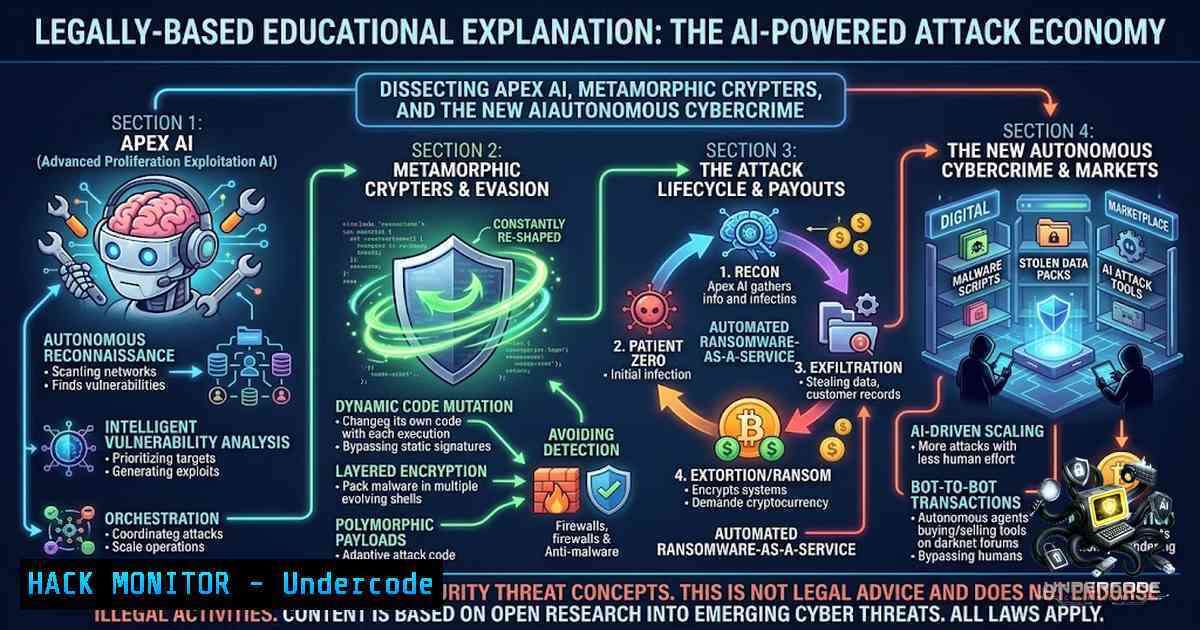
The commoditization of artificial intelligence on underground forums has fundamentally altered the threat landscape, democratizing sophisticated cyberattacks previously reserved for nation-state actors. With posts about AI hacking tools surging from 38 in December 2025 to nearly 1,500 by February 2026, defenders now face an adversary capable of executing ransomware campaigns, bypassing endpoint detection and response (EDR) solutions, and exploiting AI assistants—all at machine speed.
Learning Objectives:
- Understand the operational mechanics and threat models of three emerging AI-powered attack vectors: APEX AI, Metamorphic Crypter, and indirect prompt injection.
- Master defensive techniques, including behavioral analysis, EDR hardening, and AI-specific input sanitization.
- Develop actionable incident response procedures for environments compromised by AI-generated malware and prompt injection attacks.
You Should Know:
1. APEX AI: The Ransomware-as-a-Service Generator
The APEX AI service, operated by a threat actor known as Shadowx007, represents a paradigm shift in ransomware deployment. By simply inputting a target domain, APEX AI generates a complete attack plan with step-by-step commands tailored to the victim’s infrastructure. This removes the technical barrier that once required manual reconnaissance and exploit development.
Step-by-Step Offensive Analysis (for Defensive Understanding):
Step 1: Target Enumeration. The tool likely performs DNS reconnaissance and WHOIS lookups to identify the target’s public-facing infrastructure.
Step 2: Vulnerability Mapping. Using LLM-powered analysis, APEX AI correlates known CVEs with the target’s stack.
Step 3: Payload Generation. The service compiles ransomware binaries with obfuscation layers designed to evade signature-based detection.
Step 4: Command Execution Plan. The output provides specific commands—often in PowerShell or Python—to deploy the ransomware across the network.
Defensive Commands (Linux/Windows):
- Linux (Monitor for suspicious outbound connections):
sudo tcpdump -i eth0 -1 'dst port 443 and (tcp[((tcp[12:1] & 0xf0) >> 2):4] = 0x47455420 or tcp[((tcp[12:1] & 0xf0) >> 2):4] = 0x504f5354)'
This captures HTTP GET/POST requests that may indicate C2 beaconing.
-
Windows (Audit PowerShell execution):
Get-WinEvent -LogName "Microsoft-Windows-PowerShell/Operational" | Where-Object { $_.Id -eq 4104 } | Select-Object TimeCreated, MessageThis retrieves PowerShell script block logs, critical for detecting AI-generated payloads.
2. Metamorphic Crypter: AI-Powered Antivirus Evasion
Advertised on Exploit forums by a threat actor known as ImpactSolutions, the “Metamorphic Crypter” service claims to render malware undetectable by Windows Defender and most antivirus products. Unlike traditional crypters that rely on static obfuscation, this AI-driven service likely employs polymorphic code generation—rewriting the malware’s binary structure with each iteration while preserving functionality.
Step-by-Step Defensive Hardening:
Step 1: Enable AMSI (Antimalware Scan Interface) logging.
Set-MpPreference -EnableScriptScanning $true
Set-MpPreference -SubmitSamplesConsent 2
Step 2: Deploy EDR behavioral rules. Configure EDR to flag processes that:
– Inject shellcode into legitimate Windows executables (e.g., notepad.exe).
– Create child processes from Office applications.
– Exhibit unusual API call sequences (e.g., `VirtualAllocEx` followed by CreateRemoteThread).
Step 3: Implement Application Control.
 Windows Defender Application Control (WDAC) policy
New-CIPolicy -FilePath C:\WDAC\policy.xml -Level Publisher -UserPEs
Step 4: Monitor for AI-generated script patterns. AI-generated PowerShell often includes verbose comments and structured variable naming—unusual for human attackers. Deploy YARA rules to detect such patterns.
3. Indirect Prompt Injection: Subverting AI Assistants
Proofpoint researchers have uncovered a growing market for indirect prompt injection (IDPI) tools, with subscription prices starting at $150 per month. These tools embed malicious instructions in PDFs, emails, calendar invites, and web pages—hidden using techniques such as white-on-white text or HTML code comments. When an AI assistant processes the content, it executes the attacker’s commands, believing them to be legitimate instructions.
Step-by-Step Mitigation:
Step 1: Sanitize AI Inputs. Implement an AI firewall that strips hidden text, HTML comments, and unusual Unicode characters before content reaches the LLM.
Step 2: Restrict AI Agent Permissions. AI assistants should operate with the principle of least privilege:
{
"permissions": {
"read_files": "/workspace/readonly/",
"send_email": false,
"api_access": ["read-only"]
}
}
Step 3: Monitor for Anomalous AI Behavior. Log all AI agent actions and flag deviations—such as an AI attempting to export data or execute system commands.
Step 4: Implement Human-in-the-Loop for Critical Actions. Require user confirmation for any action involving data exfiltration or system changes.
4. AI-Powered EDR Evasion Frameworks
Sophos researchers recently uncovered a ransomware toolkit that uses multiple AI agents—including Cursor and Claude Opus—to automate Active Directory discovery and evade EDR solutions. The framework generated nearly 80 modules tested against more than 70 detection-evasion techniques, with each iteration improving the malware’s ability to bypass defenses.
Defensive Commands:
- Linux (Monitor for AD reconnaissance):
sudo ausearch -m user_auth -ts recent | grep -E "SID|Domain"
This audits authentication events for suspicious domain queries.
- Windows (Detect Cobalt Strike beacons):
Get-1etTCPConnection -State Established | Where-Object { $<em>.RemotePort -eq 443 -and $</em>.RemoteAddress -1otmatch "^(10.|172.16.|192.168.)" }This lists outbound HTTPS connections to non-local IPs—potential beacon traffic.
- The Xanthorox Threat Model: Offline, Modular, and Unstoppable
Xanthorox AI, first spotted on darknet forums in Q1 2025, represents the next evolution in malicious AI. Unlike WormGPT or FraudGPT, which rely on jailbroken commercial APIs, Xanthorox is self-hosted, offline, and runs five custom-built AI models—Coder, Vision, Reasoner, Voice, and Web Scraper—on private servers. This architecture makes it immune to takedown attempts by platform providers.
Defensive Strategy:
- Shift from IoC-based detection to behavioral analysis.
- Deploy UEBA (User and Event Behavioral Analytics) to detect anomalies in user activity.
- Implement network segmentation to limit lateral movement.
What Undercode Say:
- Key Takeaway 1: The explosion of AI-powered hacking tools—from 38 to 1,500 forum posts in just two months—signals an industrial-scale shift in cybercrime. Defenders must abandon the assumption that sophisticated attacks require sophisticated attackers.
-
Key Takeaway 2: Indirect prompt injection is the stealthiest vector. By hiding commands in ordinary PDFs, emails, and calendar invites, attackers can subvert AI assistants without the user ever noticing. Traditional security awareness training does not address this threat.
-
Analysis: The convergence of generative AI and cybercrime has created an asymmetric threat. While defenders struggle to patch known vulnerabilities, attackers are using AI to discover and exploit new ones in real-time. The Xanthorox platform, with its offline, modular architecture, represents a tipping point—it cannot be disrupted by traditional takedown operations. Organizations must invest in AI-specific defenses, including input sanitization, behavioral monitoring, and zero-trust architectures. The era of reactive cybersecurity is over; proactive, AI-driven defense is no longer optional.
Prediction:
-
-1 The proliferation of AI-powered hacking tools will overwhelm traditional security operations centers (SOCs), leading to a significant increase in successful ransomware attacks and data breaches over the next 12–18 months.
-
-1 The offline, self-hosted nature of platforms like Xanthorox will make them virtually impossible to disrupt, creating a permanent “shadow AI” ecosystem that operates beyond the reach of law enforcement.
-
+1 The threat will accelerate the adoption of AI-1ative defense platforms, behavioral analytics, and zero-trust architectures, driving a new wave of cybersecurity innovation and investment.
-
-1 Indirect prompt injection will emerge as the primary attack vector against enterprise AI deployments, as organizations rush to deploy AI assistants without adequate security controls.
-
+1 The resulting demand for AI security specialists will create new career opportunities and training pathways, potentially addressing the cybersecurity skills gap.
-
-1 The barrier to entry for cybercrime will drop to near zero, enabling a surge in low-skill attackers who can execute sophisticated attacks using off-the-shelf AI tools.
-
+1 Organizations that proactively implement AI-specific defenses—such as input sanitization, permission restrictions, and continuous monitoring—will gain a competitive advantage in resilience and trust.
▶️ Related Video (80% Match):
https://www.youtube.com/watch?v=CNyji0z7t_Q
🎯Let’s Practice For Free:
🎓 Live Courses & Certifications:
Join Undercode Academy for Verified Certifications
🚀 Request a Custom Project:
Secure, high-velocity infrastructure and disruptive technological engineering. Contact our engineering team for high-tier development and proprietary systems:
[email protected]
💎 Smart Architecture | 🛡️ Secure by Design | ⭐ Trusted by Thousands
IT/Security Reporter URL:
Reported By: https://lnkd.in/p/ehvpAcXe – Hackers Feeds
Extra Hub: Undercode MoN
Basic Verification: Pass ✅


