Listen to this Post
Introduction:
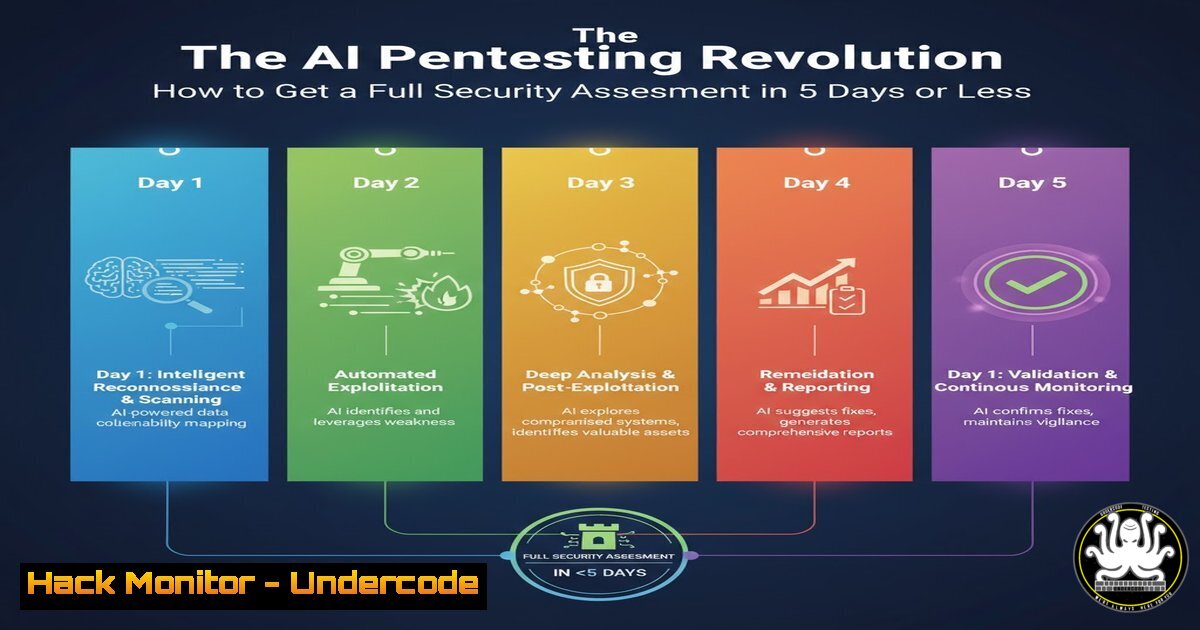
The traditional penetration testing model has long been plagued by extensive scheduling delays and bureaucratic scoping processes, often requiring weeks of preparation before any actual security assessment begins. XBOW’s newly launched Pentest On-Demand platform represents a paradigm shift toward autonomous offensive security, leveraging AI-powered testing capabilities to deliver results within five days. This approach fundamentally challenges conventional penetration testing methodologies by eliminating calendar ping-pong and preliminary scoping calls that traditionally slow down security assessments.
Learning Objectives:
- Understand how AI-powered penetration testing reduces assessment timelines from weeks to days
- Learn the technical foundations of autonomous offensive security platforms
- Identify implementation strategies for integrating on-demand pentesting into security programs
You Should Know:
1. The Architecture of AI-Powered Penetration Testing
Modern AI-driven pentesting platforms utilize sophisticated automation frameworks that combine vulnerability scanning, exploit development, and post-exploitation analysis. Unlike traditional manual testing, these systems employ machine learning algorithms that continuously adapt their testing methodologies based on discovered vulnerabilities and system responses.
Step-by-step guide explaining what this does and how to use it:
– The system begins with automated reconnaissance phases using enhanced nmap scanning with AI-driven port detection: `nmap -sS -sV -O –script ai-enhanced target.com`
– AI algorithms analyze service banners and version information to prioritize attack vectors
– Machine learning models generate custom exploit attempts based on discovered vulnerabilities
– The system automatically documents chainable vulnerabilities and provides remediation guidance
2. Automated Vulnerability Assessment and Exploitation
AI pentesting platforms transcend basic vulnerability scanning by automatically developing and deploying exploits for discovered weaknesses. These systems maintain extensive databases of common vulnerabilities while simultaneously generating novel attack paths through reinforcement learning.
Step-by-step guide explaining what this does and how to use it:
– Conduct automated web application testing using AI-driven payload generation: `python ai_pentest_framework.py –target https://target.com –mode aggressive`
– The system automatically bypasses WAF protections through adaptive payload manipulation
– AI engines perform fuzzing with contextual awareness of application functionality
– Successful exploits trigger automated privilege escalation and lateral movement modules
3. Integrating AI Pentesting into Security Operations
Organizations can maximize the value of AI-powered penetration testing by establishing continuous assessment cycles rather than treating pentests as annual compliance exercises. This requires strategic integration with existing security tools and processes.
Step-by-step guide explaining what this does and how to use it:
– Schedule automated pentests following significant system changes: `curl -X POST “https://api.xbow.com/v1/pentest” -H “Authorization: Bearer API_KEY” -d ‘{“targets”:[“prod-server-1″,”prod-server-2″],”intensity”:”high”}’`
– Configure webhooks to receive real-time vulnerability notifications in Slack or Microsoft Teams
– Establish automated ticket creation in Jira or ServiceNow for critical vulnerabilities
– Implement CI/CD integration to trigger pentests after major deployments
4. Windows Environment AI Penetration Testing
AI pentesting platforms employ specialized techniques for Windows environments, leveraging automated PowerShell scripting and registry analysis to identify misconfigurations and vulnerabilities that might be overlooked in manual testing.
Step-by-step guide explaining what this does and how to use it:
– Execute automated Windows privilege escalation checks: `Invoke-AIPenetrationScan -ComputerName TARGET-SERVER -ScanType Full`
– The AI automatically identifies misconfigured service permissions using advanced analysis
– Machine learning models predict successful attack paths based on system hardening levels
– Automated Active Directory enumeration identifies trust relationship vulnerabilities
5. Cloud Infrastructure Hardening Validation
Modern AI pentesting solutions include specialized modules for assessing cloud security configurations across AWS, Azure, and Google Cloud Platform. These tools automatically identify misconfigured storage buckets, insecure IAM policies, and network security gaps.
Step-by-step guide explaining what this does and how to use it:
– Initiate cloud configuration assessment: `ai-pentest-tool –cloud aws –region us-east-1 –service all`
– The system automatically enumerates S3 buckets and checks for public read/write permissions
– AI algorithms analyze IAM policies for privilege escalation opportunities
– Machine learning models identify anomalous security group configurations
6. API Security Assessment Automation
AI-powered penetration testing platforms excel at API security assessment through automated endpoint discovery, parameter analysis, and sophisticated fuzzing techniques that adapt based on API responses and error messages.
Step-by-step guide explaining what this does and how to use it:
– Launch automated API security testing: `python api_pentest_ai.py –swagger https://api.target.com/swagger.json –depth comprehensive`
– The system automatically tests for broken object level authorization vulnerabilities
– AI engines identify business logic flaws through sequential transaction analysis
– Machine learning detects authentication bypass opportunities through token manipulation
7. Continuous Security Validation Framework
The most significant advantage of AI pentesting platforms is their ability to provide continuous security validation rather than point-in-time assessments. This enables organizations to maintain persistent security posture monitoring.
Step-by-step guide explaining what this does and how to use it:
– Implement continuous security monitoring: `ai-pentest-scheduler –frequency daily –criticality high –reporting realtime`
– Configure differential scanning to focus on changed infrastructure components
– Establish automated compliance reporting for PCI-DSS, HIPAA, and SOC2
– Integrate vulnerability trending analysis into risk management discussions
What Undercode Say:
- AI-powered penetration testing represents the most significant evolution in offensive security since the introduction of automated vulnerability scanners, fundamentally changing assessment economics and frequency
- While AI cannot completely replace human creativity in identifying novel attack vectors, it dramatically increases testing consistency and coverage of known vulnerability classes
- The reduction from weeks to days for penetration testing engagements will force traditional security consultancies to either adapt their service delivery models or risk obsolescence
- Organizations should view AI pentesting as complementary to rather than replacement for human-led red team exercises, with each approach serving distinct but overlapping security validation needs
Prediction:
The widespread adoption of AI-powered penetration testing will democratize advanced security assessment capabilities, making enterprise-grade testing accessible to organizations of all sizes within the next 18-24 months. This technological shift will likely create a bifurcated security testing market where AI handles routine vulnerability identification and validation while human experts focus on sophisticated, multi-vector attack simulation and novel vulnerability research. The accelerated testing cycle will pressure organizations to develop more responsive patch management processes, potentially reducing average vulnerability remediation timelines by 40-60%. However, this rapid evolution may also trigger an AI arms race between defensive and offensive security applications, with both sides leveraging increasingly sophisticated machine learning models to outmaneuver each other.
🎯Let’s Practice For Free:
IT/Security Reporter URL:
Reported By: Aqeel A – Hackers Feeds
Extra Hub: Undercode MoN
Basic Verification: Pass ✅


