Listen to this Post
Introduction:
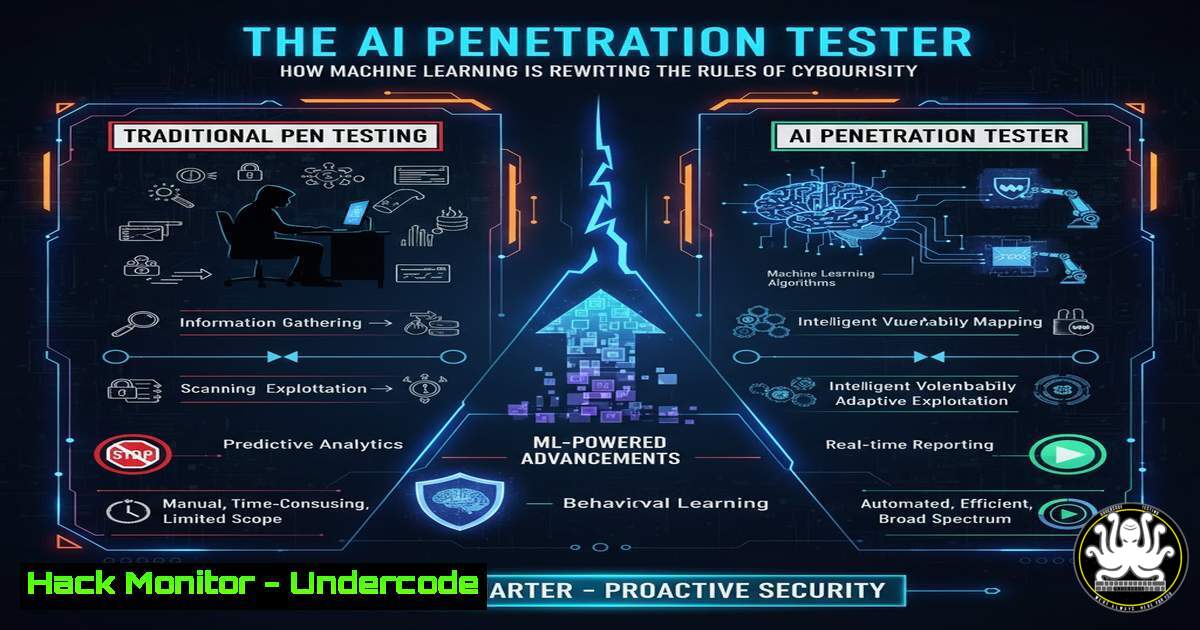
The integration of Artificial Intelligence (AI) into cybersecurity is no longer a futuristic concept but a present-day reality, fundamentally altering the landscape of both offensive security and defensive postures. AI-powered penetration testing tools are now capable of automating complex attack chains, identifying novel vulnerabilities, and learning from defensive mechanisms in real-time. This article delves into the core techniques and commands that underpin this new era of automated security assessment, providing a crucial guide for IT professionals to understand and defend against AI-driven threats.
Learning Objectives:
- Understand the core components and workflows of an AI-powered penetration testing pipeline.
- Learn to utilize command-line tools for data scraping, model training, and automated exploitation.
- Develop mitigation strategies to harden systems against intelligent, automated attacks.
You Should Know:
1. Automated Reconnaissance with AI-Enhanced Scraping
The first stage of any AI-driven attack is the automated collection of intelligence. Tools can now scrape data far more intelligently than simple scripts.
`$ katana -u https://target.com -d 3 -jc -aff | grep -E “(email|api|login)” | tee scraped_data.txt`
`$ gospider -s https://target.com -d 2 -q | ai_parser –filter “sensitive_keywords.json”`
Step-by-step guide: This workflow uses Katana, a next-generation crawling framework, to deeply crawl a target website. The `-d 3` flag sets the crawl depth, `-jc` processes JavaScript, and `-aff` enables advanced form filling. The output is piped to `grep` to filter for high-value strings like “email” or “api”, and the results are saved. The second command uses GoSpider for sitemapping, and the output is fed into a hypothetical AI parser that uses a predefined keyword list to identify and classify potentially sensitive information, mimicking how an AI would prioritize data.
2. Leveraging AI for Vulnerability Discovery in Code
Static Application Security Testing (SAST) has been supercharged by machine learning models trained on millions of code vulnerabilities.
`$ semgrep –config=auto .`
`$ codeql database create /tmp/codeql-db –language=cpp`
`$ codeql database analyze /tmp/codeql-db –format=sarif-latest –output=results.sarif codeql/cpp-queries:codeql-suites/cpp-security-and-quality.qls`
Step-by-step guide: Semgrep with the `auto` config uses community-driven, ML-informed patterns to find vulnerabilities across dozens of languages. CodeQL takes this further by treating code as data. The first command creates a database from the source code. The second command analyzes that database using a suite of security queries (cpp-security-and-quality.qls). AI can be integrated to prioritize the results from these tools, reducing false positives and identifying complex, chained vulnerabilities that traditional tools miss.
3. Intelligent Fuzzing with AI-Guided Generation
Fuzzing is no longer about random input. AI models can now learn the structure of protocol and file formats to generate more effective, malicious inputs.
`$ ./afl-fuzz -i ./input_seeds/ -o ./findings/ -S fuzzer2 — /usr/bin/target_binary @@`
`$ winAFL.exe -i in -o out -D C:\\DRIO\\bin32 -t 10000 — -coverage_module target_dll.dll -fuzz_exe target.exe @@`
Step-by-step guide: American Fuzzy Lop (AFL) and winAFL use genetic algorithms—a form of machine learning—to guide their fuzzing. They start with a corpus of valid input seeds (-i). As the fuzzer runs, it mutates these seeds and monitors for crashes. The mutations that lead to new code paths are kept and used for further fuzzing, effectively “learning” how to penetrate deeper into the program. This automated, intelligent input generation is a cornerstone of AI-offensive security.
4. AI-Powered Web Application Exploitation
Frameworks can now automate the exploitation of common web vulnerabilities like SQLi and XSS by understanding context.
`$ sqlmap -u “https://target.com/page?id=1” –batch –level=5 –risk=3 –tamper=space2comment –ai-suggestions`
`$ xsstrike.py -u “https://target.com/search?q=query” –crawl –ai`
Step-by-step guide: While `sqlmap` already uses sophisticated techniques, an `–ai-suggestions` flag (hypothetical) could use an on-device model to analyze server responses and suggest more effective tampering scripts or exploitation techniques beyond its built-in heuristics. Similarly, an AI-enhanced XSStrike could learn which payloads are most effective against specific WAFs or input sanitization routines, adapting its attack vectors in real-time.
5. Cloud Infrastructure Hardening Against AI Enumeration
Defending cloud environments requires anticipating how an AI would attack them. The following commands help lock down AWS S3 and IAM.
`$ aws s3api put-bucket-policy –bucket my-bucket –policy file://bucket-policy.json`
`$ aws iam create-policy –policy-name DenyS3PublicAccess –policy-document file://deny-public-policy.json`
`$ for bucket in $(aws s3 ls | awk ‘{print $3}’); do aws s3api put-public-access-block –bucket $bucket –public-access-block-configuration BlockPublicAcls=true,IgnorePublicAcls=true,BlockPublicPolicy=true,RestrictPublicBuckets=true; done`
Step-by-step guide: An AI attacker will systematically scan for misconfigured, public S3 buckets. The first command applies a strict bucket policy. The second creates an IAM policy that explicitly denies public access to S3 resources. The third is a Bash loop that programmatically applies a public access block to every bucket in an account, a critical bulk-hardening operation that disrupts automated AI scanners looking for low-hanging fruit.
6. API Security: Thwarting AI-Driven Endpoint Discovery
APIs are a primary target for AI scanners. Rate limiting and stringent authentication are key.
` Nginx rate limiting configuration`
`http {`
` limit_req_zone $binary_remote_addr zone=api:10m rate=10r/m;`
` server {`
` location /api/ {`
` limit_req zone=api burst=20 nodelay;`
` auth_basic “Administrator’s Area”;`
` auth_basic_user_file /etc/nginx/.htpasswd;`
` }`
` }`
`}`
Step-by-step guide: This Nginx configuration snippet creates a “zone” for rate limiting, allowing only 10 requests per minute per IP address to the `/api/` location, with a burst capability of 20. It also implements Basic Authentication. This directly counters an AI’s ability to rapidly fuzz or enumerate API endpoints, as it will quickly be rate-limited and challenged for credentials, breaking its automated workflow.
7. Mitigating AI-Enhanced Social Engineering with DMARC
AI can generate highly convincing phishing emails. DMARC is a critical defense.
`$ dig +short TXT “_dmarc.target.com”`
`v=DMARC1; p=reject; rua=mailto:[email protected]; pct=100; adkim=s; aspf=s;`
Step-by-step guide: This command checks a domain’s DMARC (Domain-based Message Authentication, Reporting, and Conformance) record. A strong policy like `p=reject` instructs receiving mail servers to reject emails that fail SPF and DKIM checks, a primary method for defeating email spoofing. By implementing a strict DMARC policy, organizations can significantly reduce the effectiveness of AI-generated phishing campaigns that rely on domain impersonation.
What Undercode Say:
- The Defense Must Also Be Intelligent: Relying solely on traditional, signature-based defenses is a recipe for failure. Security systems must now incorporate behavioral analytics and AI-driven anomaly detection to identify the subtle, evolving patterns of an AI-led attack.
- The Speed of Attack is the New Battleground: An AI can perform reconnaissance, vulnerability discovery, and exploitation in minutes. Human-scale response times are insufficient; automated defense and orchestration are no longer optional but essential for survival.
The emergence of the AI penetration tester creates a paradoxical imperative: to defend against intelligent machines, we must deploy them. The offensive use of AI is not just about scaling existing attacks but about qualitatively changing their nature, enabling the discovery of vulnerabilities that are invisible to the human eye and conventional tools. This arms race will bifurcate the security landscape. Organizations that embrace AI-augmented defense—integrating it into their SOC workflows, vulnerability management, and threat hunting—will build a formidable barrier. Those that do not will find their digital perimeters systematically dismantled by silent, efficient, and relentless algorithms. The future of security is not human vs. machine, but human and machine vs. human and machine.
Prediction:
The near future will see the rise of fully autonomous “Red Team” AI agents that can operate within a defined scope, continuously probing enterprise networks without human intervention. These agents will not only find and exploit vulnerabilities but will also learn from the defensive measures they encounter, developing more sophisticated bypass techniques over time. This will force a paradigm shift towards “Adaptive Defense” systems that use AI to continuously reconfigure security controls, create deceptive honeypots on the fly, and launch pre-emptive countermeasures against attacking IPs, leading to a new era of automated cyber warfare conducted at machine speeds.
🎯Let’s Practice For Free:
IT/Security Reporter URL:
Reported By: B1bikua Tryhackme – Hackers Feeds
Extra Hub: Undercode MoN
Basic Verification: Pass ✅


