Listen to this Post
Introduction:
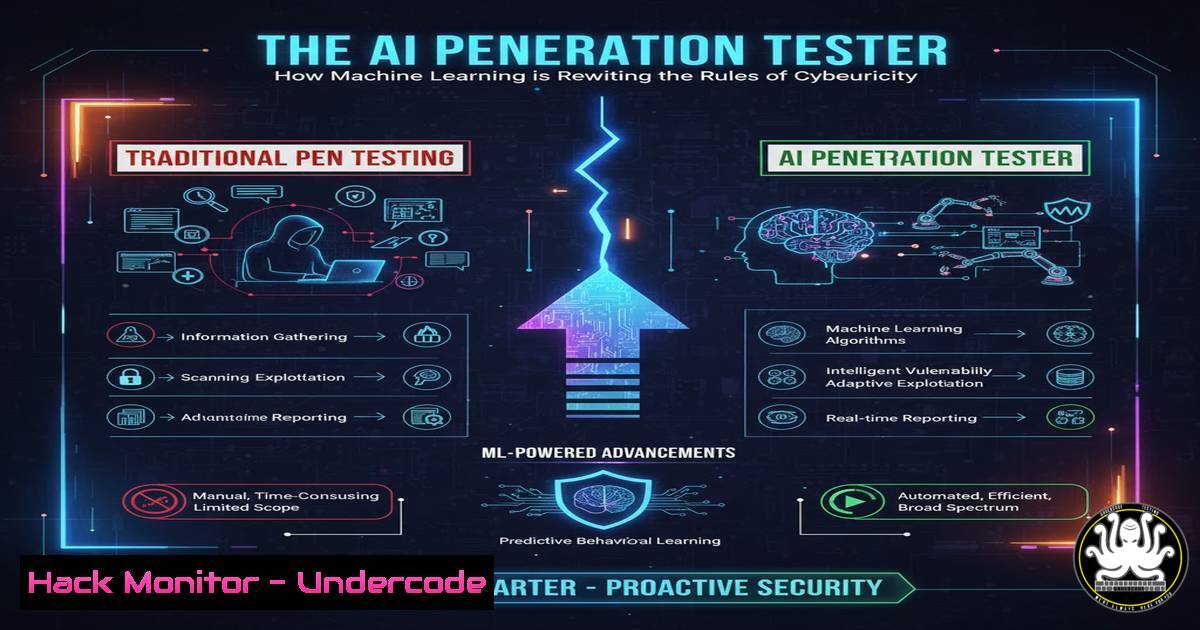
The integration of Artificial Intelligence into cybersecurity is no longer a futuristic concept but an operational reality, particularly in the domain of penetration testing. AI-powered tools are automating complex reconnaissance, vulnerability discovery, and exploit development tasks, enabling security professionals to move at machine speed. This paradigm shift is creating a new landscape where both defenders and attackers must adapt to intelligent, automated adversaries and allies.
Learning Objectives:
- Understand the core AI methodologies being applied to the penetration testing lifecycle.
- Learn to utilize AI-powered security tools for reconnaissance, vulnerability analysis, and social engineering.
- Develop mitigation strategies to defend against AI-augmented cyber attacks.
You Should Know:
1. AI-Enhanced Reconnaissance with `recon-ng` and Custom Scripts
The reconnaissance phase is being supercharged by AI’s ability to process vast datasets. While tools like `recon-ng` are staples, AI scripts can now correlate and prioritize data from their outputs.
Verified Commands/Scripts:
 Launch recon-ng and install a key module
recon-ng
marketplace install recon/domains-hosts/hackertarget
modules load recon/domains-hosts/hackertarget
options set SOURCE example.com
run

A Python snippet using the `requests` library to parse and filter recon-ng's output for high-value targets, a task often augmented by ML models.
import json
with open('recon_results.json', 'r') as f:
data = json.load(f)
 Pseudo-code for AI-based prioritization: ML model would analyze this data
for entry in data:
if entry['subdomain'] in model_predict_high_value(data):
print(f"High Priority: {entry['subdomain']}")
Step-by-step guide:
This approach automates the traditionally manual process of sifting through reconnaissance data. The `recon-ng` tool gathers raw data about subdomains and hosts. A subsequent AI script, using a pre-trained model, can analyze this data to predict which targets are most likely to be vulnerable or high-value based on factors like subdomain name patterns, historical data, or service banners, drastically reducing the analyst’s workload.
2. Intelligent Vulnerability Scanning with `nuclei`
`nuclei` uses templates to drive its vulnerability scanning, and the community-driven template ecosystem is a form of collective intelligence. AI can generate and optimize these templates based on newly disclosed vulnerabilities.
Verified Commands:
 Basic nuclei scan with a template directory
nuclei -u https://target.com -t /path/to/custom-templates/ -o results.txt

Using nuclei to monitor for new vulnerabilities on a target
nuclei -u https://target.com -t cves/ -es info -nc -o live-cves.txt
Step-by-step guide:
`nuclei` is a fast, customizable vulnerability scanner. The `-t` flag specifies a directory of templates, which define how to detect specific vulnerabilities. By continuously updating these templates (often automated via nuclei -update-templates), you leverage the “AI of the crowd.” Security researchers constantly write new templates, which `nuclei` can then use to check your systems against the latest known attack patterns automatically.
3. Automated Web Application Fuzzing with `ffuf`
Fuzzing is ideal for AI augmentation. Machine learning can generate more effective, context-aware payloads rather than relying on static wordlists.
Verified Commands:
 Standard directory fuzzing
ffuf -w /usr/share/wordlists/dirb/common.txt -u https://target.com/FUZZ -mc 200,301,302

Parameter fuzzing, where AI could optimize the parameter wordlist
ffuf -w /usr/share/wordlists/SecLists/Discovery/Web-Content/burp-parameter-names.txt -u https://target.com/script.php?FUZZ=test -fs 0
Step-by-step guide:
`ffuf` is a web fuzzer that rapidly iterates through payloads. The `-w` flag specifies the wordlist. An AI-augmented workflow would involve using an AI tool to generate a custom wordlist tailored to the target’s technology stack (e.g., generating likely endpoint names for a React.js application), making the fuzzing process far more efficient and less noisy than using a generic list.
4. AI-Powered Password Cracking with `hashcat` Rules
While `hashcat` cracks password hashes, AI can analyze previous password breaches to generate sophisticated mutation rules that guess human-like password variations more effectively.
Verified Commands:
 Basic hashcat attack using a wordlist
hashcat -m 1000 hashes.txt /usr/share/wordlists/rockyou.txt

Using a rule-based attack, where the rules can be AI-generated
hashcat -m 1000 hashes.txt /usr/share/wordlists/rockyou.txt -r /path/ai-generated.rule
Step-by-step guide:
`hashcat` applies rules to words from a wordlist to create password permutations. Instead of using static rules like `’d` (append digit), AI models trained on billions of leaked passwords can create dynamic rules that mimic real-world password creation behaviors, such as “capitalize first letter, append a specific year, then add a common symbol.” This significantly increases the success rate of password cracking attacks.
- Machine Learning for Anomaly Detection in Logs (
SigmaRules)
On the defensive side, AI is crucial for detecting attacks. The Sigma rule format provides a generic signature for log events, and ML can help write and tune these rules by identifying anomalous patterns.
Verified Code/Sigma Rule:
 A Sigma rule for detecting suspicious service creation (Hypothetical example)
title: Suspicious Service Creation
logsource:
product: windows
service: system
detection:
selection:
EventID: 7045
ServiceName:
- 'tmp'
- 'temp'
- 'svc_'
condition: selection
level: high
Step-by-step guide:
This Sigma rule is a signature for a specific malicious behavior: creating a service with a suspicious name. An AI-driven Security Information and Event Management (SIEM) system wouldn’t just use static rules. It would learn the normal “baseline” of activity for a network (e.g., typical times for service creation, typical user accounts) and flag significant deviations from this baseline, potentially discovering novel attacks that lack a known signature.
6. Cloud Security Posture Management (CSPM) via AI
AI-driven CSPM tools continuously analyze cloud environments (AWS, Azure, GCP) against compliance benchmarks and best practices, identifying misconfigurations that human auditors might miss.
Verified AWS CLI Command for a common misconfiguration:
 Check for S3 buckets with public read access (a common finding)
aws s3api list-buckets --query "Buckets[].Name" --output text
aws s3api get-bucket-acl --bucket YOUR_BUCKET_NAME
Step-by-step guide:
This manual command checks the access control list (ACL) of an S3 bucket. An AI-powered CSPM automates this across thousands of resources and hundreds of check types. It doesn’t just look for “public,” but understands context—e.g., a bucket that is publicly readable and contains “client_data” is a higher severity risk than one that is public and contains “marketing_brochures.” It learns from global cloud threat intelligence to prioritize risks.
7. Generative AI for Social Engineering Phishing Kits
Generative AI models like GPT can create highly convincing and personalized phishing emails at scale, making traditional spam filters less effective.
Mitigation Command (Email Header Analysis):
 Analyzing email headers in a Linux environment to trace origin
cat phishing_email.eml | grep -E '(Received:|From:|Return-Path:)'
Step-by-step guide:
This command parses a suspicious email’s headers to inspect the `Received` fields, which show the mail server path. Defending against AI-phishing requires a multi-layered approach: technical controls like DMARC, DKIM, and SPF; user training to spot increasingly sophisticated lures; and AI-powered email security gateways that analyze language patterns and behavioral cues to flag synthetic or malicious content, even from a “trusted” domain.
What Undercode Say:
- The Double-Edged Sword is Sharpening: The same AI models that power defensive CSPM tools can be reverse-engineered by attackers to find novel cloud misconfigurations to exploit. The technology is neutral; its application defines its morality.
- The Skills Gap is Evolving, Not Closing: AI will not replace penetration testers but will redefine the role. The value will shift from manually running tools to interpreting AI output, curating training data for AI models, understanding false positives/negatives, and conducting complex, creative attack simulations that AI cannot yet conceive.
The core analysis is that we are entering an era of automated, intelligent cyber conflict. The speed and scale of attacks will increase exponentially, forcing defense to become equally automated. The human expert’s role will elevate from frontline soldier to strategic commander and AI trainer, requiring a deeper understanding of both the technology and the underlying algorithms. The organizations that succeed will be those that integrate AI most effectively into their security orchestration, creating a continuous feedback loop between human intelligence and machine execution.
Prediction:
The next 24-36 months will see the emergence of the first fully autonomous, AI-driven penetration testing suites capable of going from a single domain name to a full compromise report with minimal human intervention. This will be followed shortly by the weaponization of these same frameworks by state-level and highly organized criminal actors, leading to a new class of “flash” cyber attacks that unfold in minutes rather than days. The defense will counter with AI-driven Autonomous Security Operations Centers (ASOCs) that can detect, analyze, and respond to these attacks in real-time, potentially leading to an “AI stalemate” where the primary battlefield shifts to the data integrity and security of the AI models themselves.
🎯Let’s Practice For Free:
IT/Security Reporter URL:
Reported By: Goodmarketing Biggest – Hackers Feeds
Extra Hub: Undercode MoN
Basic Verification: Pass ✅


