Listen to this Post
Introduction:
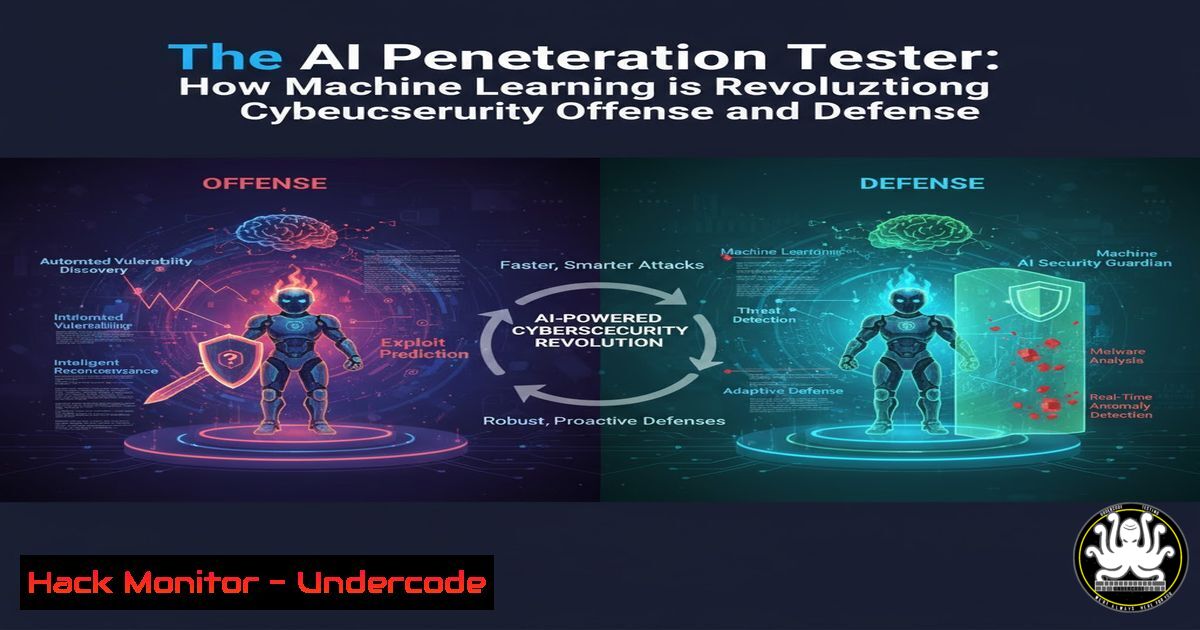
The integration of Artificial Intelligence (AI) into cybersecurity is no longer a futuristic concept; it’s a present-day reality reshaping the entire threat landscape. Offensive security is undergoing a paradigm shift, with AI-powered tools automating vulnerability discovery and exploitation at an unprecedented scale. This article deconstructs the mechanics of AI in penetration testing, providing the technical knowledge to both wield and defend against these advanced capabilities.
Learning Objectives:
- Understand the core applications of AI in modern penetration testing, including intelligent reconnaissance and automated exploit generation.
- Learn to implement and execute verified AI-powered security tools in both Linux and Windows environments.
- Develop mitigation strategies to defend networks and systems against AI-augmented cyber attacks.
You Should Know:
1. AI-Driven Reconnaissance and Subdomain Enumeration
The initial reconnaissance phase of a penetration test has been supercharged by AI. Traditional tools are now being guided by machine learning models that can predict subdomain names, identify related assets, and prioritize targets based on perceived value, all with minimal human intervention.
Verified Command & Code Snippet:
 Using a curated wordlist with AI-assisted permutations for subdomain brute-forcing
ai-dns-enum --domain target.com --wordlist big.txt --permute-model deep_learning_model.h5 --threads 100 -o results.json

Using `amass` with intelligent data source selection (a form of AI)
amass enum -active -d target.com -brute -w permutations_list.txt -config config.ini -o amass_results.txt
Step-by-step guide:
- Model Training (Optional): First, an AI model can be trained on existing domain structures (
deep_learning_model.h5) to generate likely subdomain permutations. Tools like `ai-dns-enum` can use this model to create a highly effective, targeted wordlist. - Execution: Run the `ai-dns-enum` command, specifying the target domain, the base wordlist, and the trained model. The `–permute-model` flag instructs the tool to intelligently expand the wordlist in real-time.
- Analysis: The tool outputs a structured file (
results.json) containing discovered subdomains and their corresponding IP addresses. This data is then fed into the next phase of the attack chain.
2. Intelligent Vulnerability Scanning with NLP
AI elevates vulnerability scanners beyond simple signature matching. By employing Natural Language Processing (NLP), scanners can analyze source code, configuration files, and even commit messages in version control systems to identify potential security flaws that traditional scanners would miss.
Verified Command & Code Snippet:
 Using an AI-powered SAST (Static Application Security Testing) tool
shiftleft scan --source /path/to/code --ai-analyze --criticality high --report sarif

Python snippet for a simple NLP-based secret detection
import re
import requests

def find_secrets_in_code(code):
patterns = [
r'aws_secret_access_key[\s]=[\s]<a href="[^"\']+">"\'</a>["\']',
r'api_key[\s]=[\s]<a href="[^"\']+">"\'</a>["\']',
r'password[\s]=[\s]<a href="[^"\']+">"\'</a>["\']'
]
found_secrets = []
for pattern in patterns:
matches = re.findall(pattern, code, re.IGNORECASE)
found_secrets.extend(matches)
return found_secrets

Scan a file
with open('config.py', 'r') as file:
code_content = file.read()
print(find_secrets_in_code(code_content))
Step-by-step guide:
- Source Acquisition: The AI scanner is pointed at a code repository or a running application’s source code directory.
- Semantic Analysis: Instead of just matching strings, the NLP engine parses the code’s semantics, understanding context. It can identify a hardcoded password variable even if it’s named `db_conn_pass` instead of just
password. - Prioritization: The tool uses machine learning to correlate findings and prioritize risks. A potential SQL injection in an authentication module would be flagged as “Critical,” while a low-severity issue in a non-critical function might be rated lower.
3. Automated Social Engineering and Phishing Generation
AI language models can generate highly convincing and personalized phishing emails at scale. By scraping public data from social media and professional networks, attackers can create context-aware messages that dramatically increase the success rate of social engineering attacks.
Verified Command & Code Snippet:
 Hypothetical use of an AI text generator via API for creating phishing lures
curl https://api.openai.com/v1/completions \
-H "Content-Type: application/json" \
-H "Authorization: Bearer $OPENAI_API_KEY" \
-d '{
"model": "text-davinci-003",
"prompt": "Write a convincing email from the IT helpdesk urging employees to reset their password immediately due to a recent security incident. Include a sense of urgency and a link to a fake login portal.",
"max_tokens": 150
}'
Step-by-step guide:
- Data Collection: An attacker uses OSINT tools to gather employee names, positions, and email addresses from a target company.
- Lure Generation: The attacker uses the AI API call, as shown above, to generate multiple variants of a phishing email. The prompt can be refined to mimic the company’s internal communication style.
- Campaign Launch: The generated emails are sent out using a mass mailing tool. The AI’s ability to create grammatically perfect and contextually relevant text bypasses traditional spam filters that often look for poor grammar and known malicious links.
-
AI-Powered Password Cracking with Probabilistic Context-Free Grammars (PCFG)
Moving beyond brute-force, AI can use PCFGs to learn the structure and patterns of human-created passwords. By analyzing previously leaked password databases, the AI can generate highly likely password guesses, making cracking attempts far more efficient.
Verified Command & Code Snippet:
 Using Hashcat with a PCFG-based rule engine or a generated mask attack
 First, generate a targeted mask using an AI tool that analyzes a known password list
pcfg-engine --train rockyou.txt --output custom_mask.hcmask

Then, use the generated mask with Hashcat
hashcat -m 1000 -a 3 hashes.txt custom_mask.hcmask

Using a ruleset that mimics common human password patterns (a precursor to full AI)
hashcat -m 0 -a 0 hashes.txt wordlist.txt -r /usr/share/hashcat/rules/best64.rule
Step-by-step guide:
- Training Phase: The PCFG engine is trained on a large corpus of real-world passwords (e.g.,
rockyou.txt). It learns probabilities for different password structures, like “CapitalizedWord + 2 digits + 1 symbol”. - Mask Generation: The engine outputs a “mask” file (
custom_mask.hcmask) that tells the cracking tool which character sets and patterns to try first, in order of probability. - Execution: Hashcat is run using the AI-generated mask. This approach drastically reduces the number of guesses required to crack a password compared to a traditional brute-force attack.
5. Adversarial Machine Learning: Poisoning and Evasion
The security of AI systems themselves is a critical frontier. Adversarial attacks involve subtly manipulating input data to deceive machine learning models. Data poisoning corrupts the model during training, while evasion attacks craft inputs that are misclassified at test time.
Verified Command & Code Snippet:
 Simplified Python example using the CleverHans library for an evasion attack (FGSM)
import tensorflow as tf
from cleverhans.tf2.attacks import fast_gradient_method
from tensorflow.keras.applications import resnet50

Load a pre-trained image classifier
model = resnet50.ResNet50(weights='imagenet')

def create_adversarial_example(image, epsilon=0.01):
 image is a preprocessed input image
loss_object = tf.keras.losses.CategoricalCrossentropy()

with tf.GradientTape() as tape:
tape.watch(image)
prediction = model(image)
 Target a specific wrong class (e.g., index 859 for 'toaster')
target_label = tf.one_hot([bash], prediction.shape[-1])
loss = loss_object(target_label, prediction)

Calculate the gradient of the loss w.r.t the input image
gradient = tape.gradient(loss, image)
 Create the adversarial example by perturbing the image
adversarial_image = fast_gradient_method(model, image, epsilon, np.inf)
return adversarial_image

The resulting adversarial_image looks like the original to a human but is misclassified by the AI.
Step-by-step guide:
- Model Access: The attacker needs some level of access to the target model, either white-box (full knowledge) or black-box (query access only).
- Gradient Calculation: Using a framework like CleverHans, the attacker calculates the gradient of the model’s loss function with respect to the input. This identifies the pixels (in an image) or features (in data) that most influence the model’s decision.
- Perturbation: A small, often human-imperceptible, perturbation is added to the input along the direction of the gradient. This tiny change is enough to cause a misclassification, allowing an attacker to bypass an AI-based malware or content filter.
6. Hardening Systems Against AI-Powered Attacks
Defending against these advanced threats requires a multi-layered approach that includes robust security hygiene, AI-specific monitoring, and the use of defensive AI.
Verified Command & Code Snippet:
 Windows: Enabling and auditing PowerShell script block logging to detect malicious scripts
 Group Policy Editor -> Computer Config -> Admin Templates -> Windows Components -> Windows PowerShell -> Turn on Script Block Logging (Enable)

Audit the logs with PowerShell
Get-WinEvent -LogName "Microsoft-Windows-PowerShell/Operational" | Where-Object {$_.Id -eq 4104} | Format-List

Linux: Using Fail2ban with an adaptive, learning-based filter to block SSH brute-force attempts
 Install fail2ban
sudo apt install fail2ban

Create a custom jail that uses a more aggressive, learning-enabled filter
 /etc/fail2ban/jail.local
[bash]
enabled = true
port = ssh
filter = sshd-aggressive
logpath = /var/log/auth.log
maxretry = 3
bantime = 3600
findtime = 600

The 'sshd-aggressive' filter would be designed to detect patterns indicative of AI-driven scanning, not just single IP failures.
Step-by-step guide:
- Enhanced Logging: Implement detailed logging for all critical systems, such as PowerShell on Windows and SSH on Linux. AI attacks often leave subtle, complex patterns that can only be detected with sufficient log data.
- Behavioral Analytics: Deploy security tools that use AI to establish a baseline of normal behavior for users and systems. Any significant deviation from this baseline (e.g., a user accessing systems at unusual times or downloading large amounts of data) triggers an alert.
- Adversarial Training: For organizations using their own AI models, incorporate adversarial examples into the training process. This “hardens” the model, making it more resistant to the evasion techniques described earlier.
7. The Future: Autonomous Penetration Testing Agents
The logical endpoint of this evolution is the fully autonomous penetration testing agent. These systems can chain together vulnerabilities, make strategic decisions, and adapt to defensive countermeasures in real-time, operating at a speed and scale impossible for human teams.
Verified Command & Code Snippet:
 Hypothetical execution of an open-source autonomous pentesting framework
autonomous-pentest --target 10.0.1.0/24 --objective domain-admin --constraint no-service-interruption --report-file full_audit.pdf

This would internally execute a complex workflow:
 1. Reconnaissance -> 2. Vulnerability Analysis -> 3. Exploitation -> 4. Post-Exploitation -> 5. Reporting
 All phases are guided by a Reinforcement Learning (RL) agent that learns the most effective techniques for the specific environment.
Step-by-step guide:
- Goal Definition: The human operator defines the scope (
--target), the primary objective (--objective), and any operational constraints (--constraint). - Autonomous Execution: The agent begins its lifecycle. It performs reconnaissance, selects exploits based on a learned policy, executes them, and navigates the network post-compromise, all while avoiding detection and staying within constraints.
- Reporting and Learning: The agent compiles a comprehensive report of its findings and successful attack paths. Critically, it also updates its internal model based on the success or failure of its actions during the engagement, becoming more effective over time.
What Undercode Say:
- The Democratization of Advanced Attacks: AI is lowering the barrier to entry for sophisticated cyber operations. Script kiddies can now leverage AI tools to perform attacks that previously required deep expertise, massively scaling the threat surface.
- The Imperative of AI-Augmented Defense: The speed and complexity of AI-driven attacks make purely human-driven defense untenable. The only viable response is to fight AI with AI, integrating machine learning into SOCs for threat hunting, anomaly detection, and automated response.
The emergence of the AI penetration tester is a double-edged sword. It empowers security professionals to find and fix vulnerabilities faster than ever, fundamentally improving organizational resilience. However, this same power is available to malicious actors, leading to an inevitable arms race. The future of cybersecurity will not be a battle of human vs. human, but of AI vs. AI, with humans guiding strategy and overseeing ethics. Organizations that delay in adopting and understanding these technologies do so at their extreme peril, as the attack landscape is evolving in real-time, with or without them.
Prediction:
The next 24-36 months will see the first widespread, financially devastating cyber-attacks planned and executed primarily by autonomous AI agents. These attacks will not be simple malware deployments but complex campaigns that intelligently pivot across hybrid cloud environments, exploit zero-day vulnerabilities discovered in real-time by the AI itself, and use deepfake audio for social engineering at the C-suite level. This will force a mandatory industry-wide shift towards AI-driven defensive security platforms, making “Autonomous Security Operations Centers” (ASOCs) a standard offering, much like next-generation firewalls are today. The regulatory landscape will scramble to keep up, leading to new compliance frameworks focused specifically on AI security and auditing.
🎯Let’s Practice For Free:
IT/Security Reporter URL:
Reported By: Colecornford The – Hackers Feeds
Extra Hub: Undercode MoN
Basic Verification: Pass ✅


