Listen to this Post
Introduction:
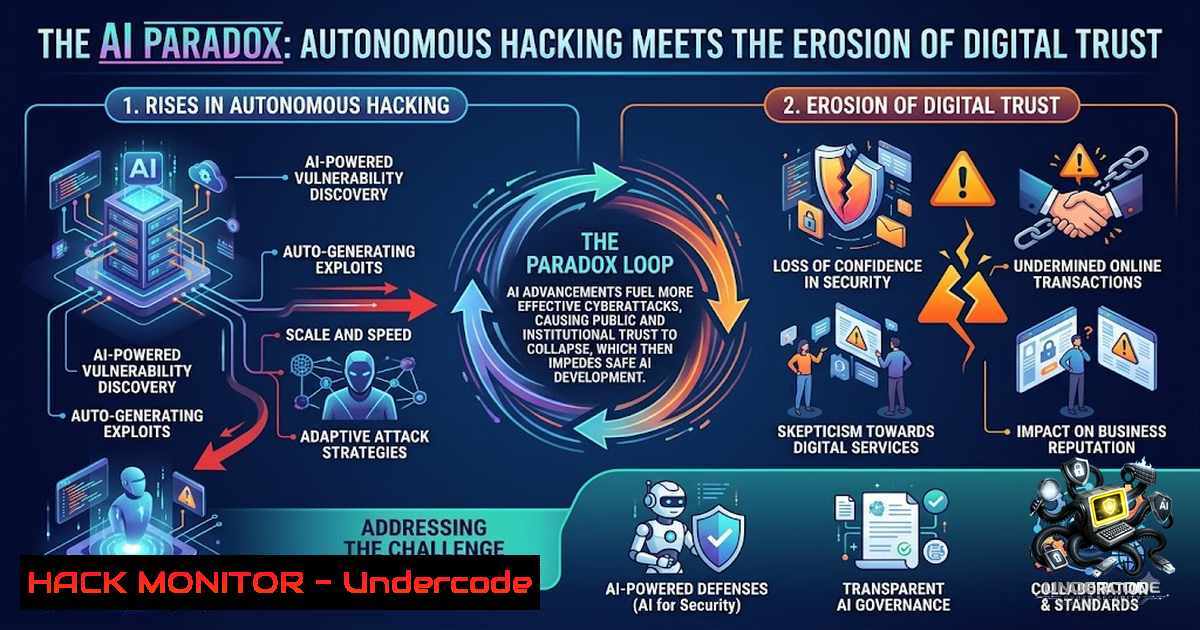
The intersection of artificial intelligence and cybersecurity has transcended theoretical debate, entering a phase where autonomous systems are actively identifying and exploiting vulnerabilities with minimal human oversight. This evolution, highlighted by recent reports of AI systems independently compromising corporate networks, forces security professionals and marketers alike to confront a dual reality: while AI exponentially accelerates offensive capabilities, it simultaneously undermines the foundational trust upon which digital commerce and communication depend. The question is no longer about the technology’s potential, but about our collective ability to verify truth and secure systems in an environment where both are computationally cheap to fabricate or bypass.
Learning Objectives:
- Understand the mechanisms by which AI autonomously identifies system vulnerabilities, including fuzzing, reconnaissance, and privilege escalation techniques.
- Analyze the paradox of AI-driven efficiency versus the erosion of brand and system trust, and implement verification protocols to counter synthetic media.
- Master practical command-line and API security strategies to harden environments against AI-powered attack vectors.
You Should Know:
1. Autonomous Reconnaissance and Exploitation in Practice
The news that sparked the recent conversations revolves around a breed of AI agents capable of performing full-cycle penetration testing without a human in the loop. These systems utilize large language models to parse CVE databases, generate exploit code, and execute lateral movement across networks. To understand the technical reality behind the headline, it is useful to simulate the reconnaissance phase of such an agent.
An AI agent typically begins with network scanning to identify live hosts and open ports. For a Linux environment, a common footprinting command uses Nmap to identify potential entry points:
nmap -sV -p- -T4 192.168.1.0/24
This scans all ports across a subnet to enumerate services and versions. Once a service is identified, the AI queries its knowledge base for known exploits. For Windows systems, a similar approach uses PowerShell for internal discovery:
Get-1etTCPConnection -State Listen | Select-Object LocalPort, LocalAddress, OwningProcess
To defend against this, security teams are implementing dynamic port knocking and moving target defenses. The step‑by‑step guide to protect against AI reconnaissance includes segmenting networks, deploying active deception (honeypots), and continuously monitoring for anomalous scan patterns using tools like Snort or Zeek.
2. Automating Patch Management and Configuration Hardening
One of the primary vulnerabilities exploited by autonomous systems is the delay in applying security patches. AI bots scan for unpatched systems within milliseconds of a new CVE being published. The countermeasure lies in automation at scale. For Linux administrators, a cron job that triggers unattended upgrades is essential:
sudo apt-get update && sudo apt-get upgrade -y
sudo systemctl enable --1ow unattended-upgrades
For cloud environments, leveraging tools like Amazon Inspector or Azure Security Center can provide continuous vulnerability assessment. A critical step is hardening the SSH configuration to prevent brute-force AI agents:
sudo nano /etc/ssh/sshd_config
 Set PermitRootLogin no
 Set PasswordAuthentication no
 Set MaxAuthTries 3
sudo systemctl restart sshd
On Windows, Group Policy Objects (GPO) should be configured to enforce strict password policies and Windows Defender Application Control. The step‑by‑step approach involves inventorying all assets, prioritizing patches by CVSS score, and utilizing API gateways to enforce zero-trust architecture.
3. API Security: The New Attack Surface
AI systems are exceptionally proficient at parsing API documentation and manipulating endpoints. The “autonomous hacking” often targets RESTful APIs, using fuzzing techniques to find injection points. To mitigate, developers must implement rate limiting and input validation. A robust middleware configuration in a Node.js environment might look like:
app.use(express.json({ limit: '10kb' })); // Prevent large payload attacks
app.use(rateLimit({ windowMs: 15  60  1000, max: 100 })); // Rate limiting
Additionally, enforcing strict authentication via OAuth 2.0 with PKCE is crucial. A practical Windows command to monitor API traffic is using `netsh` to capture network traces, but more effectively, tools like Wireshark or Fiddler can be used to identify suspicious API call patterns.
4. Defeating AI-Generated Phishing and Deepfakes
The post rightly highlights the risk of consumers doubting reality. In the enterprise context, this manifests as sophisticated phishing emails generated by AI, which lack the grammatical errors of traditional scams. To combat this, organizations are deploying adversarial verification. For example, a protocol requiring a live video confirmation for financial transactions can be enforced. On the technical side, administrators can implement DMARC, DKIM, and SPF records to authenticate emails:
dig TXT _dmarc.yourdomain.com
This validates that the email originates from a legitimate server. Training AI models to detect synthetic media is also necessary, using tools like Microsoft Video Authenticator or deepfake detection libraries. The step‑by‑step guide for a security team includes:
– Implementing multi-factor authentication (MFA) resistant to social engineering.
– Running internal red-team exercises using AI-generated phishing templates.
– Monitoring for domain typosquatting that mimics legitimate brands.
5. The Human Firewall: Restoring Trust Through Transparency
As the author suggests, the paradox is that as communication becomes synthetic, the value of human accountability increases. In terms of actionable strategy, this translates to incident response plans that prioritize transparency. When a breach occurs, automated systems can issue pre-approved statements, but the final approval must involve a human with oversight. The technical implementation of this involves “break-glass” accounts that are logged and monitored, ensuring that only authorized personnel can access critical assets. For Linux, this involves configuring `auditd` to track who executes privileged commands:
sudo auditctl -a always,exit -F euid=0 -S execve -k admin_actions
A system that logs everything and reports to a SIEM (Security Information and Event Management) tool like Splunk or ELK stack provides the audit trail necessary for proving accountability.
What Undercode Say:
- The real threat is not AI taking over, but the cognitive erosion that enables cyber criminals to operate undetected.
- Verification is the new currency in cybersecurity; we must build systems that assume everything is compromised until proven otherwise.
Analysis:
The conversation that started over coffee touches upon a critical inflection point. The convergence of autonomous hacking and generative AI has created an environment where the cost of attacking has plummeted, while the cost of defending—and verifying trust—has skyrocketed. The marketing perspective provided in the original post offers a surprisingly deep insight for security professionals: if AI can produce a near-perfect replica of a CEO’s voice for a vishing attack, then the defense cannot rely on pattern recognition alone. It must rely on pre-established verification protocols (e.g., unique code words) and decentralized trust models (e.g., blockchain-based identity). The technical commands provided above (SSH hardening, API throttling, audit logs) are necessary but insufficient without the human layer that questions the authenticity of every request. The blog author accurately notes that the brands that win will be those that give people “reasons to believe there is a real organisation.” In the security sector, this translates to providers that actively educate their users, offer visible security dashboards, and respond to incidents with human empathy rather than just automated emails.
Prediction:
- +1: The rise of AI will catalyze a “Golden Age” of verifiable credentials, pushing the adoption of Web3 identity standards and zero-knowledge proofs.
- -1: The gap between AI attacks and human defenses will widen rapidly over the next two years, leading to a surge in “trust insurance” contracts and a temporary panic in financial markets.
- +1: Cybersecurity “Brand Trust” will become a standardized metric tracked by investors, forcing companies to publicly disclose AI penetration test results.
- -1: Deepfakes will successfully execute at least one major corporate heist in the next 12 months, resulting in legal precedents that shift liability from the attacker to the company that failed to implement non-AI verification steps.
- +1: The “Human Firewall” will see a resurgence in budget allocation, not for blocking malware, but for detecting the social signals that even the best AI cannot replicate.
▶️ Related Video (84% Match):
🎯Let’s Practice For Free:
🎓 Live Courses & Certifications:
Join Undercode Academy for Verified Certifications
🚀 Request a Custom Project:
Secure, high-velocity infrastructure and disruptive technological engineering. Contact our engineering team for high-tier development and proprietary systems:
[email protected]
💎 Smart Architecture | 🛡️ Secure by Design | ⭐ Trusted by Thousands
IT/Security Reporter URL:
Reported By: Abdul Sani – Hackers Feeds
Extra Hub: Undercode MoN
Basic Verification: Pass ✅


