Listen to this Post
Introduction:
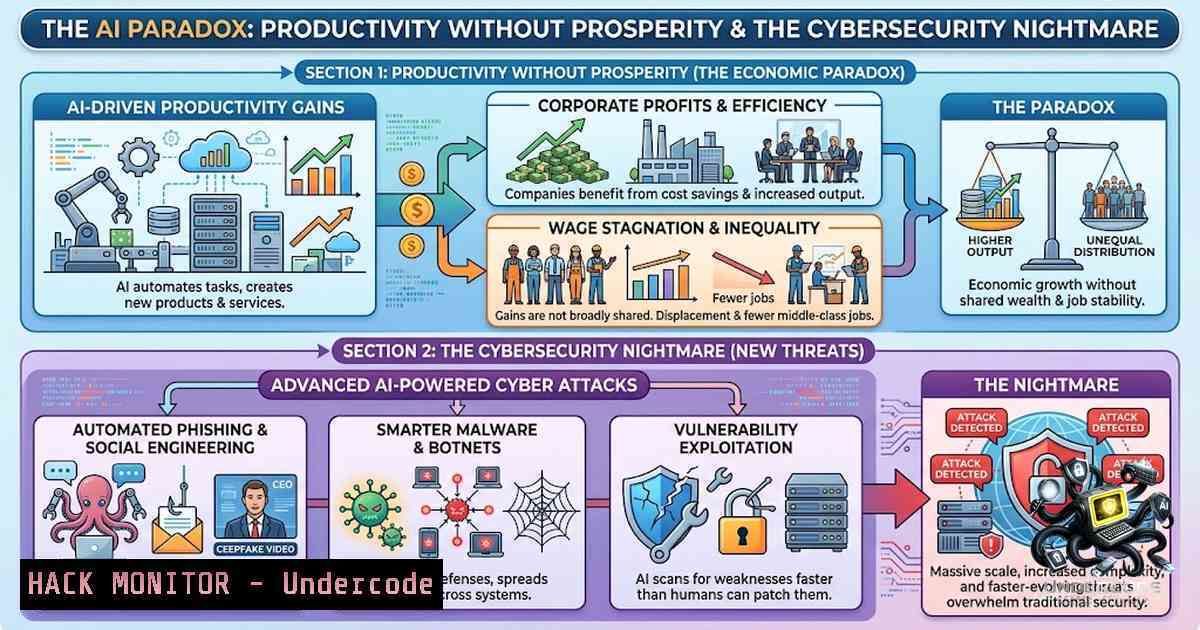
Moody’s Analytics recently dropped a bombshell: the AI scenario with the fastest productivity growth (3.1% annually) also produces the slowest economic growth (just 2.0% GDP) because it triggers a “Job Market Dystopia” – nearly 4 million jobs lost and unemployment spiking to 7%. This isn’t just an economic warning; it’s a cybersecurity canary in the coal mine. As AI models become more powerful, they also become more dangerous – Cisco’s threat team recently found jailbreak success rates as high as 88% on flagship models, while North Korea’s Kimsuky group is now using local LLMs and RAG to automate spear-phishing and cyberattacks. The concentration of AI’s benefits among a few hyperscalers, funded by a worrying “circular financing” loop, creates a systemic risk where economic and digital security are inextricably linked. This article breaks down the technical realities behind these headlines, providing actionable commands, configurations, and training pathways to navigate this new reality.
Learning Objectives:
- Understand the technical mechanics of AI model jailbreaks and how to detect them using open-source tools.
- Learn to identify and mitigate AI-powered attack vectors, including those used by state-sponsored groups like Kimsuky.
- Master the configuration of cloud and API security controls to protect against AI-driven data exfiltration.
- Gain practical skills in deploying local LLMs securely and auditing AI supply chain risks.
You Should Know:
- The Jailbreak Epidemic: How Attackers Bypass AI Guardrails
The recent Cisco multi-turn jailbreak study revealed that even frontier models like GPT-5.4 and Gemini 3 Pro are vulnerable to sophisticated attacks. These aren’t simple “Do Anything Now” prompts; they are multi-turn conversational exploits that gradually erode the model’s safety alignment. A Russian-speaking threat actor was recently observed jailbreaking Claude to turn it into an AI-powered penetration testing platform. This means attackers can now use AI to automate vulnerability discovery, write exploit code, and even plan physical attacks.
Step-by-Step Guide: Detecting and Mitigating Jailbreak Attempts
Step 1: Monitor for Anomalous Prompt Patterns
On Linux, you can use `grep` and `awk` to parse API logs for suspicious prompt sequences. For example, to find prompts that attempt to override system instructions:
sudo grep -E "ignore (previous|all) instructions|system prompt|developer mode" /var/log/ai-api/requests.log | awk '{print $1, $NF}' > jailbreak_attempts.txt
Step 2: Implement a Prompt Injection Detection Layer
Use open-source tools like `LLM-Guard` to scan inputs. Install and run a basic scan:
pip install llm-guard
llm-guard scan --input "Your prompt here" --threshold 0.7
Step 3: Deploy a Capability-Routed Guard
Recent research (arXiv:2608.07892) proposes a “Capability-Routed Guard” that dynamically routes queries based on intent. While a full implementation requires custom coding, you can simulate this with a simple Python script that uses a secondary, smaller model to classify intent before passing to the main LLM.
Step 4: On Windows, Use PowerShell to Monitor for Unusual API Consumption
A sudden spike in token usage often indicates a jailbreak attempt. Run:
Get-WinEvent -LogName "Application" | Where-Object { $<em>.Message -match "token" -and $</em>.TimeCreated -gt (Get-Date).AddHours(-1) } | Measure-Object
- The Kimsuky Playbook: Defending Against AI-Augmented State-Sponsored Attacks
North Korea’s Kimsuky group has been observed establishing a local LLM environment using tools like Ollama, GPT4All, and Msty, combined with Retrieval-Augmented Generation (RAG) to automate cyberattacks. They use these tools to analyze stolen data, automate coding, and create highly convincing spear-phishing documents. This represents a fundamental shift: AI is no longer just a tool for defenders; it’s a force multiplier for attackers.
Step-by-Step Guide: Hardening Against AI-Driven Phishing and Reconnaissance
Step 1: Audit Your External Attack Surface
Attackers use AI to scrape and correlate data from millions of sources. Use `theHarvester` on Linux to see what information is publicly available about your domain:
theHarvester -d yourcompany.com -b all -f output.html
Step 2: Implement DMARC, DKIM, and SPF to Mitigate Spear-Phishing
AI-generated emails are nearly perfect. Configure your email server (e.g., Postfix on Linux) with strict DMARC policies:
 Add to /etc/postfix/main.cf
smtpd_tls_security_level = may
smtpd_tls_auth_only = yes
 Then, add a DMARC record in your DNS: v=DMARC1; p=reject; rua=mailto:[email protected]
Step 3: Deploy Network-Level Anomaly Detection
Kimsuky uses local AI to analyze stolen data, which can lead to data exfiltration. Use `Zeek` (formerly Bro) to monitor for unusual data flows:
sudo zeek -i eth0 /usr/local/zeek/share/zeek/site/local.zeek
 Look for connections to known malicious IPs or unusually large outbound transfers
Step 4: On Windows, Use Sysmon to Log Process Creation
AI-generated malware often uses unusual process chains. Configure Sysmon with a comprehensive config (available from SwiftOnSecurity) and monitor for anomalies:
Sysmon64.exe -accepteula -i sysmon-config.xml
Get-WinEvent -LogName "Microsoft-Windows-Sysmon/Operational" | Where-Object { $<em>.Id -eq 1 -and $</em>.Message -match "powershell|wmic|rundll32" }
- The Circular Financing Trap: Securing the AI Infrastructure Supply Chain
Nvidia’s recent announcements to mobilize up to $500 billion for AI infrastructure, in partnership with Wall Street giants like Goldman Sachs and KKR, have reignited fears of “circular financing”. This is where Nvidia funds customers (e.g., through loans or equity investments) who then use that money to buy Nvidia chips, creating an artificial demand loop. This concentration of financial and technological power creates a single point of failure. If the AI bubble bursts, the resulting economic shock could cripple the very infrastructure that powers modern cybersecurity.
Step-by-Step Guide: Auditing Your AI Supply Chain for Financial and Technical Risk
Step 1: Map Your AI Dependencies
Use `pip` and `npm` to list all AI-related dependencies in your projects. On Linux:
pip list | grep -i "tensorflow|torch|transformers|openai" > ai_deps.txt
npm list --depth=0 | grep -i "ai|ml|tensorflow" >> ai_deps.txt
Step 2: Check for Vulnerable or Outdated Components
Use `safety` or `npm audit` to scan for known vulnerabilities:
safety check -r requirements.txt
npm audit --audit-level=high
Step 3: Evaluate Your Cloud Provider’s Financial Health
Hyperscalers (AWS, Azure, GCP) are projected to spend nearly $690 billion in capex in 2026. A significant portion of this is debt-funded. Ensure your disaster recovery plan includes contingencies for cloud provider instability. Implement a multi-cloud strategy using tools like Terraform:
 terraform/main.tf
provider "aws" {
region = "us-east-1"
}
provider "azurerm" {
features {}
}
 Deploy critical resources to both clouds
Step 4: On Windows, Use PowerShell to Check for Suspicious Financial Data Access
AI models often have access to sensitive financial data. Monitor for unusual access patterns:
Get-EventLog -LogName "Security" -InstanceId 4663 | Where-Object { $<em>.Message -match "OBJECT ACCESS" -and $</em>.TimeGenerated -gt (Get-Date).AddHours(-2) }
- Training and Certification: Building a Cyber-Resilient AI Workforce
The threats are evolving faster than traditional security training can keep up. Fortunately, several organizations now offer specialized AI security courses. The Certified AI Security Professional (CAISP) course, offered through CISA’s NICCS, covers secure AI development techniques, including differential privacy, federated learning, and robust AI model deployment. Other programs, like the Advanced in AI Security Management (AAISM) and NUS’s “Deploying Safe and Secure AI Agents,” provide hands-on training in identifying AI-related vulnerabilities and integrating mitigation strategies.
Step-by-Step Guide: Getting Started with AI Security Training
Step 1: Identify Your Skill Gaps
Take a free assessment like the OWASP Top 10 for LLM Applications to understand your current knowledge level.
Step 2: Enroll in a Foundational Course
Start with the CAISP course or similar. Many are available online and some are even subsidized by government training grants.
Step 3: Set Up a Local Lab Environment
Use a virtual machine (e.g., VirtualBox) to safely practice attacking and defending AI models. Install a vulnerable AI model (like a deliberately misconfigured LLaMA) and practice jailbreaking it, then hardening it.
Step 4: On Linux, Use `docker` to Isolate Your Lab:
docker pull ollama/ollama
docker run -d -v ollama:/root/.ollama -p 11434:11434 --1ame ollama-lab ollama/ollama
docker exec -it ollama-lab ollama run llama2
 Now practice injecting prompts and observing the model's behavior
Step 5: Document Your Findings
Keep a detailed log of your experiments, including the prompts used, the model’s responses, and the mitigation techniques that worked. This log can serve as a valuable reference for your team.
- The K-Shaped Future: Who Wins, Who Loses, and Who Gets Hacked?
Moody’s predicts a “K-shaped” global economy, where the AI boom pushes some sectors ahead while leaving others behind. This disparity will also manifest in cybersecurity. Organizations with the resources to invest in AI-driven defense will thrive, while those without will become prime targets for AI-powered attacks. The “Job Market Dystopia” scenario, with its 7% unemployment, will create a pool of desperate, highly skilled individuals who may turn to cybercrime. The combination of economic desperation and accessible AI hacking tools (like those used by Kimsuky) is a recipe for a cybersecurity crisis.
What Undercode Say:
- Key Takeaway 1: Productivity gains from AI are meaningless if they aren’t distributed equitably. Economic instability breeds cybercrime.
- Key Takeaway 2: The technical community must focus on “secure by design” principles for AI, not just reactive patching.
Analysis:
The convergence of economic inequality, AI-powered cyberattacks, and financial instability in the AI sector creates a perfect storm. Defenders can no longer afford to view cybersecurity as a purely technical problem. It is now deeply intertwined with economics, geopolitics, and social policy. The tools and commands provided above are a starting point, but they must be part of a broader strategy that includes workforce development, supply chain auditing, and a commitment to ethical AI deployment. The question “is it worth it?” that Jonathan Sheer poses is not just about GDP; it’s about the kind of digital world we are building. If we don’t address the distribution of AI’s benefits, we will find ourselves fighting a losing battle against an endless wave of AI-augmented adversaries.
Prediction:
- -1: The “Job Market Dystopia” scenario, combined with the democratization of AI hacking tools, will lead to a significant increase in cybercrime and ransomware attacks by 2027. The pool of potential attackers will expand dramatically as skilled workers are displaced.
- -1: The circular financing of AI infrastructure will lead to a major correction or “bubble burst” within the next 18-24 months, causing significant disruptions to cloud services and AI model availability, creating a “digital dark age” for companies heavily reliant on a single provider.
- +1: The growing awareness of these risks will accelerate the development and adoption of “responsible AI” frameworks and security standards, leading to a more robust and resilient AI ecosystem in the long term (3-5 years).
- -1: Nation-state actors like North Korea will successfully deploy AI agents capable of autonomous cyberattacks, leading to the first fully AI-driven, large-scale data breach within the next 12 months.
- +1: The demand for AI security professionals will skyrocket, creating new career opportunities and driving innovation in defensive AI technologies, including capability-routed guards and differential privacy.
▶️ Related Video (78% Match):
🎯Let’s Practice For Free:
🎓 Live Courses & Certifications:
Join Undercode Academy for Verified Certifications
🚀 Request a Custom Project:
Secure, high-velocity infrastructure and disruptive technological engineering. Contact our engineering team for high-tier development and proprietary systems:
[email protected]
💎 Smart Architecture | 🛡️ Secure by Design | ⭐ Trusted by Thousands
IT/Security Reporter URL:
Reported By: Jonathan Sheer – Hackers Feeds
Extra Hub: Undercode MoN
Basic Verification: Pass ✅


