Listen to this Post
Introduction:
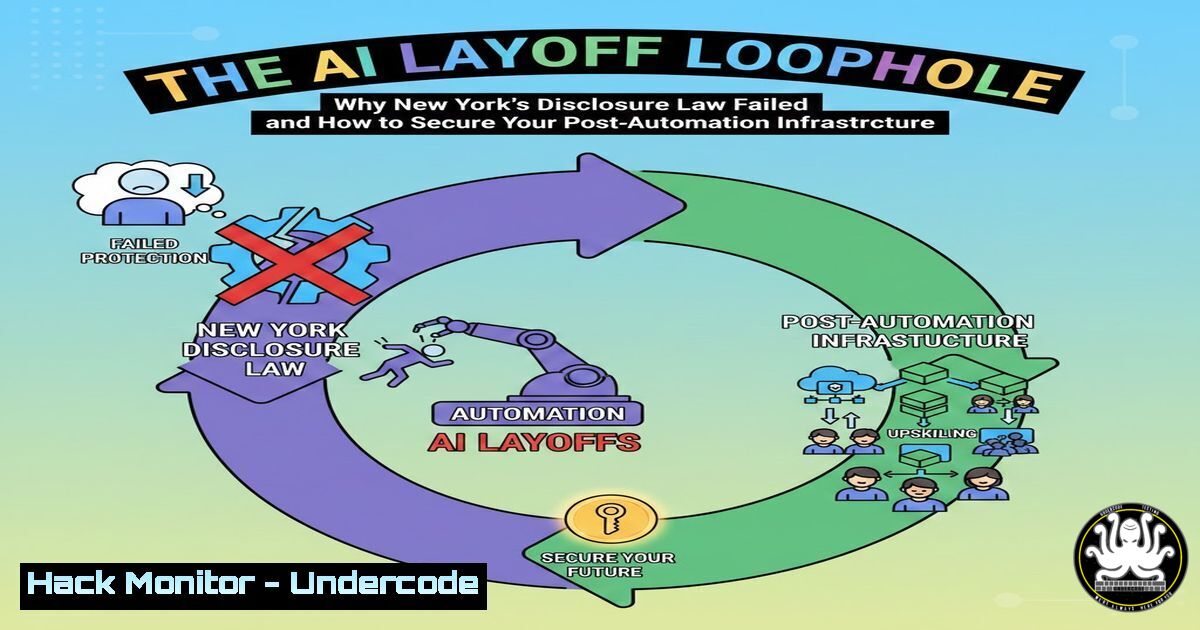
A groundbreaking New York law requiring companies to disclose if AI or automation caused mass layoffs has yielded a startling result: zero admissions. Despite over 160 filings from tech giants like Amazon and Goldman Sachs, none cited technology as the cause, revealing a critical gap between policy, corporate honesty, and the tangible IT transformation happening behind the scenes. This discrepancy forces cybersecurity and IT leaders to proactively secure environments where human roles are silently being replaced by automated agents, API-driven processes, and AI models, creating new attack surfaces.
Learning Objectives:
- Understand the technical indicators of workforce automation that surpass regulatory disclosures.
- Implement security controls for AI-augmented and fully automated IT environments.
- Harden the APIs, cloud infrastructure, and logging systems that become critical when human oversight is reduced.
You Should Know:
1. Identifying Technical Precursors to AI-Driven Layoffs
Before a layoff is announced, IT infrastructure undergoes significant changes. Monitoring these can serve as an early warning system.
Step-by-step guide:
Audit Authentication Logs: Look for a reduction in daily active users (DAU) for specific enterprise applications (e.g., CRM, support ticketing) while overall API call volume to these services remains steady or increases. This signals automation replacing human interaction.
Linux Command (using `journalctl` for auth logs):
journalctl _SYSTEMD_UNIT=sshd.service | grep "Failed password" | wc -l
 Compare counts month-over-month. A drop may indicate fewer human users.
Cloud Audit (AWS CloudTrail Lookup):
SELECT eventSource, eventName, COUNT() as apiCallCount
FROM cloudtrail_logs
WHERE eventTime >= '2024-01-01'
GROUP BY eventSource, eventName
ORDER BY apiCallCount DESC;
-- Identify APIs with surging call volumes.
Monitor Service Account Proliferation: A surge in service account creation, especially those with high-privilege access to data pipelines or customer systems, is a key indicator.
PowerShell Command (Azure AD / Microsoft Entra ID):
Get-MgServicePrincipal -All | Where-Object {$_.CreatedDateTime -gt (Get-Date).AddDays(-90)} | Select-Object DisplayName, AppId, CreatedDateTime
2. Securing the API-First Backbone of Automation
AI replacements often interact via APIs. These become the new perimeter.
Step-by-step guide:
Implement Strict API Inventory and Schema Enforcement: Use tools like `SWAGGER` or `OpenAPI` to define strict schemas. Enforce validation at the gateway.
Deploy an API Security Gateway: Configure rate limiting, anomaly detection, and data loss prevention (DLP) for all internal and external APIs.
Example Kubernetes Ingress Annotation for Rate Limiting (NGINX):
apiVersion: networking.k8s.io/v1
kind: Ingress
metadata:
name: automation-api
annotations:
nginx.ingress.kubernetes.io/limit-rpm: "1000"
nginx.ingress.kubernetes.io/limit-rps: "100"
Require Mutual TLS (mTLS) for Service-to-Service Communication: This is critical for preventing machine identity spoofing in automated workflows.
3. Hardening Cloud Infrastructure for Reduced Human Oversight
With fewer sysadmins, misconfigurations can spiral. Infrastructure as Code (IaC) and automated compliance become essential.
Step-by-step guide:
Shift to Immutable Infrastructure: Use Terraform or AWS CloudFormation to define all resources. Any change requires a code update.
Basic Terraform Security Rule (using `tfsec` or Checkov):
 In your Terraform configuration for an S3 bucket
resource "aws_s3_bucket" "data_lake" {
bucket = "automation-data-lake"
acl = "private"  Ensures no public read access
}
Scan with: `checkov -d /path/to/terraform/code`
Implement Automated Cloud Security Posture Management (CSPM): Tools like AWS Security Hub, Azure Defender, or Wiz should be configured with automated remediation runbooks for common misconfigurations (e.g., public S3 buckets, unencrypted databases).
- Supercharging SIEM for AI Agent and Bot Detection
Your Security Information and Event Management (SIEM) must now differentiate between malicious bots and legitimate automation.
Step-by-step guide:
Create Baselining Queries: Establish normal behavioral baselines for service accounts and API endpoints.
Splunk SPL Query Example:
index=api_logs source=/api_gateway/
| stats count by client_id, http_user_agent, status_code
| where count > 1000 AND http_user_agent="PythonBot"
| eval requests_per_second=count/3600
| where requests_per_second > 10
Integrate UEBA for Service Accounts: User and Entity Behavior Analytics (UEBA) platforms must be trained on machine identities to flag anomalous data access patterns or geographic hops impossible for a cloud-based agent.
5. Mitigating Insider Threat Risks During AI Transition
The period of workforce reduction and role redefinition is high-risk. Privileged access must be meticulously managed.
Step-by-step guide:
Conduct Immediate Privileged Access Reviews (PAM): Use the principle of least privilege. Automate the deprovisioning process.
Linux Command to Audit Sudoers:
sudo -l  For current user
grep -r "NOPASSWD" /etc/sudoers.d/  Find accounts with passwordless sudo
Implement Just-In-Time (JIT) Access: Use a PAM solution like CyberArk or Azure PIM to grant elevated access only for approved, time-bound sessions.
Deploy Data Loss Prevention (DLP) with Context-Aware Policies: Update DLP rules to monitor for large data exports by employees in roles slated for or adjacent to automation, especially in sales, HR, and R&D.
What Undercode Say:
- Key Takeaway 1: Regulatory disclosure laws are easily gamed, but IT telemetry doesn’t lie. Security teams must become adept at forensic business intelligence—using logs, API metrics, and account lifecycles—to understand the real-world impact of automation on their organization’s risk profile.
- Key Takeaway 2: The silent shift to an AI-augmented workforce doesn’t eliminate risk; it redirects it. The attack surface transforms from user endpoints to API gateways, cloud control planes, and machine identities, requiring a fundamental re-prioritization of security controls and budgets.
The failure of New York’s law is a canonical case of policy meeting PR reality. For cybersecurity professionals, it provides a crucial, unspoken mandate: to become the organizational truth-tellers. By instrumenting the infrastructure, you can see the automation that companies won’t admit to. Your role evolves from defender to essential strategist, ensuring that the pursuit of efficiency through AI doesn’t blindly create a brittle, over-automated, and vulnerable system. The technical controls you implement—from API security to immutable infrastructure—are no longer just IT concerns; they are the foundational safeguards for the future of work.
Prediction:
Within two years, we will see the first major data breach directly attributed to an over-automated, under-secured AI workflow, where a compromised machine identity or an exploited API dependency led to massive data exfiltration. This will trigger not softer disclosure laws, but stringent, technically-defined regulations akin to SOX compliance, mandating specific security controls for any “critical automated agent.” Cybersecurity frameworks will formally incorporate “Automation Risk Management” modules, and CISOs will be required to sign off on the security posture of any AI system that replaces human decision-making in business-critical processes.
▶️ Related Video (74% Match):
🎯Let’s Practice For Free:
IT/Security Reporter URL:
Reported By: Bobcarver Ai – Hackers Feeds
Extra Hub: Undercode MoN
Basic Verification: Pass ✅


