Listen to this Post
Introduction:
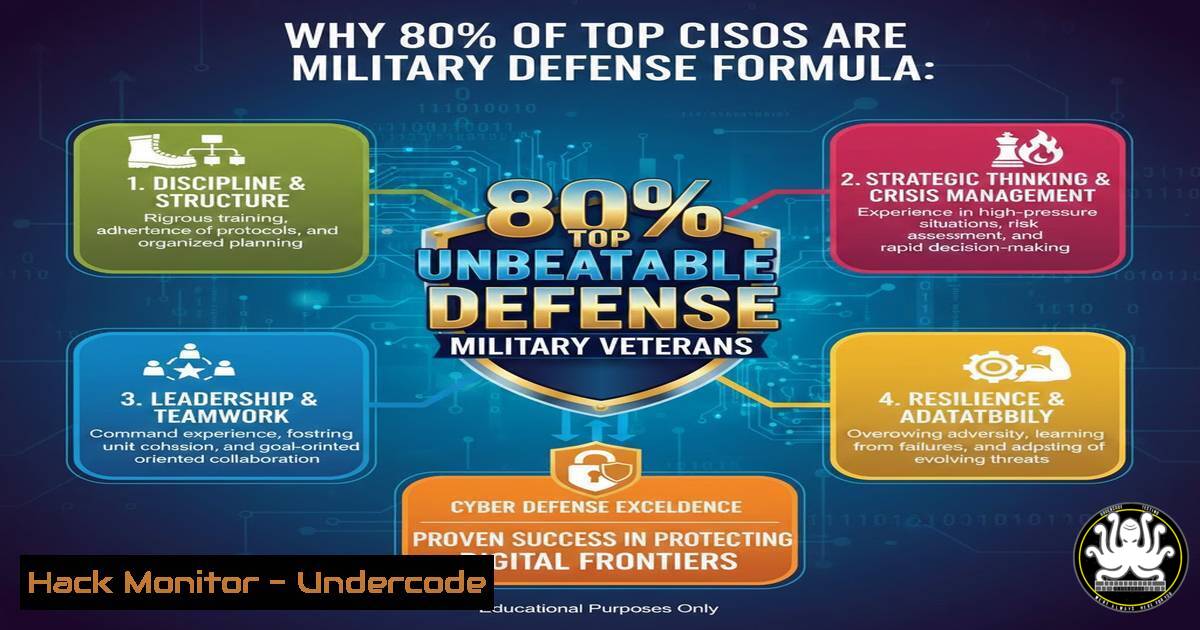
In the high-stakes world of cybersecurity, a surprising pattern emerges: a disproportionate number of elite Chief Information Security Officers (CISOs) possess military backgrounds. This is no coincidence. The modern cybersecurity battlefield requires the same operational rigor, crisis leadership, and strategic foresight honed in military service. This article deconstructs the military mindset and translates its core principles into actionable, technical security protocols for enterprise defense.
Learning Objectives:
- Decode the military-derived disciplines that forge superior security leadership.
- Implement tactical, procedure-driven security operations mimicking military standards.
- Develop and test a crisis response playbook capable of withstanding real-world cyber assaults.
You Should Know:
- Operational Discipline: From Guard Duty to Continuous Log Monitoring
Military operations run on unwavering adherence to procedure. In cybersecurity, this translates to automated, relentless vigilance over your digital perimeter and internal systems.
Step‑by‑step guide:
The core activity is establishing and auditing routine security checks. This isn’t manual; it’s automated enforcement.
Linux (Using `cron` and `logwatch`):
First, ensure critical authentication logs are monitored. Schedule a daily summary.
 Install logwatch for comprehensive log analysis
sudo apt-get install logwatch
 Configure logwatch to analyze auth.log and send daily reports
sudo logwatch --detail High --service sshd --service pam --range Yesterday --output mail --mailto [email protected]
 Add to crontab for daily execution
echo "0 7    /usr/sbin/logwatch --detail High" | sudo crontab -
Windows (Using PowerShell Scheduled Tasks):
Automate the review of failed login attempts and new event log errors daily.
 Create a PowerShell script (C:\Scripts\Daily-Security-Audit.ps1)
$Events = Get-WinEvent -FilterHashtable @{LogName='Security'; ID=4625; StartTime=(Get-Date).AddDays(-1)} -ErrorAction SilentlyContinue
$EventCount = $Events.Count
$Output = "Failed login attempts in last 24 hours: $EventCount`n"
$Output | Out-File "C:\Audit\Security_Report_$(Get-Date -Format yyyyMMdd).txt"
 Create a scheduled task to run this script daily at 8 AM
$Action = New-ScheduledTaskAction -Execute 'PowerShell.exe' -Argument '-File C:\Scripts\Daily-Security-Audit.ps1'
$Trigger = New-ScheduledTaskTrigger -Daily -At 8am
Register-ScheduledTask -TaskName "DailySecurityAudit" -Action $Action -Trigger $Trigger -User "SYSTEM"
- Crisis Management: Executing the Incident Response (IR) Playbook
When a breach occurs, panic is the enemy. A military-style Incident Response plan is your drill manual. It must be practiced, known by all, and executable under pressure.
Step‑by‑step guide:
Activate your IR plan the moment a critical alert—like a widespread ransomware signature—is detected.
- Identification & Declaration: Use your SIEM (e.g., Splunk, Elastic SIEM) to scope the alert. Confirm the incident. Immediately declare an IR Level 1, notifying the CISO and IR team via a pre-established, secure channel (e.g., Signal group, PagerDuty).
- Containment (Short-Term): Isolate affected network segments. On a Linux server suspected of compromise:
Isolate server by adding a restrictive firewall rule (using iptables as an example)
sudo iptables -A INPUT -s 0.0.0.0/0 -j DROP
sudo iptables -A OUTPUT -d 0.0.0.0/0 -j DROP
Capture running processes and network connections for forensics
ps aux > /var/forensics/process_snapshot_$(date +%s).txt
netstat -tunap > /var/forensics/network_snapshot_$(date +%s).txt
- Eradication & Recovery: Identify and remove the malware. Restore systems from known-clean, hardened backups. This step validates the absolute necessity of immutable, regularly tested backups.
- Post-Incident Review: Conduct a mandatory “lessons learned” session. Document every action, decision, and timeline gap. Update the playbook accordingly.
-
Strategic Vision & Threat Modeling: Thinking Like the Adversary
Military strategy involves anticipating enemy moves. In cyber, this is proactive threat modeling using frameworks like STRIDE or PASTA.
Step‑by‑step guide:
Conduct a basic threat modeling session for a new web application.
- Diagram: Map the application’s data flow (e.g., User -> Load Balancer -> Web Server -> Database).
2. Identify Threats: Apply STRIDE categories:
Spoofing: Can an attacker fake their identity? Enforce MFA (e.g., using Duo or Okta APIs).
Tampering: Can they modify data in transit? Enforce TLS 1.3 only.
Repudiation: Ensure all auth and admin actions are logged to a centralized, immutable log store.
3. Mitigate: For each threat, define a countermeasure. For “Tampering,” implement file integrity monitoring (FIM):
 Linux: Use AIDE (Advanced Intrusion Detection Environment)
sudo apt-get install aide
sudo aideinit
sudo mv /var/lib/aide/aide.db.new /var/lib/aide/aide.db
 Run a daily check and mail results
sudo aide --check | mail -s "AIDE Daily Report for $(hostname)" [email protected]
- Leadership Under Pressure: Stress-Testing Your Team with Tabletop Exercises
Leadership is tested at 3 AM. Simulate this pressure with no-notice, inject-based tabletop exercises.
Step‑by‑step guide:
Run a quarterly “Midnight Meltdown” drill.
- Scenario: At an off-hours time, send the inject: “The SIEM shows anomalous lateral movement from the HR department’s subnet. Preliminary indicators suggest Mimikatz activity. The CFO’s account just logged in from a foreign IP.”
- Execution: Observe the team’s use of communication channels, access to playbooks, and decision-making hierarchy. Do they know how to quickly disable a compromised account in Active Directory?
Windows/AD: Immediate account disable and session termination
Disable-ADAccount -Identity "CFO_Username"
Force logoff any active sessions (requires RSAT)
Invoke-RDUserLogoff -HostServer "RDGW-Server" -UnifiedSessionID <SessionID>
- Debrief: Focus on communication breakdowns and procedural gaps, not technical blame.
-
Compliance as a Fortification: Building Robust PSSI with ISO 27001 & DORA
Military standards exist for a reason. Frameworks like ISO 27001 and the Digital Operational Resilience Act (DORA) provide the blueprint for a fortified Security Policy (PSSI).
Step‑by‑step guide:
Operationalize a control from Annex A of ISO 27001: A.12.6.1 (Management of Technical Vulnerabilities).
- Policy: Mandate that all systems are scanned for vulnerabilities weekly.
- Procedure: Use a scanner like OpenVAS or Nessus. Automate scanning and reporting.
Example using OpenVAS CLI (gvm-cli) to trigger a scan and generate a report
gvm-cli --gmp-username admin --gmp-password 'password' socket --socketpath /run/gvmd/gvmd.sock --xml "<create_task><name>Weekly_Scan</name><config id='daba56c8-73ec-11df-a475-002264764cea'/><target id='target-id-here'/></create_task>"
- Audit: Maintain a register of all scans, findings, and remediation timelines. This is direct evidence for auditors and a living map of your attack surface.
What Undercode Say:
- Mindset Over Toolset: The ultimate weapon isn’t a specific firewall or AI tool; it’s the ingrained culture of discipline, preparedness, and strategic defense-in-depth that military experience instills. Tools are merely force multipliers for this mindset.
- Procedures Are Survival: In a crisis, you don’t rise to the occasion; you default to your level of training. Documented, practiced procedures are the difference between a contained incident and a catastrophic breach.
The correlation between military veterans and cybersecurity excellence is a lesson for the entire industry. It underscores that while technical skills are teachable, the foundational attributes of resilience, leadership, and systematic operation are forged in high-consequence environments. Hiring or cultivating this mindset may be the most strategic security investment an organization can make.
Prediction:
As cyber threats become more sophisticated and pervasive—fueled by AI-powered attacks and geopolitical cyber warfare—the demand for leaders with this military-grade resilience will skyrocket. We will see a formalization of this pathway, with more “cyber veteran” training programs and a conscious effort by corporations to instill military-style operational security (OPSEC) disciplines across their entire IT workforce. The future CISO will be less of a pure technologist and more of a battle-tested commander, orchestrating cyber defenses across a complex, hybrid battlefield.
▶️ Related Video (82% Match):
🎯Let’s Practice For Free:
IT/Security Reporter URL:
Reported By: Romainfessard Cybersaezcuritaez – Hackers Feeds
Extra Hub: Undercode MoN
Basic Verification: Pass ✅


