Listen to this Post
Introduction:
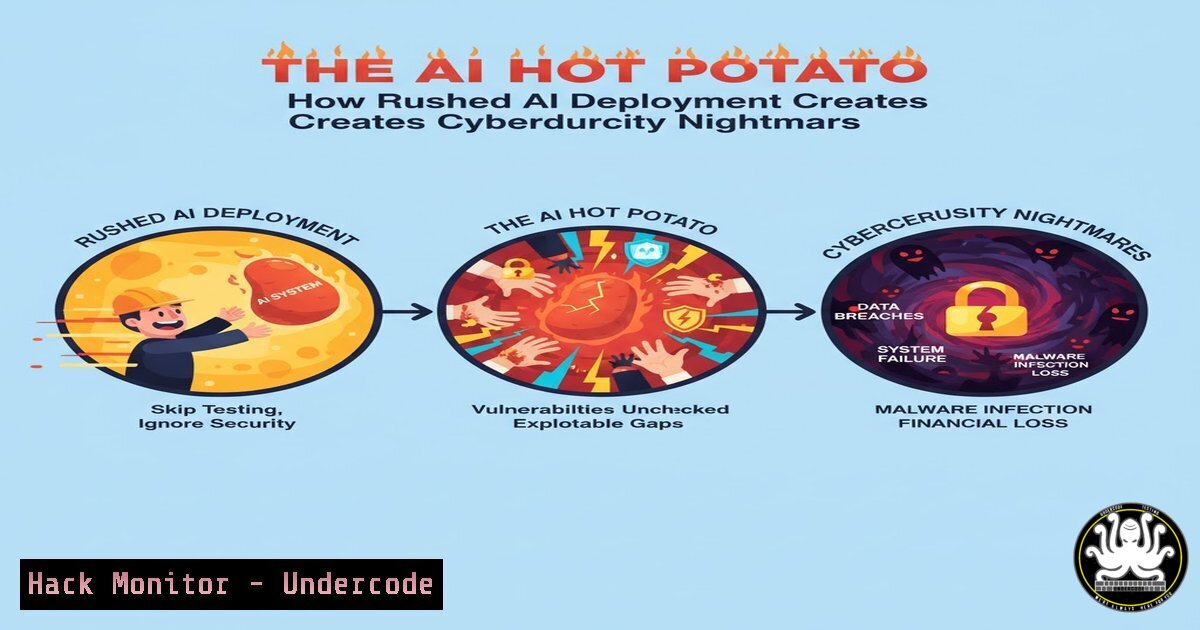
The frantic race to adopt artificial intelligence mirrors a high-stakes game of hot potato, where the perceived risk of being left behind outweighs the genuine risk of deploying immature technology. This pressure-cooker environment is creating a sprawling new attack surface ripe for exploitation. Cybersecurity is no longer a secondary consideration but the foundational element that determines whether an AI initiative becomes a strategic advantage or a catastrophic failure.
Learning Objectives:
- Identify and mitigate critical data poisoning and model evasion vulnerabilities inherent in rushed AI systems.
- Implement secure MLOps pipelines to enforce governance, traceability, and integrity from data collection to model deployment.
- Harden AI API endpoints and cloud infrastructure against novel attack vectors targeting machine learning models.
You Should Know:
1. Securing Your AI Data Pipeline
The integrity of your AI model is entirely dependent on the integrity of its training data. Adversarial data poisoning is a primary attack vector.
Verified Commands & Tutorials:
` Linux: Generate SHA-256 checksums for training data files`
`find ./training_data -type f -exec sha256sum {} \; > data_manifest.sha256`
` Use this to verify integrity before model training`
`sha256sum -c data_manifest.sha256`
` Python: Basic data sanity check with Pandas`
`import pandas as pd`
`from sklearn.model_selection import train_test_split`
` Load data`
`df = pd.read_csv(‘sensitive_training_data.csv’)`
` Check for anomalous labels or outliers that could indicate poisoning`
`print(df[‘label’].value_counts())`
`print(df.describe())`
` Split data, ensuring stratification for critical classes`
`X_train, X_test, y_train, y_test = train_test_split(df[‘feature’], df[‘label’], test_size=0.2, stratify=df[‘label’], random_state=42)`
Step-by-Step Guide:
This process establishes a baseline for data integrity. The Linux command generates a manifest of file checksums, allowing you to detect any unauthorized modifications to your training dataset before retraining. The Python script performs essential sanity checks, looking for unexpected distributions in labels or feature sets that could signify a data poisoning attack. Always split your data after these checks and use stratification to preserve the distribution of critical labels, preventing an attacker from skewing the model by manipulating a small, key subset of the data.
2. Hardening Model Serving Endpoints (API Security)
Exposed AI model APIs are low-hanging fruit for attackers. Standard API security is not enough; you must also protect against model-specific attacks like evasion and extraction.
Verified Commands & Tutorials:
` Kubernetes: Apply security context to your model serving pod`
`apiVersion: v1`
`kind: Pod`
`metadata:`
` name: ml-model-pod`
`spec:`
` containers:`
` – name: model-server`
` image: my-company/ml-model:v1.2`
` securityContext:`
` runAsNonRoot: true`
` runAsUser: 1000`
` allowPrivilegeEscalation: false`
` capabilities:`
` drop:`
` – ALL`
` Web Application Firewall (WAF) Rule to throttle excessive requests (Pseudocode)`
` Rule: If source_ip requests > 1000/minute to /api/v1/predict, then block for 1 hour.`
` Using Python Flask with rate-limiting`
`from flask import Flask`
`from flask_limiter import Limiter`
`from flask_limiter.util import get_remote_address`
`app = Flask(__name__)`
`limiter = Limiter(get_remote_address, app=app, default_limits[“200 per day”, “50 per hour”])`
`@app.route(‘/api/v1/predict’, methods=[‘POST’])`
`@limiter.limit(“10/minute”)`
`def predict():`
` Model prediction logic here`
` return model_output`
Step-by-Step Guide:
Deploying your model as a container requires a hardened configuration. The Kubernetes manifest demonstrates running the container as a non-root user and dropping all Linux capabilities, drastically reducing the impact of a container breakout. At the application layer, implement strict rate limiting on your prediction endpoints. This not only prevents denial-of-wallet attacks (running up your cloud bill) but also hinders model extraction attacks, where an adversary makes millions of queries to steal your intellectual property by reconstructing the model.
- Auditing Model Access and Training Pipelines (MLOps Security)
Unauthorized access to model artifacts or training pipelines can lead to IP theft or backdoored models. Strict access control and auditing are non-negotiable.
Verified Commands & Tutorials:
` AWS S3: Enable logging and encryption for your model artifact bucket`
`aws s3api put-bucket-logging –bucket my-ml-models –bucket-logging-status file://logging.json`
`aws s3api put-bucket-encryption –bucket my-ml-models –server-side-encryption-configuration file://encryption.json`
` Azure: Use Azure CLI to assign minimal role-based access (RBAC)`
`az role assignment create –assignee
` Linux: Audit who accesses model files using auditd`
`sudo auditctl -w /opt/ml/models/ -p war -k access_ml_models`
` Search the audit logs`
`ausearch -k access_ml_models`
Step-by-Step Guide:
In the cloud, enable comprehensive logging and default encryption on any bucket storing model weights, training scripts, or datasets. The AWS CLI commands above configure this for an S3 bucket. Principle of least privilege is critical; use Azure CLI or AWS IAM to grant users and services only the permissions they absolutely need. On a filesystem level, as shown with the Linux `auditd` commands, you can monitor and log all access to sensitive model directories, creating an immutable trail for forensic analysis in case of a breach.
4. Implementing Adversarial Input Detection
Even a perfectly trained model can be fooled by specially crafted “adversarial examples.” Deploying detection mechanisms at the inference stage is a key mitigation.
Verified Commands & Tutorials:
` Python: Using the Adversarial Robustness Toolbox (ART) to detect outliers`
`from art.estimators.classification import SklearnClassifier`
`from art.defences.detector.evasion import BinaryInputDetector`
`import numpy as np`
` Wrap your model`
`classifier = SklearnClassifier(model=my_trained_model)`
` Create and train the detector on a sample of known good data`
`detector = BinaryInputDetector(classifier)`
`detector.fit(X_train, y_train)`
` For each new prediction, check for adversarial input`
`new_predictions = classifier.predict(new_data)`
`is_adversarial = detector.detect(new_data)`
`if is_adversarial:`
` print(“ALERT: Potential adversarial input detected. Blocking request.”)`
` Trigger security incident response`
Step-by-Step Guide:
Libraries like IBM’s Adversarial Robustness Toolbox (ART) provide production-ready detectors. This code snippet shows how to wrap your classifier with a detector that is first trained on your clean, trusted data. For every incoming prediction request, the input is screened against this baseline. If the input is flagged as an outlier or adversarial, the request can be blocked, and a security alert can be triggered, preventing an attacker from manipulating your model’s output.
5. Vulnerability Scanning for AI/ML Dependencies
Your AI model’s security is only as strong as the weakest link in its software supply chain, which includes frameworks like TensorFlow, PyTorch, and their countless dependencies.
Verified Commands & Tutorials:
` Using Trivy to scan a container image for vulnerabilities`
`trivy image my-company/ml-model-service:latest`
` Scan specifically for misconfigurations`
`trivy config ./my-kubernetes-manifests/`
` Using Grype to scan a directory of Python requirements`
`grype dir:/path/to/your/ml-project –scope all-layers`
` Linux: Piping scan results to a file for CI/CD integration`
`trivy image –format json –output trivy-report.json my-company/ml-model-service:latest`
` Fail the build if critical vulnerabilities are found`
`trivy image –exit-code 1 –severity CRITICAL,HIGH my-company/ml-model-service:latest`
Step-by-Step Guide:
Integrate Software Composition Analysis (SCA) tools like Trivy or Grype directly into your CI/CD pipeline. The commands above demonstrate how to scan your final container image and your configuration files for known CVEs. The most critical step is to set a policy that fails the build automatically if vulnerabilities of “CRITICAL” or “HIGH” severity are discovered. This prevents a vulnerable model from ever reaching a production environment.
6. Penetration Testing Model Inference APIs
Your AI API is a web endpoint and must be tested with the same rigor as any other critical web service. Standard pen-testing tools can be adapted for this purpose.
Verified Commands & Tutorials:
` Using OWASP ZAP to baseline a model API`
`zap-baseline.py -t https://api.mycompany.com/v1/predict -I`
` Using curl to fuzz the prediction endpoint with malformed inputs`
`curl -X POST https://api.mycompany.com/v1/predict -H “Content-Type: application/json” -d ‘{“input”: “AAAAAA….(long string)….”}’`
`curl -X POST https://api.mycompany.com/v1/predict -H “Content-Type: application/json” -d ‘{“input”: {“$gt”: “”}}’ NoSQL Injection test`
` Using ffuf for endpoint discovery and fuzzing`
`ffuf -w /usr/share/wordlists/dirb/common.txt -u https://api.mycompany.com/FUZZ -H “Authorization: Bearer
Step-by-Step Guide:
Proactively attack your own systems before a malicious actor does. Start with OWASP ZAP for an automated baseline scan. Then, use tools like `curl` to manually fuzz your prediction endpoints with malformed, oversized, or injection-style payloads to see how the model server responds. Use a fuzzer like `ffuf` to discover hidden or forgotten API endpoints that may lack proper security controls. The goal is to find and fix logical flaws, input handling errors, and information disclosure issues.
What Undercode Say:
- Foundation is Everything: Rushing AI without a secure data and MLOps foundation is building a castle on sand. The first and most costly breaches will be from poisoned data and exploited APIs, not sophisticated algorithmic attacks.
- Governance is Not Bureaucracy: The “governance” that Jeff Winter mentions is, in cybersecurity terms, the enforcement of secure development lifecycles, strict access controls, and continuous monitoring for AI systems. Without it, you have no control and no accountability.
The analysis is clear: the “AI hot potato” creates a culture of negligence where security is an afterthought. The comments on the original post, like “get your industrial data cleaned and ready” and “rushed projects don’t get clear on the outcomes,” point directly to the root cause of security flaws. When the business imperative is “speed,” the lengthy processes of threat modeling, penetration testing, and secure pipeline design are the first to be sacrificed. This creates a predictable and easily exploitable environment for attackers who are already developing tools to target AI systems specifically. The organizations that “win” will be those that treat AI security as a core engineering discipline from day one.
Prediction:
The widespread, rushed deployment of poorly secured AI systems will lead to a “Model Meltdown” within the next 18-24 months—a cascading failure event not of a single model, but of trust in the technology itself. This will be triggered by a combination of high-profile incidents: a financial model manipulated via data poisoning causing massive market distortion, a critical infrastructure AI system evaded leading to physical damage, or the systematic extraction and public leaking of proprietary models from multiple Fortune 500 companies. The regulatory and financial fallout will be severe, forcing a painful industry-wide reckoning and a sharp pivot towards the rigorous, foundational security practices that should have been implemented from the start.
🎯Let’s Practice For Free:
IT/Security Reporter URL:
Reported By: Jeffreyrwinter Ai – Hackers Feeds
Extra Hub: Undercode MoN
Basic Verification: Pass ✅


