Listen to this Post
Introduction:
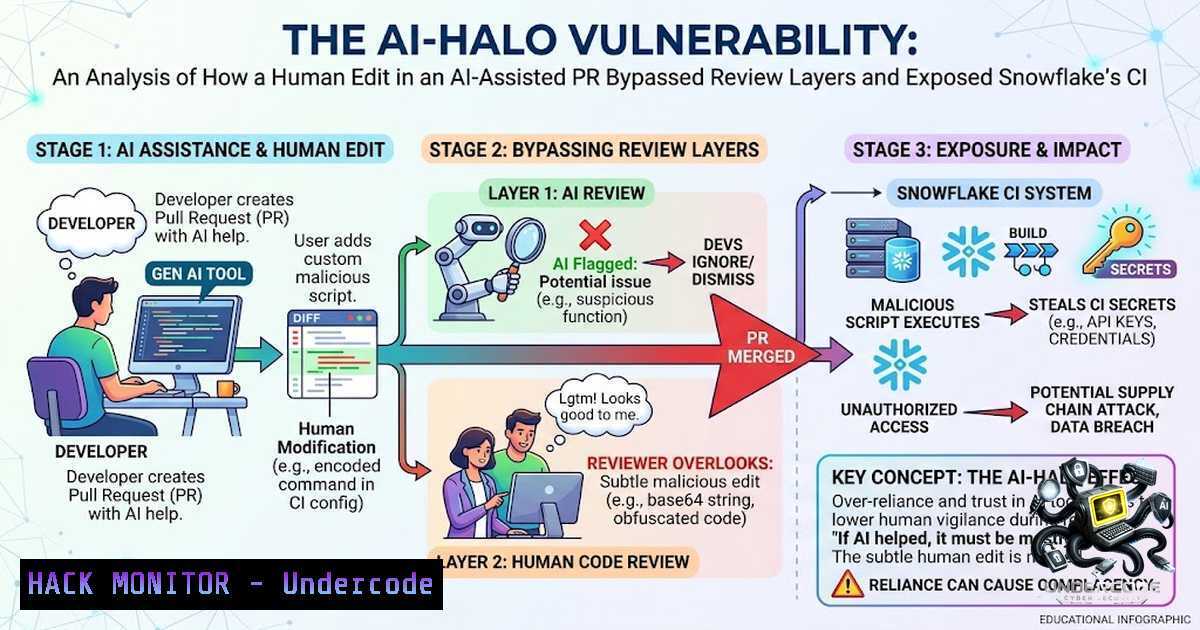
A recent case study disclosed by Wiz reveals a critical command injection vulnerability in Snowflake’s public .NET connector repository. The flaw stemmed from a seemingly benign PR that replaced a secure environment variable pattern with direct shell interpolation of an issue title within a GitHub Actions workflow. While headlines initially pointed to AI-generated code as the culprit, the reality is more nuanced: the AI-authored portion was secure, but a human edit in the same PR introduced the vulnerability, which subsequently sailed through both human reviewers and GitHub Advanced Security scanning, aided by the “AI halo” effect.
Learning Objectives & Secrets:
- Objective 1: Understand the mechanics of command injection in CI/CD pipelines and how untrusted input (like issue titles) can lead to remote code execution.
- Objective 2 (Secret Tip): Implement deterministic linting (e.g., zizmor or actionlint) as a mandatory pipeline gate to catch unsafe shell interpolation patterns automatically.
- Objective 3 (Secret Tip): Establish a review protocol that subjects AI-assisted pull requests to heightened scrutiny, particularly for human-authored changes that may be overlooked due to the “AI halo.”
You Should Know:
1. The Vulnerability: Command Injection via Issue Titles
The vulnerable PR replaced a safe pattern using environment variables and `jq –arg` with direct shell interpolation of the issue title inside a `run:` block of a GitHub Actions workflow. By opening an issue with a single quote in the title, an attacker could inject arbitrary commands into the CI environment. This is a classic injection flaw, but its presence in a public repository’s CI pipeline made it especially dangerous, as no account access was required to trigger it. The exposed Jira credentials granted read access to sensitive projects, including engineering, security-compliance, and bug-bounty data.
Step‑by‑Step Guide:
- Identify the Risk: Review your CI workflows for any `run:` or `script:` blocks that use `${{ github.event.issue.title }}` or similar variables directly.
- Test for Injection: In a controlled environment, create a test issue with a title like `test’ && whoami ` and observe the workflow output.
- Apply Safe Practices: Replace direct interpolation with environment variables and parameterized JSON parsing (e.g.,
jq --arg title "$TITLE"). - Enforce Linting: Integrate a tool like `actionlint` into your CI to flag insecure interpolation patterns.
Command Example (Linux/macOS):
 Install actionlint
curl -L https://github.com/rhysd/actionlint/releases/download/v1.6.24/actionlint_linux_amd64.tar.gz | tar xz
sudo mv actionlint /usr/local/bin/

Run actionlint on your workflow file
actionlint .github/workflows/ci.yml
2. The AI Halo Effect in Code Review
The PR in question carried a “Copilot Autofix” label, which subconsciously lowered the reviewers’ guard. The AI-authored section was safe; the vulnerable line was added by a human in the same PR. This demonstrates a significant cognitive bias: code from automated tools is often skimmed rather than rigorously reviewed. To mitigate this, treat AI-generated code as any other contribution—apply the same, if not more, scrutiny, especially to changes made alongside AI output.
Step‑by‑Step Guide for Reviewers:
- Check Labels Critically: Do not reduce scrutiny for PRs with AI labels. Treat them as high-risk changes.
- Audit Human Commits: Focus on lines authored by humans within AI-assisted PRs; these are where tooling may lack coverage.
- Use Differential Analysis: Compare the original code vs. the proposed change, focusing on security-sensitive patterns (e.g., shell execution, API calls).
- Mandate Security Reviews: Enforce that at least one security-trained engineer reviews every PR touching CI/CD workflows.
3. Making Injection Unshippable with Linters
Human reviewers missed the injection by eye; automated linters would not. Tools like `zizmor` (specifically for GitHub Actions) or `actionlint` can detect unsafe shell interpolation and fail the build. Integrating these as a pipeline gate ensures that such patterns never reach production.
Step‑by‑Step Guide:
- Add Linting to CI: Include a step in your CI pipeline that runs `actionlint` on all workflow files.
- Fail on Violations: Configure the linter to exit non-zero if it finds an insecure pattern, blocking the PR merge.
- Custom Rules: Extend linters with custom rules to catch project-specific anti-patterns.
Windows Command Example (using PowerShell):
 Download actionlint for Windows
Invoke-WebRequest -Uri "https://github.com/rhysd/actionlint/releases/download/v1.6.24/actionlint_windows_amd64.exe" -OutFile "actionlint.exe"
 Run on your workflow file
.\actionlint.exe .github/workflows/ci.yml
4. Workflow YAML as Production Code
Many organizations treat YAML files as configuration, not code, and thus fail to apply the same security rigor as application code. The Snowflake incident shows that a workflow file with a public trigger surface is essentially a publicly accessible API endpoint. Any input that flows into it—issue titles, comments, branch names—is untrusted.
Step‑by‑Step Guide:
- Map Attack Surfaces: List all GitHub Actions workflows and their triggers (e.g.,
issues,pull_request,push). - Sanitize Inputs: Always validate and sanitize event payloads before using them in shell commands.
- Apply Code Review Standards: Require the same level of review for workflow YAML changes as you would for code handling user input.
Command Example (GitHub CLI to List Workflows):
gh api repos/:owner/:repo/actions/workflows --jq '.workflows[].path'
5. Incident Response and Token Rotation
Snowflake patched the vulnerability on the same day and rotated the exposed Jira token within 24 hours. This rapid response is commendable and highlights the importance of having a well-practiced incident response plan. Key takeaways include early detection (by Wiz’s agent), quick patching, and immediate credential rotation to contain the blast radius.
Step‑by‑Step Guide:
- Detect Early: Deploy autonomous agents or continuous scanning tools to detect anomalies in CI behavior.
- Patch Fast: Apply the fix as a hotfix to the main branch without delay.
- Rotate Secrets: Immediately revoke and rotate any credentials exposed during the incident.
- Post-Mortem: Conduct a thorough review to understand how the vulnerability was introduced and how it bypassed existing checks.
6. Securing CI/CD Secrets and Access
The exposed Jira credentials had broad read access. This underscores the principle of least privilege—even for CI/CD systems. Secrets should be scoped to the minimum necessary permissions and rotated frequently. Tools like HashiCorp Vault or AWS Secrets Manager can help manage and rotate secrets dynamically.
Example: Using Vault to Manage GitHub Actions Secrets:
 Retrieve a secret from Vault
vault kv get -field=token secret/ci/jira-token
 Use it in a GitHub Actions step
echo "::add-mask::$TOKEN"
 Rotate the secret post-use if possible
What Undercode Say:
- Key Takeaway 1: The “AI halo” effect is a real review failure mode; AI-assisted PRs deserve more scrutiny, not less. Human edits in such PRs are the blind spot.
- Key Takeaway 2: Deterministic linters are superior to human reviewers for detecting decade-old injection classes. Integrating `zizmor` or `actionlint` as a pipeline gate is non-1egotiable.
- Analysis: This incident exposes a critical cultural and technical gap in modern DevSecOps. While AI accelerates development, it also introduces new cognitive biases that can undermine security. Organizations must update their review processes to account for these biases, enforce stringent linting, and treat all CI/CD inputs as untrusted. The vulnerability was not complex; it was a basic injection flaw that slipped through because reviewers trusted the “Copilot” label. This serves as a stark reminder that security is as much about human factors as it is about code.
Prediction:
- +1: Increased adoption of AI-specific review checklists and mandatory linter gates will become standard practice in DevSecOps pipelines, significantly reducing similar risks.
- -1: The number of CI/CD-related vulnerabilities will temporarily surge as attackers shift focus to exploiting the “AI halo” effect in other open-source projects.
- +1: Autonomous security agents, like Wiz’s, will be integrated into CI/CD pipelines, providing real-time detection and response for injection vulnerabilities.
- -1: Organizations that fail to update their review processes will experience similar breaches, as the human tendency to trust AI outputs persists.
- +1: The open-source community will develop more robust linters and static analysis tools specifically designed for YAML and workflow files, strengthening the overall security posture of CI/CD systems.
▶️ Related Video (70% Match):
🎯Let’s Practice For Free:
🎓 Live Courses & Certifications:
Join Undercode Academy for Verified Certifications
🚀 Request a Custom Project:
Secure, high-velocity infrastructure and disruptive technological engineering. Contact our engineering team for high-tier development and proprietary systems:
[email protected]
💎 Smart Architecture | 🛡️ Secure by Design | ⭐ Trusted by Thousands
IT/Security Reporter URL:
Reported By: https://lnkd.in/p/estB22YM – Hackers Feeds
Extra Hub: Undercode MoN
Basic Verification: Pass ✅


