Listen to this Post
Introduction:
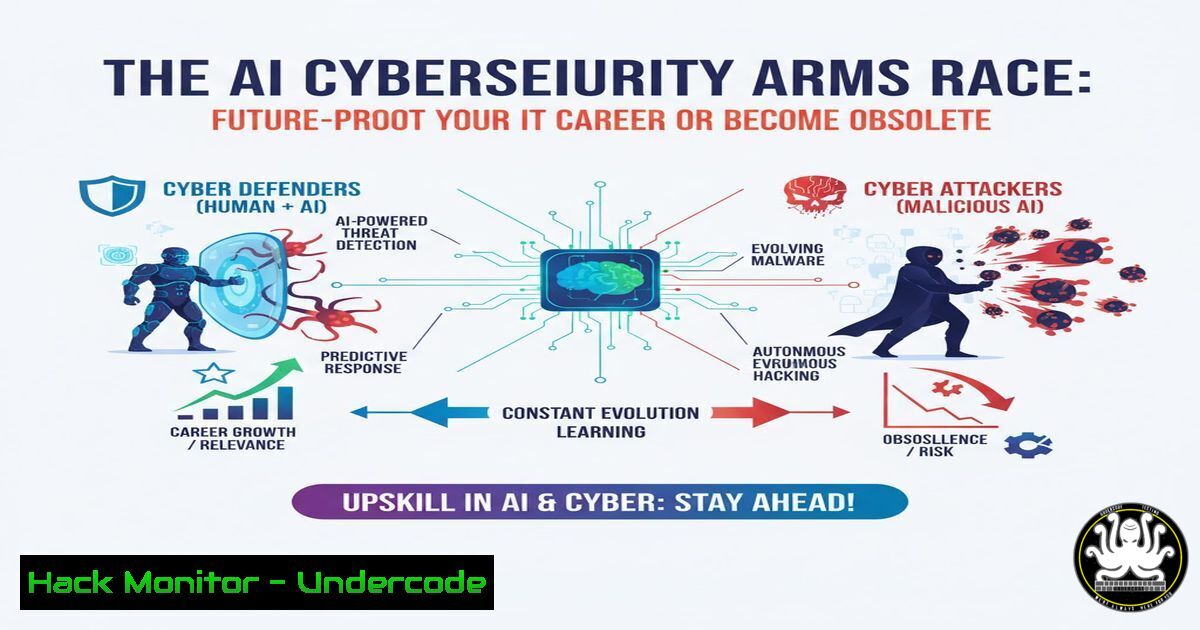
The rapid integration of Artificial Intelligence into the cybersecurity landscape is not a distant future trend; it is the present-day reality. As highlighted by industry leaders, failing to leverage AI to augment security capabilities is a direct path to professional obsolescence. This article provides the technical command-line and strategic knowledge necessary to transition from a traditional security role to an AI-augmented cyber defender.
Learning Objectives:
- Master the use of AI-powered command-line tools for threat hunting and log analysis.
- Implement AI-driven security hardening for cloud environments (AWS & Azure).
- Understand and mitigate the novel vulnerabilities introduced by AI systems themselves.
You Should Know:
1. AI-Enhanced Log Analysis with `grep-ai` & `jq`
Modern security operations require parsing through terabytes of logs. AI can identify subtle, multi-event attack patterns that traditional SIEM rules miss.
 Example using a hypothetical AI-powered grep and jq for JSON log analysis
cat /var/log/auth.log | grep-ai --pattern "lateral_movement_behavioral" | jq '. | {user, source_ip, timestamp}'

Step-by-step breakdown:
 1. `cat /var/log/auth.log` streams the authentication log file.
 2. The `grep-ai` command uses a machine learning model to flag sequences of events that resemble lateral movement, even if no single event is explicitly malicious.
 3. `jq` parses the resulting JSON log entries and extracts only the relevant fields for the analyst to review.
This workflow transforms a manual, time-intensive hunt into a targeted investigation, drastically reducing Mean Time to Detect (MTTD).
2. Automating Cloud Security Hardening with AI Policies
Cloud misconfigurations are a primary attack vector. AI can continuously analyze your cloud infrastructure as code (IaC) and runtime configuration against a dynamic threat model.
 Using an AI-powered cloud security tool (e.g., `cfn-nag` enhanced) to scan CloudFormation templates
cfn_nag_ai --template my_stack.yml --output json | jq '.violations[] | select(.risk_score > 8)'

Step-by-step breakdown:
 1. The `cfn_nag_ai` command scans the CloudFormation template <code>my_stack.yml</code>.
 2. The AI component assigns a dynamic risk score based on current threat intelligence, not just static rules (e.g., an S3 bucket being public is higher risk if it's recently been targeted in campaigns).
 3. `jq` filters the output to show only high-risk violations with a score above 8, allowing analysts to prioritize remediation.
This moves cloud security from a periodic checklist to a continuous, intelligent assessment process.
3. Windows Command Line AI Threat Hunting
PowerShell is a powerful tool for both attackers and defenders. AI can help baseline normal PowerShell activity and flag anomalous script blocks.
 Hypothetical AI module for PowerShell log analysis
Get-WinEvent -LogName "Microsoft-Windows-PowerShell/Operational" | Invoke-AIAnomalyDetection -Parameter "ScriptBlockText" -Sensitivity "High"

Step-by-step breakdown:
 1. `Get-WinEvent` retrieves events from the PowerShell operational log.
 2. The `Invoke-AIAnomalyDetection` cmdlet processes the `ScriptBlockText` of each event.
 3. The AI model, trained on normal organizational activity, flags scripts that are statistically anomalous in terms of obfuscation, rare API calls, or execution flow, even if they are not signatured as malware.
This technique is critical for detecting fileless malware and living-off-the-land (LotL) attacks that bypass traditional antivirus solutions.
4. Hardening API Security with AI-Powered Analysis
APIs are a critical attack surface. AI can analyze API traffic in real-time to detect business logic abuse and sophisticated scraping that standard WAFs miss.
 Using an AI-enhanced API security tool to analyze traffic logs
cat api_gateway_logs.json | jq '. | {ip, endpoint, user_agent, status_code}' | api-ai-analyzer --model "business_logic_abuse"

Step-by-step breakdown:
 1. The API gateway logs are parsed with `jq` to extract key fields.
 2. The `api-ai-analyzer` tool processes the data stream.
 3. The "business_logic_abuse" model looks for patterns like credential stuffing, inventory scraping, or data exfiltration through legitimate API endpoints that appear as normal traffic to a WAF.
This provides a defense layer against the OWASP API Security Top 10 threats that rely on exploiting logic flaws.
5. Proactive Vulnerability Management with AI Prioritization
The volume of CVEs is overwhelming. AI can contextualize vulnerabilities based on your specific environment, threat intelligence, and exploit availability.
 Querying an AI-curated vulnerability database for your assets
vuln-ai-query --asset "webserver_" --environment "production" --last-scan "30d" --output "table"

Step-by-step breakdown:
 1. The command queries a vulnerability management platform enhanced with AI.
 2. It filters for assets tagged as "webserver_" in the "production" environment, scanned within the last 30 days.
 3. The AI engine prioritizes the list not just by CVSS score, but by the likelihood of exploitation in your specific tech stack and evidence of active exploitation in the wild, presenting a clean table for action.
This shifts vulnerability management from a “patch everything” mentality to a risk-based, efficient remediation strategy.
6. Simulating AI-Powered Attacks with Ethical Hacking
To defend against AI-augmented attacks, you must understand them. New penetration testing tools use AI to automate exploit chain creation.
 Using an AI-assisted penetration testing framework (conceptual)
ai-pen-test-tool --target 10.0.1.0/24 --phase "lateral_movement" --technique "pass_the_hash" --auto-generate-payload

Step-by-step breakdown:
 1. The tool is provided a target network range.
 2. The "lateral_movement" phase is specified.
 3. The AI suggests and automates the most probable technique ("pass_the_hash") based on the discovered OS types and network topology.
 4. The `--auto-generate-payload` flag directs the AI to create a custom payload that is most likely to evade defenses on the target system type.
Using these tools ethically allows security teams to identify and shore up defenses against the next generation of automated attacks.
- Mitigating AI Model Poisoning and Data Evasion Attacks
AI systems themselves are vulnerable. Defenders must implement controls to detect poisoning of training data or adversarial inputs designed to fool ML models.
 Python snippet for basic adversarial input detection using the `adversarial-robustness-toolbox`
from art.defences.detector import BinaryInputDetector

Initialize detector (pre-trained on known good and adversarial data)
detector = BinaryInputDetector(model=my_classifier)
 Predict if a new input is adversarial
is_adversarial = detector.predict(x_new)

Step-by-step breakdown:
 1. Import the BinaryInputDetector from the IBM Adversarial Robustness Toolbox (ART).
 2. Initialize the detector with the machine learning model you are protecting (<code>my_classifier</code>).
 3. Use the `predict` method on new input data (<code>x_new</code>) to get a boolean flag indicating if the input is likely an adversarial example designed to fool your model.
This is a foundational step for securing AI-powered security systems themselves, ensuring that an attacker cannot blind your defenses by attacking the underlying AI.
What Undercode Say:
- Adapt or Perish: The window for IT and cybersecurity professionals to integrate AI into their workflow is closing rapidly. Those who treat AI as a force multiplier will thrive; those who ignore it will find their skills irrelevant.
- The Dual-Edged Sword is Real: The same AI that powers advanced threat hunting and automated hardening is also being weaponized by adversaries to create more sophisticated, scalable, and evasive attacks. The defensive advantage will go to those who most effectively harness these tools.
The core analysis is that we are at the inflection point of a paradigm shift. AI in cybersecurity is moving from a “nice-to-have” to the central nervous system of any mature security program. The commands and techniques outlined above are not science fiction; they are either available today in cutting-edge tools or are rapidly being integrated into mainstream platforms. The professional cost of ignoring this shift is akin to a system administrator refusing to learn automation or cloud technologies a decade ago. Proactive learning and integration are the only viable paths forward.
Prediction:
The near future will see a “Great Divide” in the cybersecurity job market. Roles that involve repetitive, manual tasks like basic alert triage and static vulnerability scanning will be almost entirely automated by AI. Conversely, high-value roles focusing on AI model training for security, interpreting AI-driven findings, managing AI security risks, and conducting strategic cyber campaigns will see explosive growth. Organizations that fail to invest in AI-augmented security will suffer a higher frequency of successful breaches as AI-powered attacks overwhelm their human-scale defenses.
🎯Let’s Practice For Free:
IT/Security Reporter URL:
Reported By: Gabriel Millien – Hackers Feeds
Extra Hub: Undercode MoN
Basic Verification: Pass ✅


