Listen to this Post
Introduction:
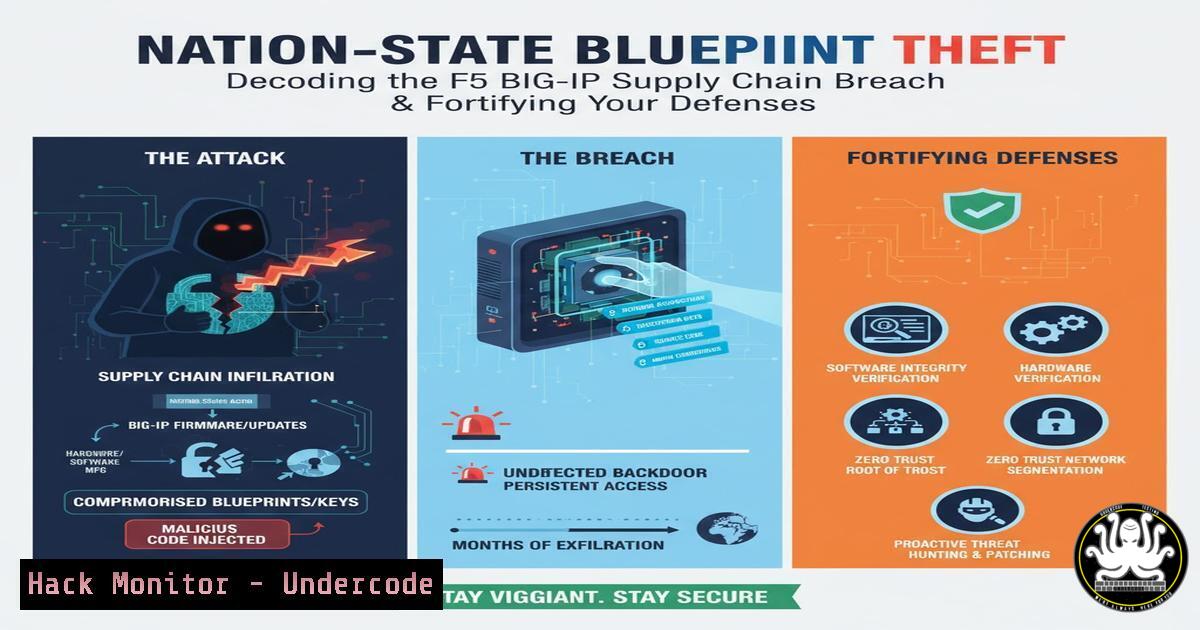
The recent F5 BIG-IP supply chain compromise represents a paradigm shift in cyber-espionage, moving beyond immediate data theft to the long-term strategic acquisition of offensive capabilities. A nation-state actor, suspected to be UNC5221, infiltrated F5’s core development environment, exfiltrating critical source code and intelligence on unpatched vulnerabilities. This breach provides the attacker with a blueprint to engineer future zero-day exploits, posing a sustained threat to global enterprises reliant on F5’s application delivery and security infrastructure.
Learning Objectives:
- Understand the technical implications of the F5 source code theft and how to mitigate emerging threats.
- Implement immediate hardening procedures for BIG-IP management interfaces and network access.
- Develop a proactive hunting strategy using Indicators of Compromise (IoCs) and behavioral analytics to detect post-breach attacker activity.
You Should Know:
1. Immediate BIG-IP Management Interface Hardening
The most critical action is to remove BIG-IP management interfaces from public internet exposure. The stolen source code allows attackers to meticulously study the authentication and authorization mechanisms, making publicly accessible systems primary targets.
Verified Command / Configuration:
Linux/Network (iptables): `sudo iptables -A INPUT -p tcp –dport 443 -s 10.0.1.0/24 -j ACCEPT && sudo iptables -A INPUT -p tcp –dport 443 -j DROP`
Windows Server (PowerShell – if hosting BIG-IP VM): `New-NetFirewallRule -DisplayName “Block-BIG-IP-Mgmt” -Direction Inbound -Protocol TCP -LocalPort 443 -RemoteAddress “NotLocalSubnet” -Action Block`
BIG-IP TMSH (Local): `tmsh create /net self-allow { 10.0.1.50/32 { } }` and modify the management route to use a non-default VLAN.
Step-by-Step Guide:
- Identify the IP address and port (typically 443) of your BIG-IP management interface.
- Using your network firewall or host-based rules, create an access control list (ACL) that only permits connections from your internal management network (e.g., a VPN subnet or a specific jump server IP range).
- Explicitly deny all other traffic to the management port. The iptables command above first allows traffic from the `10.0.1.0/24` subnet, then drops all other traffic on port 443.
- Validate the rule by attempting to connect from an unauthorized IP; the connection should time out or be refused.
2. Proactive Threat Hunting with Network IoCs
Attackers with source code access can develop highly evasive malware and persistence mechanisms. Proactive hunting is essential to find evidence of a breach that automated tools might miss.
Verified Command / Code Snippet:
Zeek/Bro (Network Monitoring): `filter “http.method == \”POST\” && /admin/ && http.host ==
YARA Rule (Host-Based):
rule F5_BIGIP_Suspicious_Module {
meta:
description = "Hunts for suspicious F5 iRule or TCL module modifications"
author = "DFIR_Team"
strings:
$a = "tmsh modify sys file ilx" wide
$b = "create ltm data-group internal" nocase
$c = "/var/config/rest/iapps/"
condition:
any of them
}
ELK Stack Query (Log Analysis): `destination.port : 8443 AND source.ip : (not 10.0.0.0/8) AND event.duration : > 1000000`
Step-by-Step Guide:
- Network Traffic Analysis: Use Zeek to capture and filter HTTP traffic. The filter above looks for POST requests to an `/admin/` path on the BIG-IP, which could indicate credential stuffing or administrative abuse.
- Host Integrity Monitoring: Deploy the YARA rule to scan BIG-IP file systems, particularly the `/var` directory, for unauthorized changes to iRules, TCL scripts, or data groups, which are common persistence vectors.
- SIEM Correlation: In your SIEM (e.g., Elasticsearch), create a alert for long-duration connections (
event.durationin microseconds) to the management port (8443) from non-internal IPs, which may indicate a successful C2 session.
3. Enforcing Strict Role-Based Access Control (RBAC)
Limit the potential damage of compromised credentials by ensuring the principle of least privilege is enforced on all BIG-IP devices.
Verified Command / Configuration:
BIG-IP TMSH: `tmsh create /auth partition-access { { role operator partitions { Common } } { role auditor partitions { PartitionA } } }`
BIG-IP TMSH (User Creation): `tmsh create /auth user analyst { description “Read-only user” partition-access add { Common { role auditor } } shell none }`
Step-by-Step Guide:
1. Access the BIG-IP command line via TMSH.
- Audit existing users and their roles with
tmsh list /auth user. - Create custom roles or assign pre-defined ones (e.g.,
operator,auditor,manager) that grant only the permissions necessary for a user’s function. The command above creates partition-specific access. - Create a dedicated, non-privileged user account for read-only auditing and monitoring purposes, as shown in the user creation command.
4. Vulnerability Scanning and EOL Product Management
Attackers now possess knowledge of vulnerabilities before patches are even released. A rigorous and frequent vulnerability management cycle is critical.
Verified Command / Code Snippet:
Nuclei Template (Custom):
id: f5-bigip-management-check
info:
name: F5 BIG-IP Exposed Management Interface
severity: high
http:
- method: GET
path:
- "{{BaseURL}}/mgmt/tm/"
matchers:
- type: word
words:
- "f5-rest"
Nmap NSE Script: `nmap -p 443 –script http-vuln-cve2021-22986
Step-by-Step Guide:
- Inventory: Use a network scanner like Nmap to create an inventory of all F5 assets:
nmap -p 443,8443 --open -oG - 10.0.0.0/8 | grep -E "^(Host:|Ports:)". - Identify EOL: Cross-reference the discovered versions with F5’s EOL matrix. Plan immediate decommissioning for any EOL products.
- Active Scanning: Use a scanner like Nuclei with custom templates to check for exposed management endpoints and known CVEs. The template above checks for a REST API endpoint that should not be public.
- Patch Immediately: Subscribe to F5 security advisories and apply all patches within the mandated timeframe, treating them as critical.
5. Implementing Application-Specific Compensating Controls
Assume that future BIG-IP vulnerabilities will be exploited. Layered defenses at the application and network level can contain an incident.
Verified Command / Configuration:
Snort/Suricata Rule:
`alert tcp any any -> $HOME_NET 443 (msg:”SUSPICIOUS F5 TMSH Command Over HTTP”; flow:established,to_server; content:”POST”; http_method; content:”/mgmt/tm/util/bash”; http_uri; content:”command”; http_client_body; metadata:service http; sid:1000001; rev:1;)`
Cloudflare WAF Rule (Terraform):
resource "cloudflare_ruleset" "f5_mgmt_block" {
zone_id = var.zone_id
name = "Block F5 Management Paths"
rules {
action = "block"
expression = "http.request.uri.path contains \"/mgmt/\""
description = "Block direct access to F5 mgmt paths"
}
}
Step-by-Step Guide:
- Network IPS: Deploy the provided Snort rule on your Intrusion Prevention System (IPS) to alert on or block attempts to execute TMSH commands via the web API, a common post-exploitation technique.
- Web Application Firewall (WAF): If your BIG-IP devices are behind a CDN/WAF like Cloudflare, create a custom rule to block any external request trying to access the internal `/mgmt/` path, as shown in the Terraform snippet.
- Segment Networks: Ensure your BIG-IP devices reside in a tightly controlled network segment, separate from critical application and data servers, to limit lateral movement.
What Undercode Say:
- The Attack Surface Has Fundamentally Expanded. This isn’t a single CVE; it’s a factory for future CVEs. Defenders must operate under the assumption that attackers have an intimate, ongoing knowledge of the platform’s weaknesses.
- Compensating Controls Are Now Primary Controls. Until F5 can rebuild trust through code audits and architectural changes, external hardening (firewalls, WAFs, RBAC) is your most reliable defense, not just a supplementary measure.
The F5 breach demonstrates a strategic pivot in cyber warfare. The objective is no longer just to exploit a system, but to steal the capability to exploit all future versions of that system. This forces defenders into a reactive posture for years to come. The only viable strategy is a zero-trust architecture around critical infrastructure like BIG-IP, where every access request is verified, and network-level controls are rigorously enforced to compensate for potential weaknesses in the application itself. The time for “set and forget” network appliance deployment is over.
Prediction:
The exfiltrated F5 source code will lead to a wave of sophisticated, targeted attacks within the next 6-18 months. We predict the emergence of “phantom zero-days”—vulnerabilities exploited in the wild that were unknown to F5 at the time of the breach, giving the threat actor a significant head start. This will erode trust in traditional patch cycles as the primary mitigation strategy, forcing a broad industry shift towards behavioral detection, stricter supply chain security audits, and the mandatory use of application allow-listing and network micro-segmentation for all critical infrastructure components.
🎯Let’s Practice For Free:
IT/Security Reporter URL:
Reported By: Ianleroyarakel F5breach – Hackers Feeds
Extra Hub: Undercode MoN
Basic Verification: Pass ✅


