Listen to this Post
Introduction:
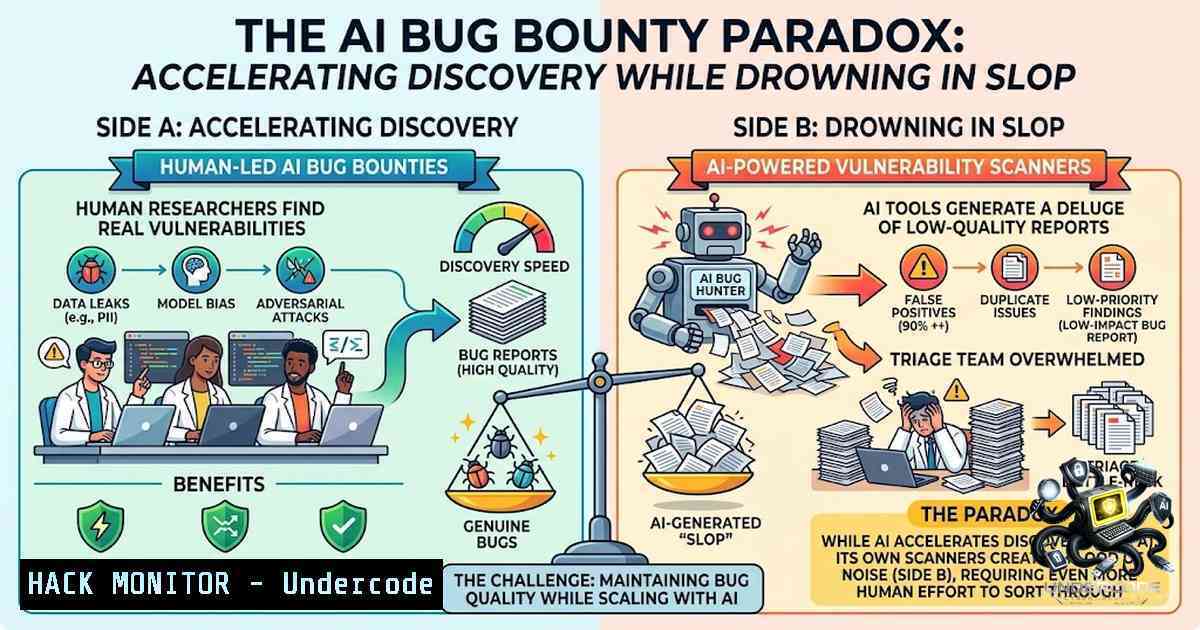
The question keeping bug bounty program managers up at night has shifted dramatically. It is no longer about whether they are receiving enough submissions—the firehose is very much on—but whether their teams can effectively triage the deluge. As AI tools empower researchers to accelerate reconnaissance, filter scanner noise, and draft reports, they simultaneously lower the barrier for low-effort, AI-generated submissions that lack real vulnerabilities. This paradox—where the same technology that speeds up genuine discovery also floods triage queues with “slop”—has become the defining challenge for modern bug bounty programs. Major platforms now report that 60 to 80 percent of submissions are invalid, overwhelming triage teams with AI-generated false positives. The burning issue is no longer volume but signal-to-1oise ratio.
Learning Objectives & Secrets:
- Objective 1: Master AI-Assisted Reconnaissance Without the Noise – Learn how to leverage AI for automated scanning and initial reconnaissance while implementing strict validation checkpoints to filter out false positives before they reach the triage queue. The secret is to use AI for speed but never for final judgment.
-
Objective 2: Build a Hybrid Triage Workflow That Scales – Implement a six-step triage process that combines AI probability scoring with human validation. The secret tip is to create distinct review paths for first-time submitters versus experienced researchers, using AI to compress context gathering while keeping final verdicts with trained reviewers.
-
Objective 3: Automate Exploit Chain Development Responsibly – Use AI to draft and iterate proof-of-concept code for vulnerability chains, but always validate and adapt the output manually. The secret is to treat AI-generated PoCs as starting points, not finished products—human creativity remains essential for chaining vulnerabilities in ways AI cannot yet replicate.
You Should Know:
1. AI-Assisted Reconnaissance and Automated Scanning
AI is transforming the reconnaissance phase of bug hunting. Tools like PenTest++ and xOffense automate critical penetration testing tasks including reconnaissance, scanning, enumeration, and exploitation. These AI-augmented systems can process vast attack surfaces far faster than manual efforts. However, this automation comes with a cost: it generates大量 findings that require validation.
Step‑by‑step guide for AI-assisted recon:
- Step 1: Deploy an AI-powered reconnaissance tool (e.g., Gemini CLI integrated with Kali Linux 2025.3) to automate initial asset discovery and port scanning.
- Step 2: Configure the tool to output findings in a structured format (JSON/XML) for downstream processing.
- Step 3: Implement a validation script that cross-references findings against known false-positive patterns before they enter the main triage queue.
- Step 4: Use AI to prioritize findings based on CVSS consistency and historical data from similar bug types on your program.
- Step 5: Route only high-probability findings to human triage for reproduction and validation.
Linux command example for automated recon:
 Automated subdomain enumeration with AI-assisted prioritization
subfinder -d target.com -silent | httpx -silent | nuclei -t cves/ -severity critical,high -json | jq 'select(.info.severity=="critical")' > critical_findings.json

AI-powered vulnerability scanning using custom LLM integration
python3 ai_scanner.py --target target.com --model custom_llm --output validated_findings.txt
Windows/PowerShell equivalent:
 Automated port scanning with AI prioritization
nmap -sS -p- target.com -oG - | Select-String "Ports:" | ForEach-Object { $_ -replace "Ports: ", "" } | Out-File ports.txt

Run AI validation script
python ai_validator.py --input ports.txt --model security_llm --output validated_ports.json
2. AI-Powered Triage: Separating Signal from Slop
The triage backlog is the new bottleneck. AI-generated submissions that look polished but fall apart during reproduction are clogging queues across the industry. The solution is not to abandon AI but to implement intelligent triage workflows that use AI to fight AI.
Step‑by‑step guide for AI-powered triage:
- Step 1: Implement an AI-powered agentic validation system that automatically reviews incoming reports within minutes of submission.
- Step 2: Configure the AI to perform initial classification—checking scope compliance, detecting duplicates, and assigning preliminary severity scores.
- Step 3: Use AI probability signals to flag high-severity findings for immediate human review while low-probability findings undergo additional automated checks.
- Step 4: Train internal AI agents on your organization’s unique tone, history, and scoring precedents to improve consistency.
- Step 5: Maintain a human-in-the-loop for final verdicts—AI should support, not replace, trained reviewers.
- Step 6: Rebaseline triage capacity against AI-driven throughput, measuring submission volume, duplicate rates, and average time-to-validation.
Triage workflow script example:
 AI-assisted triage script
import json

def ai_triage_submission(submission):
 Step 1: Scope compliance check
if not is_in_scope(submission['target']):
return {"status": "out_of_scope", "action": "reject"}

Step 2: Duplicate detection
if is_duplicate(submission['description']):
return {"status": "duplicate", "action": "merge"}

Step 3: AI severity scoring
severity_score = ai_severity_model.predict(submission['description'])

Step 4: Route based on probability
if severity_score > 0.8:
return {"status": "high_priority", "action": "human_review", "severity": severity_score}
else:
return {"status": "low_priority", "action": "batch_review", "severity": severity_score}
3. Vulnerability Chaining: Where AI Falls Short
The most critical vulnerabilities often involve chaining multiple weaknesses together—something AI still struggles with. While AI can draft exploit code for individual vulnerabilities, the creative work of chaining them remains a human strength. Researchers report using AI to describe vulnerability chains and iterate exploit code, but they always validate and adapt the output manually.
Step‑by‑step guide for AI-assisted exploit chaining:
- Step 1: Use AI to identify potential bug candidates through automated code review and static analysis.
- Step 2: Describe the vulnerability chain to an AI coding agent that drafts and iterates exploit code.
- Step 3: Manually validate each step of the chain—AI may miss context-specific constraints or environmental dependencies.
- Step 4: Test the exploit in a controlled environment before submission.
- Step 5: Document the chain comprehensively, including all assumptions and validation steps.
Exploit chain validation script:
 Automated exploit chain testing
python3 exploit_chain.py --target target.com --chain-file chain.json --validate

Manual validation with Burp Suite
 1. Import the AI-generated PoC
 2. Step through each request/response
 3. Verify each vulnerability in the chain is actually exploitable
 4. Document the full chain with screenshots and logs
- API Security and Cloud Hardening in the AI Era
As organizations rapidly adopt cloud-1ative architectures and AI-driven applications, API security has become a critical concern. AI tools can accelerate API reconnaissance but also generate大量 API-related false positives.
Step‑by‑step guide for AI-assisted API security testing:
- Step 1: Use AI to enumerate API endpoints through automated crawling and OpenAPI specification parsing.
- Step 2: Deploy AI-powered fuzzing to test for common API vulnerabilities (injection, broken authentication, excessive data exposure).
- Step 3: Implement AI-driven anomaly detection to identify unusual API behavior patterns.
- Step 4: Validate all AI-discovered API findings manually—AI often misidentifies rate-limiting responses as vulnerabilities.
- Step 5: Harden API security by implementing strict input validation, authentication checks, and rate limiting.
API security testing commands:
 AI-assisted API endpoint discovery
katana -u https://api.target.com -d 5 -silent | grep -E '.(json|xml|yaml)$' > api_endpoints.txt

AI-powered API fuzzing
python3 api_fuzzer.py --endpoints api_endpoints.txt --payloads common_payloads.txt --output findings.json

Validate findings with manual testing
curl -X GET "https://api.target.com/v1/users?role=admin" -H "Authorization: Bearer $TOKEN"
5. Cloud Configuration Hardening
Misconfigured cloud resources remain one of the most common—and dangerous—security flaws. AI can help identify misconfigurations at scale, but human validation is essential to avoid alert fatigue.
Step‑by‑step guide for AI-assisted cloud hardening:
- Step 1: Deploy AI-powered cloud security posture management (CSPM) tools to continuously scan for misconfigurations.
- Step 2: Configure AI to prioritize findings based on exploitability and potential impact.
- Step 3: Implement automated remediation for low-risk misconfigurations while routing high-risk findings to human review.
- Step 4: Regularly update AI models with new cloud-specific threat intelligence.
- Step 5: Conduct periodic manual audits to validate AI findings and identify gaps in automated coverage.
Cloud hardening commands:
 AWS security assessment with AI prioritization
prowler aws --output json | python3 ai_prioritize.py --model cloud_security > prioritized_findings.json

Azure security scan
az security assessment list | jq '.[] | select(.status.code=="Unhealthy")' | python3 ai_classify.py

GCP security assessment
gcloud asset search-all-resources --query "security" | python3 ai_validate.py
6. Vulnerability Mitigation and Remediation Workflows
Once vulnerabilities are validated, the remediation process must be efficient and tracked. AI can assist by suggesting remediation steps and tracking fix progress.
Step‑by‑step guide for AI-assisted remediation:
- Step 1: Use AI to generate remediation recommendations based on vulnerability type and context.
- Step 2: Assign remediation tasks to the appropriate engineering teams with AI-suggested priority and timeline.
- Step 3: Implement AI-powered regression testing to verify that fixes haven’t introduced new vulnerabilities.
- Step 4: Track remediation progress using AI dashboards that highlight bottlenecks and delays.
- Step 5: Conduct post-remediation validation to confirm vulnerabilities are fully resolved.
Remediation tracking script:
 AI-powered remediation tracking
import pandas as pd

def track_remediation(findings_df):
 Group findings by severity and team
grouped = findings_df.groupby(['severity', 'assigned_team']).size()

AI-suggested remediation timeline
for severity in ['critical', 'high', 'medium', 'low']:
timeline = ai_suggest_timeline(severity)
print(f"{severity} findings should be remediated within {timeline} days")

Track progress
progress = findings_df[findings_df['status'] == 'resolved'].shape[bash] / findings_df.shape[bash]
return f"Remediation progress: {progress:.2%}"
What Undercode Say:
- Key Takeaway 1: AI is a double-edged sword in bug bounty programs—it accelerates genuine discovery but also generates a flood of low-quality submissions that overwhelm triage teams. The key is not to abandon AI but to build intelligent workflows that use AI to fight AI.
-
Key Takeaway 2: The most critical vulnerabilities often involve chaining multiple weaknesses—a task where AI still falls short. Human creativity, intuition, and contextual understanding remain essential for identifying and exploiting complex vulnerability chains.
-
Key Takeaway 3: Organizations must rebaseline triage capacity against AI-driven submission volumes. This means investing in hybrid workflows that combine AI-powered initial triage with human validation, creating distinct review paths for different submission types, and continuously refining AI models on program-specific data.
-
Key Takeaway 4: AI tools can automate reconnaissance, scanning, and even exploit drafting, but they cannot replicate the judgment and creativity of experienced security researchers. The future of bug bounty lies in effective human-AI collaboration, not full automation.
-
Key Takeaway 5: The signal-to-1oise ratio is the new metric of success. Programs that effectively filter out AI-generated slop while capturing genuine high-impact findings will lead the industry. Those that fail to adapt may face bounty suspensions, invite-only programs, or longer triage backlogs.
Prediction:
-
+1 The adoption of AI-powered triage tools will mature rapidly, with agentic validation systems becoming standard within 12–18 months. Programs that invest early in these capabilities will gain a significant competitive advantage in managing submission volumes.
-
-1 The surge in AI-generated low-quality submissions will force some organizations to suspend or restructure public bug bounty programs, moving toward invite-only or vetted researcher models. This will reduce the diversity of researchers and potentially miss critical findings from less-established hunters.
-
+1 AI-assisted exploit chain development will enable researchers to discover and report more complex, high-impact vulnerabilities. However, this will require new validation frameworks to ensure AI-generated PoCs are actually exploitable.
-
-1 The triage backlog problem will worsen before it improves, with major platforms reporting 60–80% invalid submission rates. This will strain security teams and delay remediation of genuine vulnerabilities.
-
+1 The development of AI-specific training and certification programs will emerge, helping researchers use AI tools responsibly and effectively while avoiding the trap of generating low-effort slop.
-
-1 Organizations that fail to implement AI-powered triage will face unsustainable operational costs, with triage teams spending more time dismissing junk than fixing real flaws. This could lead to burnout and turnover among security professionals.
▶️ Related Video (86% Match):
https://www.youtube.com/watch?v=-ibRc98Ndy0
🎯Let’s Practice For Free:
🎓 Live Courses & Certifications:
Join Undercode Academy for Verified Certifications
🚀 Request a Custom Project:
Secure, high-velocity infrastructure and disruptive technological engineering. Contact our engineering team for high-tier development and proprietary systems:
[email protected]
💎 Smart Architecture | 🛡️ Secure by Design | ⭐ Trusted by Thousands
IT/Security Reporter URL:
Reported By: https://lnkd.in/p/e9hYTERR – Hackers Feeds
Extra Hub: Undercode MoN
Basic Verification: Pass ✅


