Listen to this Post
Introduction:
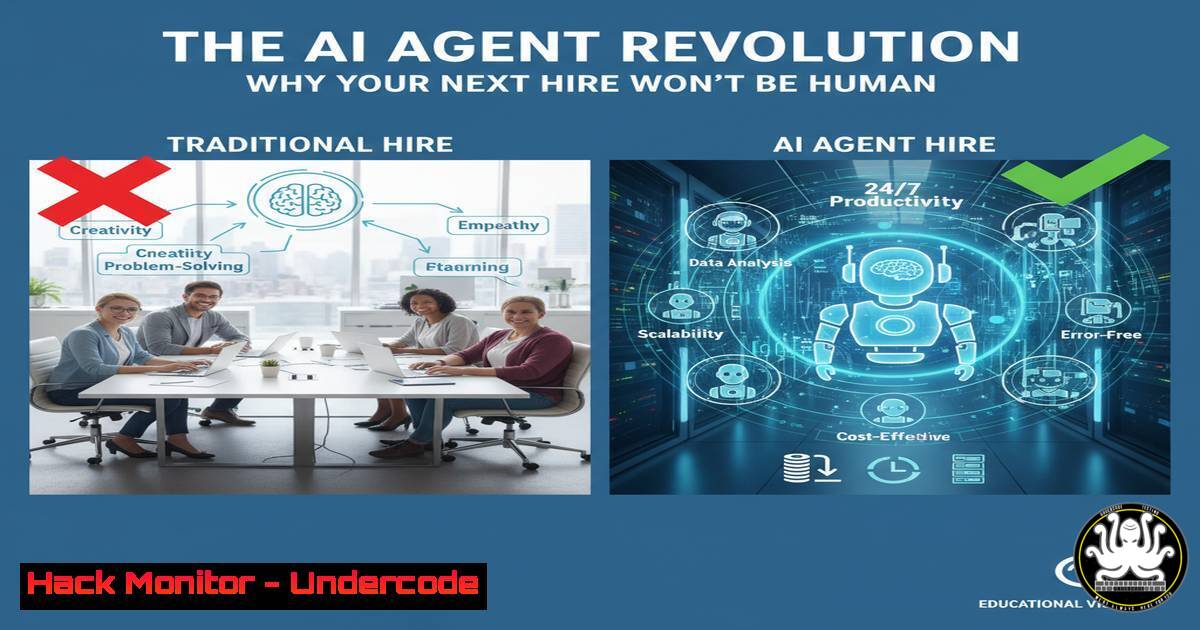
The workplace is undergoing a fundamental transformation as AI agents evolve from simple assistants to autonomous digital workers. This shift requires professionals to transition from hands-on executors to strategic orchestrators who manage teams of specialized AI agents for research, writing, coding, and analysis tasks.
Learning Objectives:
- Understand the Model Context Protocol (MCP) framework for connecting AI agents to enterprise systems
- Master security hardening for autonomous AI agent deployments
- Learn to validate and audit AI agent outputs for enterprise reliability
You Should Know:
1. Securing Your AI Agent Infrastructure
 Container security scan for AI agent deployment
docker scan ai-agent-container --file Dockerfile --severity high
 Network segmentation for agent communication
iptables -A FORWARD -i agent_network -o corporate_network -p tcp --dport 443 -j ACCEPT
iptables -A FORWARD -i agent_network -j DROP
This Docker security scan command identifies vulnerabilities in your AI agent container before deployment, while the iptables rules create a segmented network that restricts agent communication to only necessary corporate resources, preventing lateral movement in case of compromise.
2. Model Context Protocol (MCP) Implementation
 MCP server configuration with authentication
import asyncio
from mcp.server import Server
from mcp.server.models import InitializationOptions

server = Server("enterprise-ai-agent")

@server.list_tools()
async def handle_list_tools():
return [
{
"name": "database_query",
"description": "Execute approved SQL queries",
"inputSchema": {
"type": "object",
"properties": {
"query": {"type": "string"},
"timeout": {"type": "integer"}
}
}
}
]
This Python code establishes a secure MCP server that allows AI agents to connect to enterprise systems through defined tools with strict input validation, creating the “nervous system” for your digital workforce while maintaining security boundaries.
3. Agent Output Validation Framework
 Automated validation script for AI-generated code
!/bin/bash
agent_output="$1"
shellcheck "$agent_output"
bandit -r "$agent_output"
safety check --json --output report.json
This validation pipeline runs security scanning tools against AI-generated code, with ShellCheck analyzing shell scripts, Bandit checking Python code for vulnerabilities, and Safety identifying dependency issues before deployment to production environments.
4. Windows Security Hardening for Agent Hosts
 Windows Defender application control for AI agents
New-CIPolicy -FilePath AgentPolicy.xml -Level FilePublisher
Set-CIPolicyIdInfo -FilePath AgentPolicy.xml -PolicyName "AI_Agent_Runtime"
ConvertFrom-CIPolicy -XmlFilePath AgentPolicy.xml BinaryFilePath AgentPolicy.bin
This PowerShell script creates a Windows Defender Application Control policy that restricts executable files to only approved AI agent binaries, preventing unauthorized code execution by compromised or malicious agents.
5. API Security for Agent Communication
 JWT authentication with rate limiting for agent APIs
from flask_limiter import Limiter
from flask_limiter.util import get_remote_address
import jwt
import datetime

limiter = Limiter(app, key_func=get_remote_address)

@app.route('/agent/api/v1/execute', methods=['POST'])
@limiter.limit("100/hour;10/minute")
def execute_agent_task():
token = request.headers.get('Authorization')
try:
payload = jwt.decode(token, app.config['SECRET_KEY'], algorithms=['HS256'])
if payload['agent_id'] not in approved_agents:
return jsonify({'error': 'Unauthorized agent'}), 401
except jwt.InvalidTokenError:
return jsonify({'error': 'Invalid token'}), 401
This Python Flask implementation provides secure API endpoints for AI agent communication using JWT authentication and rate limiting to prevent abuse and ensure only authorized agents can access enterprise systems.
6. Linux Container Security for Agent Isolation
 SELinux policies for AI agent containers
semanage permissive -a httpd_t
semanage port -a -t http_port_t -p tcp 8080
setsebool -P httpd_can_network_connect on
 AppArmor profile for agent restriction
aa-genprof /usr/local/bin/ai-agent
aa-enforce /etc/apparmor.d/usr.local.bin.ai-agent
These Linux security commands implement mandatory access controls using SELinux and AppArmor to restrict AI agent capabilities, preventing privilege escalation and limiting damage from potential agent compromises.
7. Cloud Infrastructure Hardening
 AWS IAM roles for AI agent least privilege
resource "aws_iam_role" "ai_agent_role" {
name = "ai-agent-execution-role"

assume_role_policy = jsonencode({
Version = "2012-10-17"
Statement = [
{
Action = "sts:AssumeRole"
Effect = "Allow"
Principal = {
Service = "lambda.amazonaws.com"
}
}
]
})
}

resource "aws_iam_role_policy_attachment" "ai_agent_basic" {
role = aws_iam_role.ai_agent_role.name
policy_arn = "arn:aws:iam::aws:policy/service-role/AWSLambdaBasicExecutionRole"
}
This Terraform configuration creates minimal IAM roles for AI agents following the principle of least privilege, ensuring agents can only access specifically authorized AWS resources rather than having broad system access.
What Undercode Say:
- The transition to AI agent management represents the most significant shift in workforce dynamics since the industrial revolution
- Security must be baked into agent architectures from inception, not bolted on as an afterthought
- Organizations that master human-AI collaboration will achieve productivity gains exceeding 10x current levels
The emergence of AI agents as digital workers requires a fundamental rethinking of both technical infrastructure and human roles. While the productivity potential is enormous, the security implications are equally significant. Each agent represents a new attack surface that must be properly secured through containerization, network segmentation, and strict access controls. The professionals who succeed in this new paradigm will be those who can balance innovation with rigorous security practices, ensuring their digital workforce enhances rather than compromises organizational integrity.
Prediction:
Within three years, over 60% of knowledge work will be performed by AI agents under human supervision, creating a new cybersecurity market focused exclusively on agent security and spawning specialized roles for AI agent management and oversight. Companies that delay implementing secure agent frameworks will face significant competitive disadvantages and increased security vulnerabilities as their digital workforce expands without proper governance structures.
🎯Let’s Practice For Free:
IT/Security Reporter URL:
Reported By: Sammckayenterprisedna In – Hackers Feeds
Extra Hub: Undercode MoN
Basic Verification: Pass ✅


