Listen to this Post
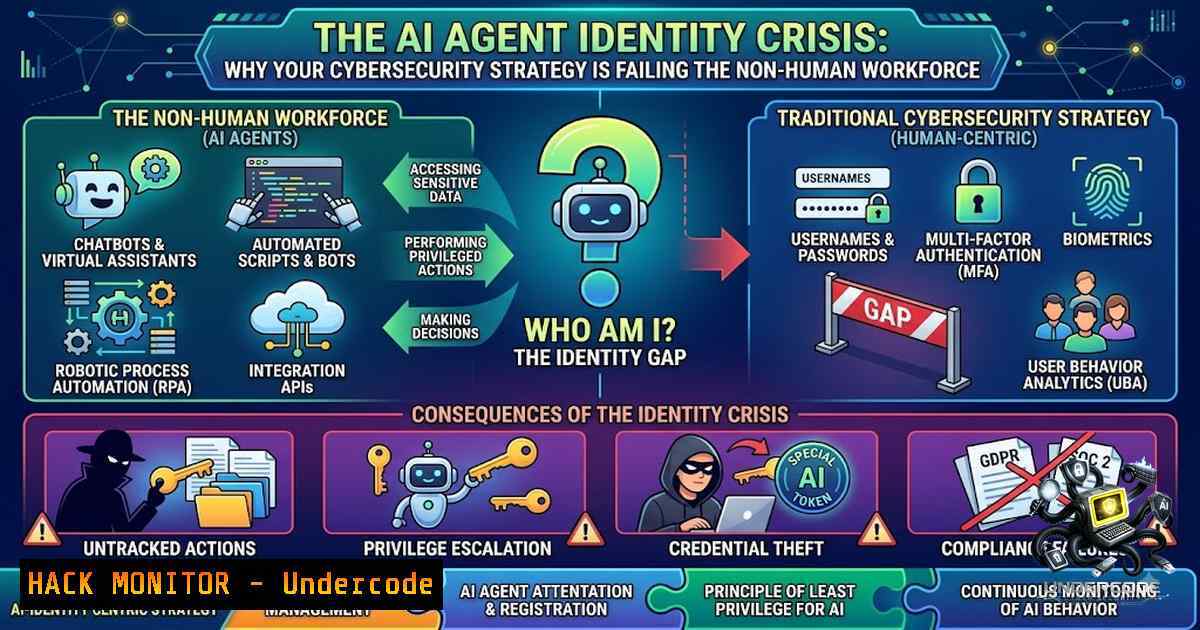
Introduction:
The modern enterprise is no longer composed solely of human employees. Autonomous AI agents—capable of reasoning, making decisions, and executing actions at machine speed—have become integral to daily operations. However, 83% of organizations have zero visibility into what their AI agents are actually doing, while legacy identity and access management (IAM) systems remain fundamentally blind to these non-human identities. This creates a critical security gap: attackers are no longer just hacking people; they are actively exploiting the trust boundary between humans and AI agents.
Learning Objectives:
- Understand the unique security risks introduced by autonomous AI agents, including prompt injection, privilege escalation, and shadow AI.
- Learn how to audit, inventory, and govern AI agents using least-privilege access and zero-trust principles.
- Implement practical technical controls—including Linux/Windows commands and API security configurations—to detect and mitigate AI agent threats.
- Auditing Shadow AI: Discovering the Unseen Agents in Your Environment
Shadow AI refers to any AI tool, agent, or large language model (LLM) integration deployed without explicit security or IT approval. These agents often enter through browser extensions, IDE plugins like Cursor, or SaaS feature toggles that enable AI capabilities by default. Unlike traditional shadow IT, these agents operate continuously, making hundreds of API calls per day and potentially exposing intellectual property, credentials, and customer data.
Step-by-Step Guide to Audit Shadow AI:
- Map Non-Human Identities (NHIs): Begin by inventorying all OAuth applications, API keys, and service accounts within your cloud environment. AI agents often inherit permissions from these NHIs, creating persistent, unmonitored access paths.
- Analyze Network and Firewall Logs: Review firewall logs and MDM data to identify unauthorized AI usage across specific workstations. Look for outbound traffic to known LLM API endpoints (e.g., OpenAI, Anthropic, Google) that are not sanctioned by your organization.
- Audit SaaS and CI/CD Pipelines: Scan platforms like GitHub Actions, GitLab CI, and Jenkins for AI-powered steps or embedded AI features that may have been enabled without proper review.
- Deploy an AI Agent Discovery Tool: Consider using a dedicated solution like KnowBe4’s Agent Risk Manager (ARM), which integrates directly with platforms like Copilot, Gemini, and Claude to provide centralized visibility into installed agents, their capabilities, and connected data sources.
Useful Commands:
- Linux (Network Monitoring): `sudo tcpdump -i eth0 ‘host api.openai.com’` – captures traffic to OpenAI’s API.
- Windows (PowerShell – Process Monitoring): `Get-Process | Where-Object { $_.ProcessName -match “cursor|copilot|claude” }` – lists running processes associated with common AI tools.
- Cloud (AWS CLI – List IAM Roles):
aws iam list-roles --query 'Roles[?contains(RoleName,agent)]'– identifies IAM roles that may be assigned to AI agents.
2. Implementing Least-Privilege Access for AI Agents
AI agents frequently accumulate excessive permissions over time, inheriting broad access from users or service roles that are not always visible in conventional reviews. A single over-privileged agent can become an insider threat: if compromised, it can exfiltrate emails, MFA codes, and files at machine speed without triggering traditional alerts.
Step-by-Step Guide to Restrict Agent Permissions:
- Adopt the “Junior Employee” Model: Treat AI agents like junior employees. They should only have access to what is absolutely necessary to complete their tasks and should require human review for high-impact actions.
- Implement Just-in-Time (JIT) Permissions: Move away from long-lived credentials. Use dynamic, intent-based authorization that grants permissions based on an agent’s specific intent and behavioral trustworthiness for each session.
- Enforce Agent Personas: Implement role-based access control (RBAC) specifically for AI agents. Define granular personas that limit an agent’s data access, tool calls, system actions, and delegated authority.
- Regularly Recertify Permissions: Review and recertify AI agent permissions quarterly, or more frequently for environments handling sensitive data. AI agents can quietly accumulate access over time, so periodic reviews prevent unnecessary permissions from lingering.
Configuration Example (Conceptual – Agent Policy):
{
"agent_id": "email-assistant-01",
"permissions": {
"read": ["inbox/", "calendar/meetings"],
"write": ["drafts/"],
"actions": ["schedule_meeting", "summarize_email"],
"forbidden": ["delete_emails", "forward_external", "access_finance_data"]
}
}
3. Defending Against Prompt Injection and AI-to-AI Phishing
Prompt injection is a critical vulnerability where attackers manipulate an agent’s input to force unintended actions—similar to SQL injection but targeting the AI’s instruction set. As AI agents begin to interact with other agents, attackers can use prompt injection and spoofed interactions to create cascading compromises.
Step-by-Step Guide to Mitigate Prompt Injection:
- Implement a Prompt Firewall: Deploy a runtime prompt inspection layer that analyzes incoming requests and outgoing responses for injection attempts, leakage patterns, and policy violations as they happen.
- Input Sanitization and Validation: Treat all external inputs to AI agents as untrusted. Strip or escape potentially malicious instructions before they reach the model’s context window.
- Inspect Traffic Before the Model: Rather than trusting the model to refuse malicious instructions, inspect and filter traffic before it reaches the agent. This “intent inspection” approach ensures that malicious instructions never land on the agent.
- Monitor for Anomalous Behavior: Log agent activity and track actions across connected systems. Watch for unusual access patterns, such as an email agent suddenly attempting to access a financial database.
Linux Command (Log Analysis):
grep "prompt" /var/log/agent-audit.log | grep -E "inject|drop|delete|exfiltrate"
This command filters audit logs for suspicious keywords commonly used in prompt injection attempts.
4. Modernizing Identity Verification to Combat Deepfake Threats
The threat landscape has expanded beyond digital systems to include the human identity layer. North Korean hackers and other state-sponsored actors are now using generative AI to create deepfake videos and synthetic identities to pass corporate HR hiring processes and gain unauthorized access. Traditional background checks are often ineffective against these synthetic identities.
Step-by-Step Guide to Verify Human Identities:
- Require Live Video Calls: Implement mandatory live video verification during the hiring process. Static checks are insufficient; live interaction with unpredictable questions can help expose deepfake overlays.
- Cross-Reference References: Move beyond simple email exchanges. Verify references through independent channels, such as direct phone calls to known company numbers.
- Train HR on Deepfake Indicators: Educate hiring managers on the signs of deepfake technology, including unnatural eye movement, audio-video sync issues, and inconsistencies in facial features.
- Integrate HR and Security Teams: Break down silos. HR, IT, and security must coordinate to create a robust vetting process that treats identity verification as a security control, not just an administrative task.
-
Deploying AI-1ative Defenses and Embracing Human Detection and Response (HDR)
Legacy defenses—designed for static perimeters and human-paced threats—cannot keep pace with AI-generated attacks that operate at machine speed. Organizations must embrace the Human Detection and Response (HDR) era, utilizing platforms that provide AI-driven coaching and real-time feedback to guide employees through suspicious interactions.
Step-by-Step Guide to Building AI-1ative Defenses:
- Implement Continuous Behavioral Analytics: Use tools that establish a baseline of normal agent behavior and alert on deviations. Behavioral analytics can proactively spot subtle signs of misuse that rule-based systems miss.
- Deploy Real-Time User Coaching: When an employee attempts to enter sensitive data into an unapproved AI prompt, the system should provide immediate, contextual coaching to prevent the action.
- Adopt a Zero-Trust Architecture for Agents: Apply zero-trust principles to AI agents. Verify every identity (human and non-human) and every action before granting access. Ask: “Who are you, what are you trying to do, what is your intent, and does the policy allow it?”.
- Secure the AI Supply Chain: Create an AI Bill of Materials (AI-BOM) that provides lineage and dependency tracking for audit evidence under regulations like the EU AI Act.
Windows PowerShell (Audit Agent Activity):
Get-WinEvent -LogName Security | Where-Object { $_.Message -match "agent|Copilot|Claude" } | Select-Object TimeCreated, Message
This retrieves security event logs related to AI agent activity on a Windows system.
What Undercode Say:
- Key Takeaway 1: The era of the “Digital Employee” has arrived. AI agents are no longer just tools; they are autonomous identities that require the same—if not more—rigorous security controls as human users. Organizations that fail to audit and govern these agents are essentially granting unknown entities privileged access to their most sensitive systems.
- Key Takeaway 2: The threat is not hypothetical. From deepfake-driven hiring fraud to prompt-injection attacks that turn agents into malicious insiders, real-world incidents are demonstrating that attackers are already exploiting the trust between humans and AI. The perimeter has shifted; it is now the complex trust boundary between your people and your AI.
Analysis: The convergence of AI adoption and cybersecurity is creating a new attack surface that traditional security models cannot address. The core problem is one of identity and visibility: security teams lack the instrumentation to see what agents are doing, who they are talking to, and what data they are accessing. This is exacerbated by the speed at which AI operates—an agent can exfiltrate terabytes of data in minutes, long before a human security analyst would notice. The solution requires a fundamental shift in mindset: treating AI agents as first-class citizens in your identity and access management program, applying zero-trust principles to both human and non-human entities, and investing in AI-1ative defenses that can detect and respond to threats at machine speed.
Prediction:
- -1: The gap between AI agent adoption and security governance will continue to widen through 2027, leading to a major, publicly disclosed data breach caused by a compromised AI agent—potentially exceeding the scale of the SolarWinds attack.
- -1: Regulatory bodies will introduce mandatory AI agent auditing and disclosure requirements, similar to GDPR for data privacy, catching many organizations unprepared and resulting in significant fines.
- +1: The development of AI-specific security frameworks (e.g., OWASP Top 10 for LLM, NIST AI RMF) will mature into actionable, auditable standards, providing CISOs with the necessary guidance to secure their digital workforce.
- +1: Human Detection and Response (HDR) platforms will become a standard component of enterprise security stacks, transforming employees from the “weakest link” into active, AI-assisted defenders against AI-generated threats.
▶️ Related Video (80% Match):
🎯Let’s Practice For Free:
🎓 Live Courses & Certifications:
Join Undercode Academy for Verified Certifications
🚀 Request a Custom Project:
Secure, high-velocity infrastructure and disruptive technological engineering. Contact our engineering team for high-tier development and proprietary systems:
[email protected]
💎 Smart Architecture | 🛡️ Secure by Design | ⭐ Trusted by Thousands
IT/Security Reporter URL:
Reported By: https://lnkd.in/p/etJX8Tq5 – Hackers Feeds
Extra Hub: Undercode MoN
Basic Verification: Pass ✅


