
Listen to this Post
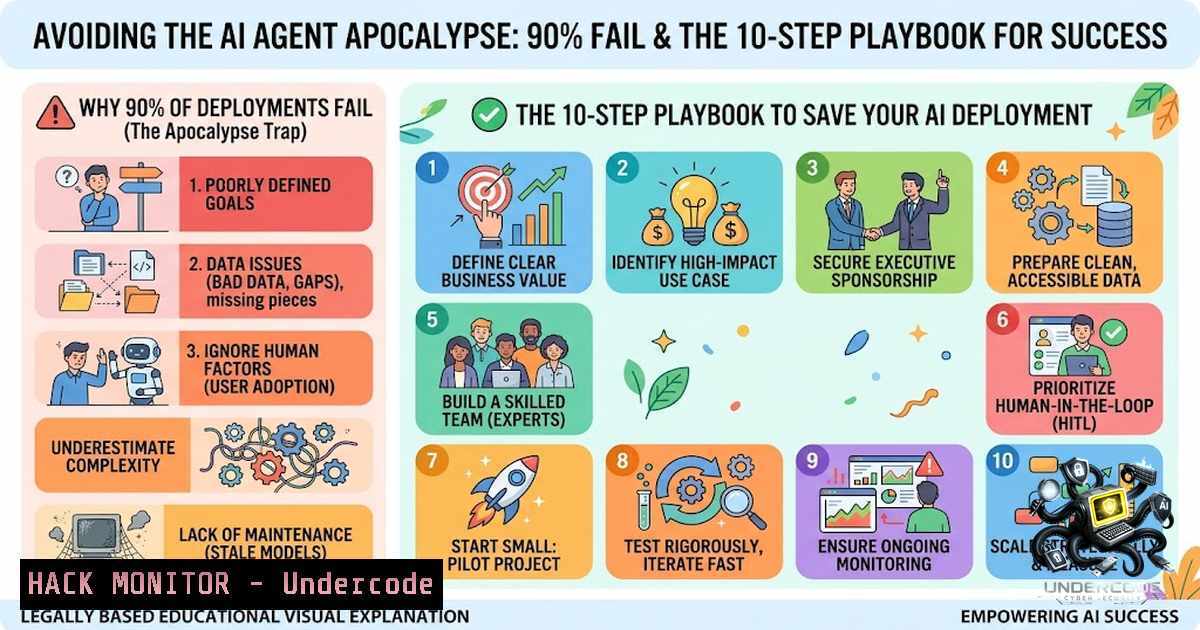
Introduction:
The promise of Artificial Intelligence (AI) agents is transformative—automating complex workflows, generating insights, and acting as digital co-workers. However, the gap between this promise and reality is vast, with the majority of enterprise AI initiatives failing to deliver ROI or actively causing operational chaos. As Rahul Agarwal, an AI strategist, recently highlighted, these failures aren’t due to a lack of advanced algorithms, but a breakdown in foundational data, documentation, and leadership strategies. This article dissects these critical failure points and provides a technical, actionable roadmap to build resilient, effective, and scalable AI systems.
Learning Objectives:
- Objective 1: Identify and mitigate the top 10 operational pitfalls that cripple AI agent performance and adoption.
- Objective 2: Implement a centralized knowledge architecture and real-time data pipelines to ensure AI agents operate with complete, accurate context.
- Objective 3: Establish a continuous improvement lifecycle and human-in-the-loop protocols to maintain accuracy and trust in AI-generated outputs.
- The Context Collapse: Centralizing Knowledge for AI Understanding
Rahul Agarwal’s first and most fundamental point is that “Scattered Knowledge → Missing Context.” Information silos—documents in Notion, conversations in Slack, data in CRMs, and tacit knowledge in employee heads—create a fragmented landscape. An AI agent, relying on a single data source, generates outputs that are at best incomplete and at worst dangerously out of context. The solution is to centralize this knowledge into a unified vector database or knowledge graph that the AI can query holistically.
Step‑by‑step guide to implement a centralized knowledge base:
- Data Ingestion: Use tools like Apache NiFi, Fivetran, or custom Python scripts with libraries like `pandas` and `sqlalchemy` to pull data from various sources (Salesforce, PostgreSQL, Google Drive, Slack APIs).
- Chunking and Embedding: Break down large documents into manageable chunks. Use a model like `text-embedding-ada-002` to convert these chunks into vector embeddings.
from openai import OpenAI
client = OpenAI()
def embed_text(text_chunk):
response = client.embeddings.create(input=text_chunk, model="text-embedding-3-small")
return response.data[bash].embedding
- Vector Storage: Store these embeddings in a vector database like Pinecone, Milvus, or pgvector (PostgreSQL extension). Ensure the index is optimized for cosine similarity searches.
- Retrieval Pipeline: Create a Retrieval-Augmented Generation (RAG) pipeline where the user’s query is embedded and used to query the vector DB for the most relevant chunks. The retrieved context is then fed into the LLM.
- Test the Connection: (Linux) Use `curl` to test API endpoints for data sources. (Windows) Use `Invoke-RestMethod` in PowerShell to validate REST APIs before integration.
2. Real-Time Synchronization: The Antidote to Stale Outputs
Point three, “No Real-Time Data → Stale Outputs,” highlights a critical error: treating AI as a static, batch-processed system. If your AI relies on weekly database dumps while your sales team updates the CRM every minute, the AI’s recommendations will be based on an obsolete reality. Connecting AI to live event streams and APIs ensures it perceives the current state of the business.
Step‑by‑step guide to connecting AI to real-time data:
- Set Up Event-Driven Architecture: Implement Apache Kafka or RabbitMQ to stream data changes (e.g., new orders, support tickets, inventory updates) in real-time.
- Webhook Integration: For simpler applications, configure webhooks within your apps (e.g., Slack, GitHub) to send HTTP POST requests to a secure endpoint that triggers an AI workflow.
- API Management: Secure your data APIs with OAuth 2.0. Use a Python library like `requests` to build a robust API client that handles authentication and retries.
import requests def get_live_data(): headers = {"Authorization": "Bearer YOUR_ACCESS_TOKEN"} response = requests.get("https://your-api.com/live/status", headers=headers) return response.json() - Orchestrate Workflows: Use an orchestrator like Apache Airflow or Prefect to monitor these streams and trigger AI inference jobs based on specific events.
- Security Check: Ensure all data in transit is encrypted using TLS 1.3. Use Azure Key Vault or AWS Secrets Manager to securely store API keys rather than hardcoding them in scripts.
-
Documentation and Workflow Standardization: From Tribal Knowledge to Automatable Code
Addressing points two and five, “Bad Documentation” and “Hidden Workflows,” requires a cultural and technical shift. Documentation must be treated as a living asset, not a one-time project. Version control like Git should be used for all SOPs and knowledge base articles. Furthermore, critical workflows must be extracted from “employees’ heads” and standardized into a format AI can understand, such as BPMN models or executable code.
Step‑by‑step guide to standardizing documentation and workflows:
- Infrastructure as Code (IaC) for Documentation: Store all Markdown documents in a GitHub repository. Implement a CI/CD pipeline (e.g., using GitHub Actions) that validates the format of these documents and deploys them to a searchable knowledge base.
- Prompt Versioning: Create `prompt_templates/` and `chains/` directories in your Git repo. Version your prompts just like you version code to track changes and improvements.
- Expose Documentation to AI: Create a dedicated API endpoint that returns the content of your organization’s SOPs. The AI agent can then query this endpoint to fetch the “correct” way to perform a task.
- Windows Automation: For automating hidden workflows, use PowerShell scripts.
Example: Automating a report generation workflow
$data = Invoke-RestMethod -Uri "https://api.yourcompany.com/data"
$report = $data | ConvertTo-Csv
$report | Out-File -FilePath "C:\Reports\daily_report.csv"
- Linux Automation: Use `cron` jobs to execute Python scripts that trigger AI agents to perform scheduled tasks based on the latest documented procedures.
- Conduct Workflow Autopsy: Interview employees and map their manual processes to a workflow diagram. This diagram is the blueprint for what needs to be documented and eventually automated.
-
The Feedback Loop: Continuous Improvement and the Human Review Layer
Points six and ten—”No Iteration” and “No Review Layer”—underline the need for a systematic approach to AI maintenance. Treating AI as a “set and forget” technology leads to model drift and poor performance over time. A feedback loop, where human evaluators rate outputs and flag errors, is essential. This data is then used to fine-tune models or refine the RAG pipeline.
Step‑by‑step guide to implement a review and iteration process:
- Build a Feedback Interface: Create a simple web app (using Streamlit or Gradio) where team members can view an AI output and provide a rating (1-5) and a comment.
- Collect Review Data: Log these interactions in a database. Record the input prompt, the AI’s output, the human rating, and the timestamp.
- Automated Evaluation Pipelines: (Linux) Write a Bash script using `jq` to parse JSON logs and extract low-rated prompts.
!/bin/bash
cat feedback_logs.json | jq '.[] | select(.rating < 3) | .prompt_id'
- Incorporate Feedback into Fine-Tuning: Use the collected data to create a dataset for supervised fine-tuning (SFT). For example, use the accepted outputs as “positive” samples in your training data.
- Dashboard and Monitoring: Use a monitoring tool like Prometheus and Grafana to visualize the AI’s performance metrics (e.g., average rating, response time, error rates) to identify issues before they become widespread.
- Rule of “N” Reviews: Mandate that any critical action (e.g., financial transactions, code releases) initiated by an AI must be reviewed by a human with appropriate authority.
5. Establishing Ground Truth and Clear Ownership
Points seven, eight, and nine (“Multiple Truths,” “No Ownership,” and “Poor Data Quality”) are the backbone of a trustworthy AI. Without a “single source of truth,” the AI cannot distinguish between conflicting records. Without ownership, no one is responsible for maintaining the underlying data. And without data validation, the AI is doomed to produce “garbage outputs.”
Step‑by‑step guide to data governance for AI:
- Implement MDM (Master Data Management): Use a tool to consolidate data from disparate systems into a master record. For example, create a golden record for each customer from your CRM, billing system, and support database.
- Data Validation Layer: Before feeding data to the AI, run it through a validation script.
def validate_data(record): if not record.get("email") or "@" not in record["email"]: return False if not isinstance(record.get("amount"), (int, float)): return False return True - Assign DRI (Directly Responsible Individual): For each data pipeline and AI workflow, assign a DRI who is accountable for its accuracy and performance. This person is responsible for updating documentation and resolving data quality issues.
- Database Deduplication: (SQL) Write SQL queries to find and merge duplicate records.
-- Example: Finding duplicates in a 'customers' table
SELECT email, COUNT() FROM customers GROUP BY email HAVING COUNT() > 1;
- Windows Scheduled Cleanup: Use Windows Task Scheduler to run a PowerShell script at 2 AM daily that runs a data profiling script and alerts the DRI if data quality metrics fall below a threshold.
What Rahul Agarwal Says: The Diagnosis and The Prescription
Rahul Agarwal’s insights are not just a list of problems but a comprehensive management and technical framework for AI success. His analysis cuts through the hype, reminding us that AI is an extension of an organization’s operations, not a magical replacement for them. The core philosophy is that AI’s intelligence is directly proportional to the quality, structure, and accessibility of the data it consumes. The “10 failures” he identifies are all variations of human and organizational errors—poor documentation, siloed information, and a lack of leadership—that are then amplified by the scale of AI. He emphasizes that AI cannot fix a broken process; it can only automate and accelerate it, for better or worse.
Key Takeaways from the analysis:
- -1: Organizations are rushing to deploy AI without fixing fundamental data hygiene, leading to a crisis of confidence and potentially dangerous decisions.
- -1: The “set and forget” mentality will lead to rapid model degradation and a waste of resources.
- +1: A structured approach to solving these 10 problems provides a clear, non-technical roadmap for business leaders, aligning IT and operations teams.
- -1: Without strong leadership and clear incentives, even the most technically sound AI agent will be rejected by employees who see it as a threat or a nuisance.
- +1: This framework highlights that building AI is a team sport requiring data engineers, software developers, business analysts, and leadership working in concert.
Prediction: The Future of AI Agent Implementations
Over the next 3-5 years, the market will mature, and the “wild west” of AI deployment will give way to a more structured, governance-heavy approach. Organizations that treat AI as a product with a lifecycle, rather than a one-time project, will build a significant competitive advantage.
- +1: The rise of “AI Observability” platforms will become as standard as application performance monitoring (APM) is today, providing real-time insights into data quality and model drift.
- -1: We will see an increase in “AI Ops” teams, specifically dedicated to managing the data pipelines and feedback loops required to keep agents performing optimally.
- +1: Standardization of documentation (like automated markdown generation from code) and workflow automation will be heavily commoditized, lowering the barrier to entry for smaller organizations.
- -1: Early high-profile failures due to “multiple truths” will lead to regulatory scrutiny and the creation of “AI audit” standards, increasing compliance costs for all involved.
▶️ Related Video (76% Match):
🎯Let’s Practice For Free:
🎓 Live Courses & Certifications:
Join Undercode Academy for Verified Certifications
🚀 Request a Custom Project:
Secure, high-velocity infrastructure and disruptive technological engineering. Contact our engineering team for high-tier development and proprietary systems:
[email protected]
💎 Smart Architecture | 🛡️ Secure by Design | ⭐ Trusted by Thousands
IT/Security Reporter URL:
Reported By: Thescholarbaniya Most – Hackers Feeds
Extra Hub: Undercode MoN
Basic Verification: Pass ✅


