
Listen to this Post
Introduction:
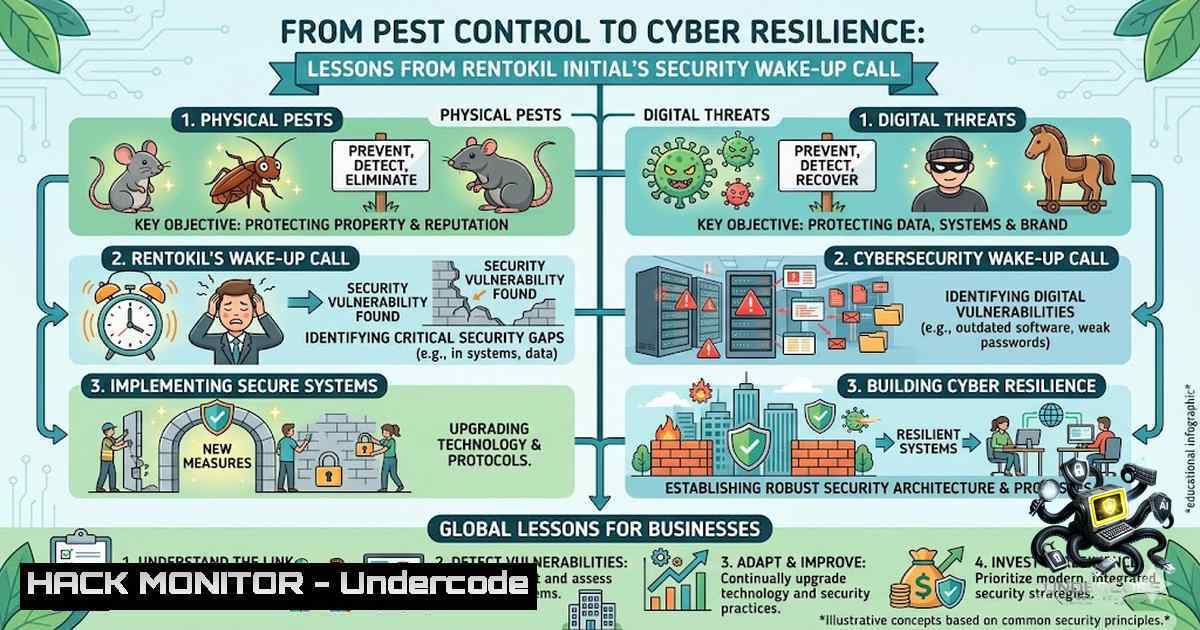
In the same way that summer heat triggers a surge in pest activity—wasps hijacking barbecues and bedbugs stowing away in vacation luggage—the digital world experiences seasonal spikes in malicious activity. The parallels between pest control and cybersecurity are striking: both demand continuous vigilance, multi‑layered defence strategies, and the ability to adapt as threats evolve. Rentokil Initial, a global leader in pest control and hygiene services operating across 90+ countries with annual revenues exceeding £5 billion, recently became a focus of attention not for its pest management expertise, but for a major credential leak that underscores the universality of cyber risk. This article explores how organisations can apply Integrated Pest Management (IPM) principles to cybersecurity defences, drawing on Rentokil Initial’s real‑world experience and the broader summer cyber threat landscape.
Learning Objectives:
- Understand the conceptual parallels between biological pest control and cybersecurity defence strategies.
- Analyse real‑world credential leak data and its implications for enterprise security.
- Learn practical Linux, Windows, and cloud platform hardening commands to mitigate common attack vectors.
- Adopt a multi‑layered “Integrated Pest Management” approach to threat detection and response.
- Identify seasonal cyber threats and take proactive measures before they escalate.
You Should Know:
1. Digital Infestation: The Rentokil Initial Credential Leak
In June 2026, cybersecurity intelligence firm Hudson Rock reported that Rentokil Initial’s domain faced a medium‑level risk threat, with 19 employee accounts compromised and a total of 435 credentials leaked, including 416 unique user accounts. The breach was attributed to information‑stealing malware and ransomware attacks, highlighting a sobering reality: even companies focused on risk management are not immune to digital “infestations.” Leaked credentials can enable attackers to access internal systems, customer data, and proprietary business intelligence—much like a single pest breaching a barrier can lead to a full‑scale invasion.
What This Means for You:
- Credential theft is the digital equivalent of pests entering through unsealed gaps. Once inside, they can spread rapidly.
- Regular monitoring for compromised credentials—using services like Have I Been Pwned or dark web scanning—is essential.
- Implementing multi‑factor authentication (MFA) significantly reduces risk even if credentials are stolen.
Step‑by‑Step Guide: Detecting and Responding to Credential‑Based Attacks
Linux – Check for Suspicious Login Attempts:
sudo grep "Failed password" /var/log/auth.log | awk '{print $9}' | sort | uniq -c | sort -1r
This command parses authentication logs to display the IP addresses with the most failed login attempts, helping you identify potential brute‑force “pests” probing your system.
Windows (PowerShell) – Review Security Event Logs for Account Lockouts:
Get-EventLog -LogName Security -InstanceId 4740 | Select-Object TimeGenerated, @{n='User';e={$<em>.ReplacementStrings[bash]}}, @{n='Domain';e={$</em>.ReplacementStrings[bash]}} | Format-Table -AutoSize
This retrieves account lockout events (Event ID 4740), revealing which users are being targeted and when.
2. Integrated Pest Management (IPM) for Cyber Defence
IPM is a holistic approach that combines biological, cultural, physical, and chemical tools to manage pests economically and with minimal environmental hazard. Translating this to cybersecurity means adopting a defence‑in‑depth strategy that includes prevention, monitoring, and rapid response.
Step‑by‑Step Guide: Building Your Cyber IPM Framework
- Prevention (Cultural Controls): Enforce strong password policies, mandatory MFA, and regular security awareness training. Just as IPM reduces pest habitat, you reduce attack surface by disabling unused services and ports.
- Monitoring (Physical & Biological Controls): Deploy intrusion detection systems (IDS), security information and event management (SIEM), and endpoint detection and response (EDR). Regularly review logs for anomalies.
- Response (Chemical Controls – Targeted Action): When a threat is detected, isolate affected systems, revoke compromised credentials, and apply patches. Have an incident response playbook ready.
Linux – Monitor Active Network Connections:
ss -tulpn | grep LISTEN
Lists all listening ports and associated processes, helping you spot unauthorised services.
Windows (PowerShell) – Check for Unusual Processes:
Get-Process | Where-Object { $_.CPU -gt 50 } | Sort-Object CPU -Descending
Identifies processes consuming high CPU, which may indicate malware activity.
3. Seasonal Threat Patterns: The Summer Surge
Just as summer drives pest proliferation, cyber attackers often increase activity during holidays and peak business periods. The Rentokil leak occurred in June, aligning with a broader pattern of seasonal cyber threats.
Step‑by‑Step Guide: Preparing for Seasonal Peaks
- Conduct a Pre‑Season Risk Assessment: Identify critical assets and potential vulnerabilities.
- Increase Monitoring Frequency: During high‑risk periods, shorten log review intervals and enhance SIEM alerting.
- Run Tabletop Exercises: Simulate a credential‑based attack to test your response team’s readiness.
- Review Third‑Party Access: Ensure vendors and partners adhere to your security standards.
Cloud Hardening – AWS Example: Enable MFA for All IAM Users
aws iam list-users --query 'Users[].UserName' --output text | xargs -I {} aws iam enable-mfa-device --user-1ame {} --serial-1umber arn:aws:iam::account-id:mfa/{} --authentication-code1 123456 --authentication-code2 789012
(Note: Replace with actual MFA device ARN and codes.)
4. Credential Hygiene: Beyond Passwords
The Rentokil breach involved information‑stealing malware, which extracts credentials directly from infected endpoints. This underscores that password complexity alone is insufficient.
Step‑by‑Step Guide: Implementing Credential Hygiene
- Deploy Endpoint Protection: Use EDR solutions to detect and block info‑stealers.
- Use Password Managers: Generate and store unique, complex passwords for each service.
- Implement Conditional Access: Restrict logins based on location, device health, and risk score.
- Rotate Secrets Regularly: Automate the rotation of API keys, database credentials, and service accounts.
Linux – Check for Suspicious SUID Binaries (Potential Privilege Escalation):
find / -perm -4000 -type f 2>/dev/null
Lists files with the SUID bit set, which could be exploited if misconfigured.
Windows – Audit Local User Accounts:
Get-LocalUser | Where-Object { $_.Enabled -eq $true }
Enumerates all enabled local users, helping you spot unauthorised accounts.
5. API Security: The Unseen Entry Point
APIs are increasingly targeted by attackers, much like pests finding their way through tiny cracks. Securing APIs is critical to preventing data exfiltration.
Step‑by‑Step Guide: API Hardening
- Authenticate and Authorise: Use OAuth 2.0 with short‑lived tokens.
- Rate Limit: Prevent brute‑force and DoS attacks by limiting request rates.
- Validate Input: Sanitise all inputs to avoid injection attacks.
- Log and Monitor: Track API access patterns for anomalies.
Linux – Test API Endpoint with `curl` and Check Response Headers:
curl -I https://api.example.com/v1/endpoint
Inspect headers for security misconfigurations (e.g., missing `Strict-Transport-Security`).
Cloud – AWS: Enable API Gateway Throttling
aws apigateway update-usage-plan --usage-plan-id <plan-id> --patch-operations op=replace,path=/throttle/burstLimit,value=100
Sets a burst limit to prevent API abuse.
6. Vulnerability Exploitation and Mitigation
Attackers exploit known vulnerabilities to gain initial access. The Rentokil case highlights the importance of timely patching and vulnerability management.
Step‑by‑Step Guide: Vulnerability Management Cycle
- Scan: Use tools like Nessus or OpenVAS to identify vulnerabilities.
- Prioritise: Focus on CVSS scores and exploitability (e.g., CISA’s Known Exploited Vulnerabilities catalog).
- Patch: Apply patches in a test environment before production.
4. Verify: Re‑scan to confirm remediation.
Linux – Check for Unpatched Packages (Debian/Ubuntu):
sudo apt list --upgradable
Lists packages with available security updates.
Windows – Check Installed Updates:
Get-HotFix | Sort-Object InstalledOn -Descending
Displays recently installed patches.
7. Training and Awareness: The Human Firewall
Rentokil’s leak involved employee accounts, emphasising the role of human error in cyber incidents. Regular training is as vital as technical controls.
Step‑by‑Step Guide: Building a Security‑Aware Culture
- Phishing Simulations: Conduct monthly simulated phishing campaigns.
- Role‑Based Training: Tailor content to developers, executives, and general staff.
- Incident Reporting: Encourage and reward reporting of suspicious activities.
- Continuous Learning: Provide access to cybersecurity courses and certifications.
Recommended Free Resources:
- Linux: `tryhackme.com` for hands‑on labs.
- Windows: Microsoft Learn’s security modules.
- Cloud: AWS Training and Certification (free digital courses).
What Undercode Say:
- Key Takeaway 1: The Rentokil credential leak is a stark reminder that no organisation is immune—credential theft is the digital equivalent of a pest infestation, and multi‑factor authentication is your first line of defence.
- Key Takeaway 2: Adopting an Integrated Pest Management mindset—combining prevention, monitoring, and targeted response—creates a resilient cybersecurity posture that adapts to evolving threats.
Analysis:
The Rentokil incident illustrates a critical vulnerability in even the most established companies: the human element. While technological defences are essential, they are rendered ineffective if credentials are stolen through social engineering or malware. The parallels between pest control and cybersecurity are not merely metaphorical—both fields require continuous monitoring, rapid response, and a willingness to adapt. The leak also highlights the importance of dark web monitoring and proactive credential rotation. Organisations must treat credential hygiene with the same urgency as physical security. Furthermore, the seasonal nature of cyber threats demands that security teams adjust their strategies during peak periods, much like pest control services ramp up during summer. Ultimately, the Rentokil case serves as a wake‑up call for enterprises to reassess their identity and access management strategies, invest in employee training, and embrace a defence‑in‑depth philosophy that leaves no entry point unguarded.
Prediction:
- +1 The increasing awareness of credential‑based attacks will drive broader adoption of passwordless authentication and zero‑trust architectures, reducing the impact of similar leaks in the future.
- +1 Organisations will increasingly draw on cross‑industry analogies—like pest control—to make cybersecurity concepts more accessible, improving employee engagement and compliance.
- -1 However, as long as information‑stealing malware remains profitable, attackers will continue to refine their techniques, making it imperative for defenders to stay ahead through continuous innovation and threat intelligence sharing.
▶️ Related Video (82% Match):
🎯Let’s Practice For Free:
🎓 Live Courses & Certifications:
Join Undercode Academy for Verified Certifications
🚀 Request a Custom Project:
Secure, high-velocity infrastructure and disruptive technological engineering. Contact our engineering team for high-tier development and proprietary systems:
[email protected]
💎 Smart Architecture | 🛡️ Secure by Design | ⭐ Trusted by Thousands
IT/Security Reporter URL:
Reported By: Our History – Hackers Feeds
Extra Hub: Undercode MoN
Basic Verification: Pass ✅


