Listen to this Post
Introduction:
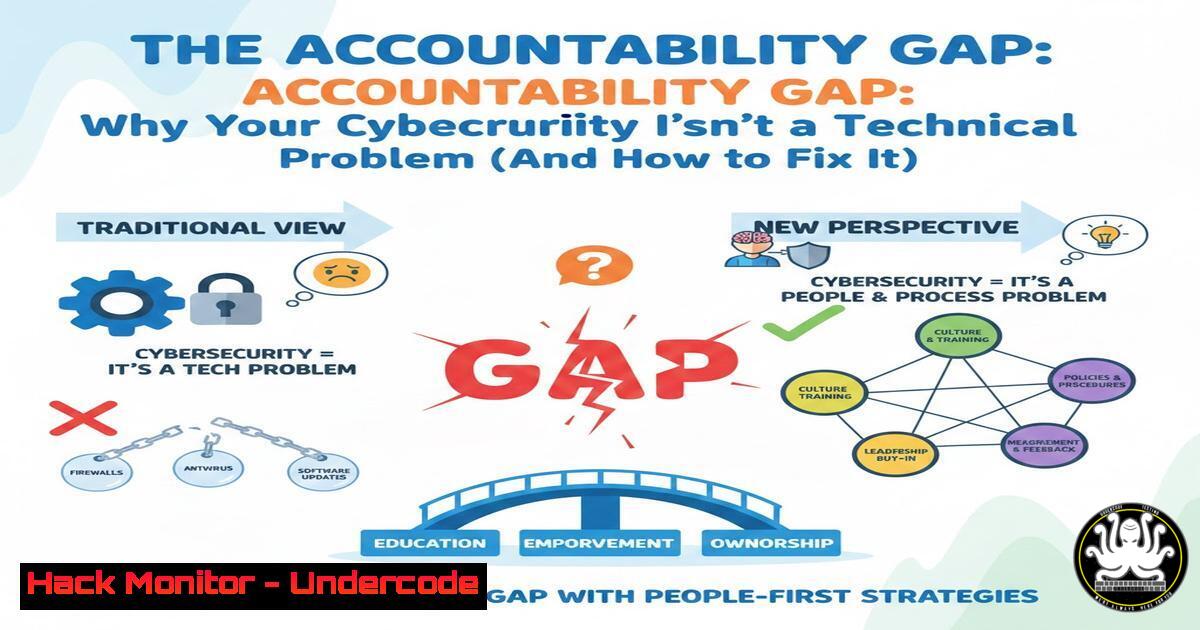
The most sophisticated security tools are rendered useless by a single, pervasive vulnerability: the accountability gap. When cybersecurity responsibility is diffused across an organization, with no single point of ownership at the executive level, it creates a dangerous illusion of control. This article dissects this organizational failure and provides a concrete framework for building true cyber resilience from the boardroom down.
Learning Objectives:
- Identify the symptoms of the accountability gap within your own organization’s structure.
- Implement practical, technical controls to enforce accountability and verify security postures.
- Develop a board-level reporting strategy that moves beyond static slides to actionable risk intelligence.
You Should Know:
1. From Abstract Risk to Concrete Control Mapping
The core failure begins when cyber risk is an abstract concept on a slide, not a mapped set of controls with clear owners. The board must demand evidence, not assurances.
Step-by-step guide explaining what this does and how to use it.
Step 1: Identify Critical Assets. You cannot protect what you do not know. Mandate a comprehensive asset inventory.
Linux Command: Use `nmap` for network discovery: `nmap -sP 192.168.1.0/24` (Replace with your network range). This provides a basic list of live hosts.
Cloud (AWS CLI): Use `aws ec2 describe-instances –query ‘Reservations[].Instances[].{ID:InstanceId,IP:PublicIpAddress,State:State.Name}’ –output table` to list all EC2 instances.
Step 2: Map Controls to Frameworks. Align your security controls with a recognized framework like the NIST Cybersecurity Framework (CSF) or CIS Critical Security Controls. This creates a common language.
Step 3: Assign Explicit Owners. For each control (e.g., “CIS Control 8: Audit Log Management”), assign a specific individual or team. This eliminates ambiguity.
2. Enforcing Privileged Access Accountability
Excessive privileges are a primary attack vector, often stemming from a lack of accountability over identity and access management (IAM).
Step-by-step guide explaining what this does and how to use it.
Step 1: Audit for Privileged Accounts. Regularly check for users with excessive rights.
Windows Command (PowerShell): `Get-ADGroupMember “Domain Admins” | Select-Object name` lists all members of the critical “Domain Admins” group.
Linux Command: `getent group sudo` or `getent group wheel` will list users with sudo privileges.
Step 2: Implement Just-Enough-Access (JEA). Move away from standing privileges. Use Privileged Access Management (PAM) solutions or native cloud tools like Azure PIM or AWS IAM Roles Anywhere to grant temporary, time-bound elevation.
Step 3: Enable Comprehensive Logging. Ensure all privileged sessions are logged and non-repudiable. In AWS, use CloudTrail; in Azure, use Activity Logs. On-prem, forward logs to a SIEM.
3. Validating Incident Response Readiness
A one-page IR plan from 2022 is a liability. Accountability means regularly testing and validating your ability to respond.
Step-by-step guide explaining what this does and how to use it.
Step 1: Conduct Tabletop Exercises. Quarterly, run simulated breach scenarios with the C-suite, IT, legal, and communications. Scenario: “An attacker has phished a finance department user and is moving laterally. What do we do in the first hour?”
Step 2: Test Isolation and Eradication Procedures. Have a playbook for isolating compromised systems.
Network Isolation (Example): On a network switch, you might shut down a port: `interface gi1/0/15` followed by shutdown.
Cloud Isolation (AWS): Use a Lambda function triggered by Security Hub to automatically isolate an EC2 instance by modifying its Security Group to one with no inbound/outbound rules.
Step 3: Conduct a Post-Incident Autopsy. After any real or simulated event, document what went well, what didn’t, and assign owners to the resulting action items.
4. Quantifying Risk for the Board
Stop reporting on “patched systems.” Start reporting on “residual risk.” Translate technical metrics into business impact.
Step-by-step guide explaining what this does and how to use it.
Step 1: Adopt a Risk Quantification Model. Use a model like FAIR (Factor Analysis of Information Risk) to estimate the probable financial loss from a given threat (e.g., ransomware on the primary file server).
Step 2: Build Dynamic Dashboards. Replace slide 23 with a live dashboard. Tools like Elastic SIEM, Splunk, or native cloud dashboards can display real-time metrics: Mean Time to Detect (MTTD), Mean Time to Respond (MTTR), and number of critical vulnerabilities by business unit.
Step 3: Report on Control Effectiveness. Instead of “We have a firewall,” report “The firewall blocked 95% of malicious traffic targeting our customer database, but a new zero-day bypassed it, creating a 5% exposure we are mitigating with WAF rules.”
5. Hardening the Human Layer with Measurable Training
Phishing remains a top initial access vector. Accountability means measuring training effectiveness, not just completion rates.
Step-by-step guide explaining what this does and how to use it.
Step 1: Deploy Phishing Simulations. Use platforms to run controlled phishing campaigns against your own employees. This provides concrete data on susceptibility.
Step 2: Segment and Remediate. Don’t just report a company-wide click-rate. Identify the most vulnerable departments and provide targeted, role-specific training.
Step 3: Implement Technical Hardening. Training is one layer; technical controls are another. Enforce DMARC, DKIM, and SPF records for your email domain to make spoofing harder. For Office 365, use PowerShell to check your SPF record: nslookup -type=TXT yourdomain.com.
What Undercode Say:
- Governance Precedes Technology: The most advanced EDR or SIEM is worthless if no one is accountable for monitoring its alerts and acting on them. Investment must start with clear ownership, not just new software.
- Verification Over Assumption: The chain of failure—”the board assumed the CEO, who assumed the CIO…”—is broken only by a culture of verification. Trust, but verify with logs, tests, and evidence.
The underlying issue is a misalignment of incentives and ownership. Cybersecurity is treated as an operational cost center rather than a core business enabler and risk management function. This creates a scenario where technical teams are set up to fail, lacking the authority and executive sponsorship to implement the necessary, and sometimes disruptive, controls. The attackers’ “clarity and timing” succeed because they operate in a environment of perfect accountability to their goal, while the defense is fragmented. Closing this gap isn’t a technical project; it is an organizational transformation that must be led from the top.
Prediction:
The escalating frequency and impact of cyber incidents, fueled by AI-powered attacks, will force a regulatory and insurance-driven reckoning. Within the next 2-3 years, we will see mandatory cybersecurity accountability laws for board members, similar to Sarbanes-Oxley for financial reporting. Directors will be held personally liable for demonstrating “due care” in their cyber governance, moving far beyond superficial slide decks. Simultaneously, cyber insurance will become unattainable for companies that cannot prove, through auditable controls and clear accountability charts, that they have actively managed their cyber risk. The line in the sand is becoming a legal and financial chasm.
🎯Let’s Practice For Free:
IT/Security Reporter URL:
Reported By: Beatakaminski The – Hackers Feeds
Extra Hub: Undercode MoN
Basic Verification: Pass ✅


