Listen to this Post
Introduction:
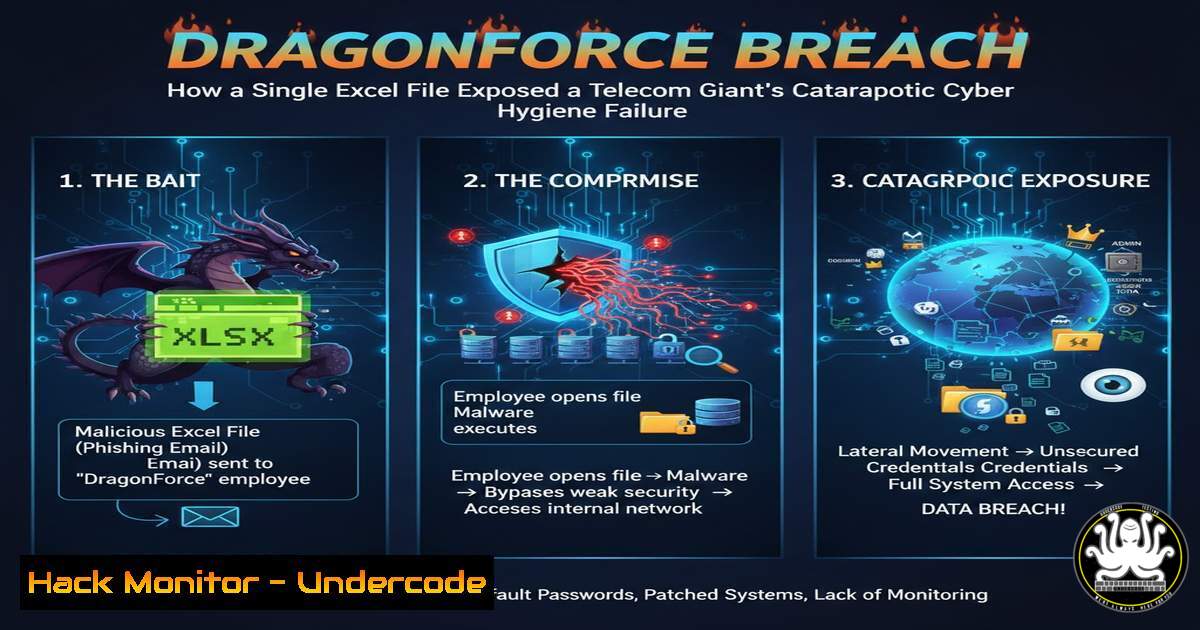
A major UAE telecommunications operator has fallen victim to the DragonForce ransomware gang, with leaked data revealing an alarming spreadsheet titled “Username and passwords_V1.0.xlsx” containing weak, plaintext credentials. This breach underscores critical failures in fundamental cybersecurity practices that allowed threat actors to compromise sensitive infrastructure through basic attack vectors that proper security controls could have prevented.
Learning Objectives:
- Understand the critical risks of storing credentials in plaintext files and implement secure credential management solutions
- Develop and enforce enterprise password policies that resist brute-force and credential stuffing attacks
- Implement multi-layered defense strategies against ransomware groups utilizing double extortion tactics
You Should Know:
1. The Dangers of Plaintext Credential Storage
Storing credentials in unprotected Excel files represents one of the most fundamental security failures an organization can make. The discovered “Username and passwords_V1.0.xlsx” file essentially provided attackers with immediate access to corporate systems without requiring sophisticated exploitation techniques.
Step-by-step guide explaining what this does and how to use it:
To detect plaintext credentials in your environment:
 Linux: Search for files containing password-related terms
find /home /tmp /var -type f -name ".xlsx" -o -name ".txt" -o -name ".csv" | xargs grep -l -i "password|login|credential" 2>/dev/null

Windows PowerShell: Search for potential credential files
Get-ChildItem -Path C:\ -Include .xlsx,.txt,.csv -Recurse -ErrorAction SilentlyContinue | Select-String -Pattern "password","login","credential" | Select-Object -Unique Path
Implement automated scanning as part of your security monitoring to detect these policy violations before attackers do.
2. Implementing Privileged Access Management (PAM) Solutions
As commented by Zaid K., Privileged Access Management (PAM) solutions with password injection provide secure alternatives to manual credential storage. These systems generate, rotate, and inject credentials without exposing them to end users.
Step-by-step guide explaining what this does and how to use it:
Basic PAM implementation steps:
- Inventory all privileged accounts across systems, applications, and databases
- Deploy a PAM solution that supports automated password rotation
3. Configure role-based access controls with session monitoring
- Implement just-in-time privilege elevation for temporary access needs
- Integrate with SIEM systems for audit trail compliance
Example of secure credential retrieval via API:
import requests
import json

Secure credential retrieval from PAM solution
def get_credential(system_id, api_key):
headers = {'Authorization': f'Bearer {api_key}'}
response = requests.get(f'https://pam.company.com/api/v1/systems/{system_id}/credentials', headers=headers)
return response.json()

Credentials are never stored in code or configuration files
3. Enforcing Strong Password Policies
The weak passwords found in the breach indicate inadequate password policy enforcement. Common examples like “Password123” or seasonal variations are easily compromised through basic dictionary attacks.
Step-by-step guide explaining what this does and how to use it:
Implement and enforce robust password policies:
 Windows Group Policy for password complexity
 Computer Configuration > Windows Settings > Security Settings > Account Policies > Password Policy
 Minimum password length: 14 characters
 Password must meet complexity requirements: Enabled
 Minimum password age: 1 day
 Maximum password age: 60 days

Linux via pam_pwquality
 Edit /etc/security/pwquality.conf
minlen = 14
minclass = 4
maxrepeat = 2
dictcheck = 1
usercheck = 1
4. Defense Against Ransomware-as-a-Service (RaaS) Operations
DragonForce operates a RaaS affiliate program utilizing variants of LockBit 3.0 and ContiV3, employing double extortion tactics where data is both encrypted and exfiltrated for leverage.
Step-by-step guide explaining what this does and how to use it:
Implement ransomware protection measures:
 Windows: Enable controlled folder access
Set-MpPreference -EnableControlledFolderAccess Enabled

Linux: Implement file integrity monitoring with AIDE
aide --init
mv /var/lib/aide/aide.db.new.gz /var/lib/aide/aide.db.gz
aide --check

Network segmentation to limit lateral movement
iptables -A FORWARD -s 192.168.2.0/24 -d 10.0.1.0/24 -j DROP
5. Comprehensive Incident Response Planning
The breach highlights the necessity of having tested incident response procedures that include communication protocols, containment strategies, and recovery processes.
Step-by-step guide explaining what this does and how to use it:
Develop and test IR capabilities:
- Establish an incident response team with clearly defined roles
- Implement monitoring and detection systems (EDR, network monitoring)
- Create communication templates for internal and external stakeholders
- Conduct tabletop exercises quarterly with various breach scenarios
- Maintain isolated, encrypted backups with tested restoration procedures
6. Security Awareness and Culture Development
Human factors consistently undermine technical controls. Building a security-conscious culture requires ongoing education and practical reinforcement.
Step-by-step guide explaining what this does and how to use it:
Implement effective security awareness programs:
1. Conduct regular phishing simulations with immediate feedback
- Provide secure alternatives to shadow IT (approved file sharing, password managers)
3. Establish clear reporting channels for security concerns
4. Implement role-based training with practical examples
- Leadership demonstration of security commitment through actions and resources
7. Regulatory Compliance and Security Frameworks
The referenced FCC elimination of cybersecurity requirements for telecom companies represents a regulatory step backward that organizations must counter with self-imposed rigorous standards.
Step-by-step guide explaining what this does and how to use it:
Implement security frameworks regardless of regulatory minimums:
- Adopt NIST Cybersecurity Framework or ISO 27001 as baseline
2. Conduct third-party security assessments annually
3. Implement continuous compliance monitoring
- Maintain detailed audit trails for all privileged access
5. Establish vendor security assessment processes
What Undercode Say:
- Fundamental security hygiene failures continue to enable devastating breaches despite advanced security technologies
- Organizational culture and process discipline separate breach targets from breach victims
- The elimination of cybersecurity regulations creates dangerous gaps that proactive organizations must fill voluntarily
The DragonForce breach demonstrates that sophisticated attack methods aren’t always necessary when fundamental security practices are neglected. The plaintext credential storage represents a catastrophic cultural and procedural failure that technical controls alone cannot prevent. Organizations must recognize that security is not primarily a technology problem but an organizational discipline problem. The most advanced security tools become irrelevant when employees can bypass them with poorly secured spreadsheets containing critical credentials. This incident should serve as a wake-up call for comprehensive security program assessments that address both technical and human factors.
Prediction:
The relaxation of telecom cybersecurity regulations coupled with the proliferation of RaaS operations will lead to increased targeting of critical infrastructure providers. Within 18-24 months, we anticipate a cascade of similar breaches affecting telecommunications, energy, and transportation sectors as threat actors exploit the regulatory gap and persistent hygiene failures. Organizations that fail to voluntarily maintain rigorous security standards will face existential threats from increasingly aggressive ransomware groups employing triple extortion tactics—adding DDoS attacks to existing encryption and data leakage threats.
🎯Let’s Practice For Free:
IT/Security Reporter URL:
Reported By: Stevenmeyergva Uae – Hackers Feeds
Extra Hub: Undercode MoN
Basic Verification: Pass ✅


