Listen to this Post
Introduction:
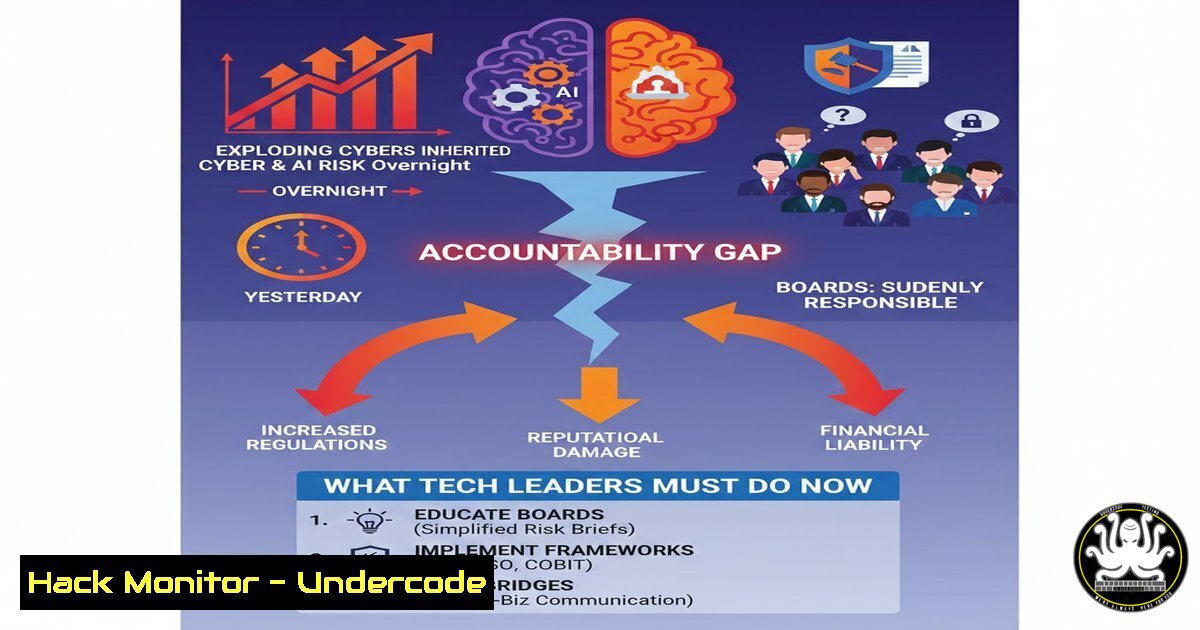
A fundamental reinterpretation of accountability is reshaping corporate governance, with boardrooms and CFOs now directly owning technology risk outcomes. This shift, driven by auditors, insurers, and regulators rather than a single mandate, has created a dangerous lag where oversight structures have not evolved to meet new fiduciary expectations. This article provides a technical roadmap for cybersecurity and IT leaders to build the demonstrable controls, visibility, and escalation mechanisms required to close this governance gap before external scrutiny forces a reactive—and costly—response.
Learning Objectives:
- Understand the technical and procedural disconnects between high-level accountability and operational oversight.
- Implement tools and processes to create board-level visibility into AI and cyber risk exposure.
- Establish auditable control frameworks that trace accountability from code to board report.
You Should Know:
- Quantifying Risk Exposure: From Abstract Liability to Technical Metrics
The board is now accountable for “exposure,” but this remains abstract without technical translation. The gap lies in failing to map technical system behavior to financial and reputational risk statements.
Step‑by‑step guide:
- Instrument Key Systems: Deploy agents to collect data on security posture, AI model performance, and system integrity.
Linux (AuditD for immutable logs): `sudo auditctl -a always,exit -F arch=b64 -S execve -k ai_model_exec` tracks AI model execution.
Windows (PowerShell): Use `Get-WinEvent` to query security and application logs, piping to `Export-Csv` for analysis. - Correlate to Business Impact: Use a Risk Register. A critical vulnerability (CVSS 9.0) isn’t just a ticket; map it to the asset’s role (e.g., “Customer Data Lake”) and potential impact (“Breach impacting 2M records @ $250/record = $500M exposure”).
- Dashboard for Oversight: Feed this into a board-level dashboard (e.g., using Power BI or Grafana) showing Top 5 Risk Exposures, Mitigation Status, and Trend Lines. The key is showing change in risk over time, not just static snapshots.
-
Creating Technical Visibility Where the Board is Legally Blind
Accountability without visibility is liability. Traditional IT reports lack the context for board-level oversight. You must build a traceable chain from infrastructure state to risk posture.
Step‑by‑step guide:
- Implement Agentless Scanning for Configuration Drift: Use tools like OpenSCAP or cloud-native config rules (AWS Config, Azure Policy) to assess hardening.
Linux Compliance Check: `oscap ssh –user root target_host 22 xccdf eval –profile cis_ubuntu_linux_lts –results compliance_report.xml /usr/share/xml/scap/ssg/content/ssg-ubuntu2204-ds.xml`
Azure Policy (CLI): `az policy assignment create –name ‘enforce-https’ –display-name ‘Enforce HTTPS ingress’ –policy ‘‘ –scope ‘/subscriptions/ ‘`
2. Centralize Findings in a SIEM/SOAR: Aggregate logs, vuln scans, and config assessments into a platform like Splunk or Elastic SIEM. Create high-fidelity alerts for control failures. - Automate Executive Briefing Packets: Use SOAR playbooks or scheduled scripts to generate a weekly “Risk Posture Summary” PDF from the SIEM, highlighting critical deviations and actions taken.
3. Hardening the “Explainability” Layer for AI Systems
“Explainability” is a board-level accountability requirement. You must be able to document why an AI model made a decision, especially for regulatory scrutiny.
Step‑by‑step guide:
- Integrate Explainability Tools: For ML models, use libraries like SHAP (SHapley Additive exPlanations) or LIME.
Python Code Snippet (using SHAP):
import shap
 Train your model (model, X_train)
explainer = shap.TreeExplainer(model)
shap_values = explainer.shap_values(X_test)
 Generate visualization for a specific prediction
shap.initjs()
shap.force_plot(explainer.expected_value[bash], shap_values[bash][0], X_test.iloc[bash])
2. Log All AI Model Decisions & Inputs: Ensure every inference call logs its inputs, version, and a pointer to the explanation. Store this in a secure, immutable log.
3. Create an AI Model Registry: Use MLflow or a similar platform to version-control models, their training data lineage, and performance metrics. This registry is your single source of truth for audits.
4. Formalizing Escalation Paths in Incident Response Playbooks
The comment noted that “escalation logic” is outdated. Your IR plan must define precise technical triggers that mandate board notification, moving beyond subjective judgment.
Step‑by‑step guide:
- Define Technical Triggers: In your IR playbook, replace “Escalate to CISO if severe” with:
“Escalate to CFO/Board within 1 hour if:(SIEM alert: 'Data Exfiltration > 100GB') OR (Vuln Scan: 'Critical RCE on public-facing financial system').” - Automate Initial Notification: Use SOAR platforms to auto-generate a draft incident brief from the alert data and send it to a secured board communication channel (e.g., a dedicated Microsoft Teams channel or Onum board portal) upon trigger.
- Conduct Tabletop Exercises: Quarterly, run exercises using realistic breach scenarios. Test not just the technical response, but the accuracy and speed of the board notification protocol.
5. Automating Compliance Evidence for Audit Trails
Auditors now expect demonstrable control. Manual evidence collection is error-prone and fails to scale. Automate the generation of your compliance artifact trail.
Step‑by‑step guide:
- Define Compliance-as-Code: Write your security policies (e.g., “All S3 buckets must be private”) as code using tools like Terraform Sentinel, Checkov, or Regula.
Checkov for IaC Scanning: `checkov -d /path/to/terraform/code –quiet –compact`
2. Schedule Continuous Compliance Scans: Run these checks in your CI/CD pipeline and nightly against production. Fail builds on critical policy violations. - Generate Automatic Audit Reports: Use the output of these tools to populate a compliance dashboard. For each control (e.g., NIST CSF ID.AM-1), the report should show the check result, timestamp, and evidence (e.g., a link to the Terraform code that enforces it).
What Undercode Say:
- Key Takeaway 1: The battlefield has moved. The primary risk is no longer just a technical breach, but the governance lag where technical systems operate without the visibility and control structures needed to satisfy board-level accountability.
- Key Takeaway 2: Intent is irrelevant to regulators. Survival hinges on building demonstrable, automated bridges between technical operations and executive oversight—making risk traceable, explainable, and governable in real-time.
The core insight from the discourse is that accountability has been silently financialized and elevated. This isn’t a IT problem; it’s an enterprise architecture problem. The organizations that will thrive are those that engineer their IT production environments with auditability and explainability as first-class requirements, not afterthoughts. This means investing in the observability pipelines, policy-as-code, and AI governance tooling that turns operational data into assurance language the board and auditors require. The cost of these controls is now definitively less than the cost of unexplained failure.
Prediction:
Within the next 18-24 months, we will see the first major litigation or regulatory action where a board is found personally liable not for a specific hack, but for failing to implement the “reasonable” oversight mechanisms—the dashboards, escalation triggers, and model governance—that would have made the risk visible and manageable. This legal precedent will trigger a frantic, industry-wide scramble for the very technical controls outlined above. The vendors and consultancies that specialize in “Accountability Bridge” technology—tools that seamlessly translate technical state into governance evidence—will become the most valuable players in the cybersecurity and AI ecosystem. The era of plausible deniability for technology risk is over; the era of mandatory technical explainability has begun.
▶️ Related Video (72% Match):
🎯Let’s Practice For Free:
IT/Security Reporter URL:
Reported By: Arshiw Aigovernance – Hackers Feeds
Extra Hub: Undercode MoN
Basic Verification: Pass ✅


