Listen to this Post
Introduction:
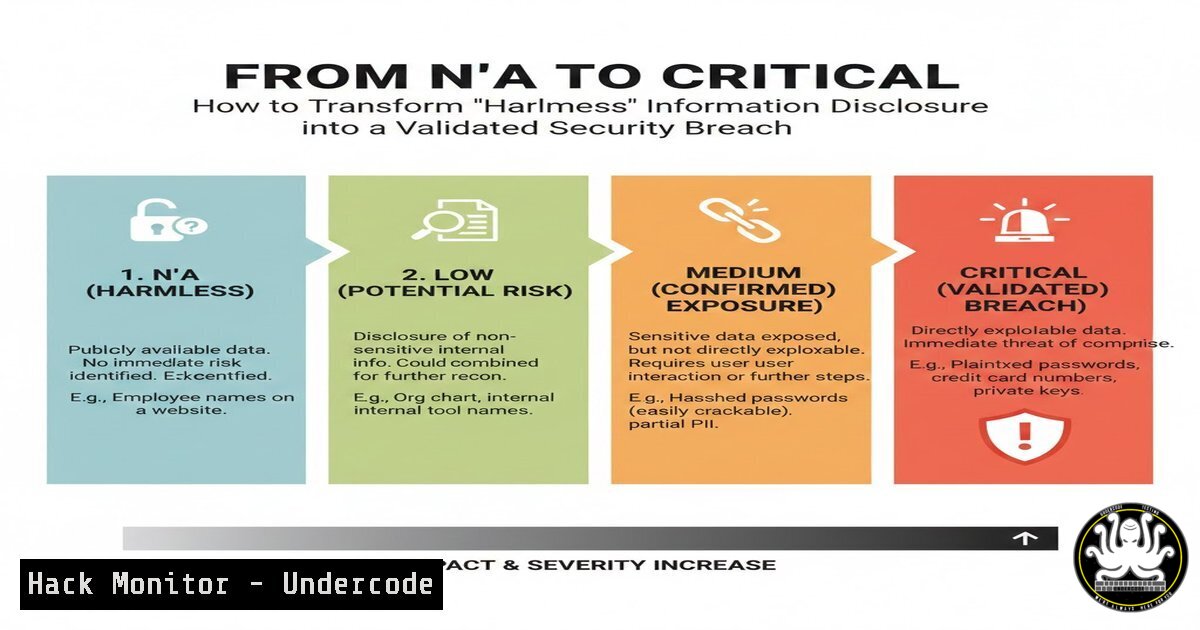
Information disclosure vulnerabilities are frequently dismissed as low-priority or marked “N/A” by bug bounty programs and internal security teams, often due to a perceived lack of immediate impact on Confidentiality, Integrity, or Availability (CIA). However, as illustrated by a recent pentester’s discovery of live production telemetry, backend service details, and runtime environment indicators, these leaks form the critical reconnaissance foundation for sophisticated attacks. This article deconstructs how to escalate seemingly benign information leaks into demonstrably high-severity findings by mapping exposed data to tangible attack surfaces and business logic flaws.
Learning Objectives:
- Learn to systematically catalog and classify all data points exposed through an information disclosure vulnerability.
- Understand how to chain exposed information with other vulnerabilities or misconfigurations to demonstrate clear impact.
- Master the methodology for crafting a compelling report that transitions a finding from “N/A” to “Accepted” by proving business risk.
You Should Know:
1. Beyond the Error Message: Cataloging the Exposure
The initial step is to move beyond a generic “information disclosure” label. You must meticulously document every piece of data leaked, as each can enable a different attack vector. In the case described, the exposure included:
Live Production Telemetry: Real-time system performance data.
Backend Identification (n8n): Specific automation tooling in use.
Runtime Environment (Node.js): Application framework and potential version.
Business Logic Surface: Insights into internal application workflows.
Event Loop Latency & Uptime: Server performance metrics and start time.
Step-by-Step Guide:
- Intercept & Document: Use a proxy tool like Burp Suite or OWASP ZAP to capture all server responses. Save every unique response containing leakage.
2. Normalize Data: Create a structured table:
| Exposed Data Point | Potential Use for an Attacker | Example Command/Tool |
| : | : | : |
| Server: `nginx/1.18.0 (Ubuntu)` | Version-specific exploit research | `searchsploit nginx 1.18.0` |
| `X-Powered-By: Express` | Node.js/Express framework attacks | `npm audit` for Express CVEs |
| Internal IP: `10.10.15.3` | Network mapping & pivot point | `nmap -sV 10.10.15.3` (if reachable) |
3. Enumerate Further: Use the initial leak (e.g., an exposed `/api/env` endpoint) to check for more severe disclosures like `.env` files containing API keys, database credentials, or cloud storage buckets.
 Linux/CURL example to check for common sensitive files
for path in /.env /config.json /api/health /api/debug /api/users; do
curl -s "https://target.com$path" | head -c 500
done
- From Recon to Attack Surface: Mapping Data to Exploitation
Information is only power if you can weaponize it. Your goal is to link each data point to a specific, exploitable attack surface.
Step-by-Step Guide:
- Identify Technology Stack: Use tools like `Wappalyzer` (browser extension) or `WhatWeb` to confirm and expand on the leaked stack info.
Linux command-line reconnaissance
whatweb -v https://target.com
- Search for Known Vulnerabilities: Correlate the exact versions (of n8n, Node.js, etc.) with public exploits and CVEs.
Using searchsploit on Kali Linux
searchsploit n8n
searchsploit node.js
- Map Business Logic: Exposed endpoints (from
Business Logic Surface) should be fuzzed for insecure direct object references (IDOR), broken access control, or SQL injection.Using ffuf for endpoint fuzzing based on discovered patterns ffuf -w /usr/share/wordlists/common.txt -u https://target.com/api/FUZZ/v1/user -fs 404
3. Proving Impact: The “So What?” Factor
This is the most critical phase. You must answer: How does this information directly enable a breach of CIA? For example:
Telemetry/Error Data: May reveal internal hostnames, IPs, database schemas, or stack traces.
Uptime & Process Start Time: Can aid in timing attacks or service disruption.
n8n Identification: Exposes an entire workflow automation platform that, if vulnerable, could be a pivot point to internal systems.
Step-by-Step Guide: Crafting a Proof of Concept (PoC):
- Scenario: Leaked data shows `AWS_S3_BUCKET=customer-uploads-prod` in a stack trace.
2. Impact Test: Check for bucket misconfiguration.
 Check for public list/read/write permissions
aws s3 ls s3://customer-uploads-prod --no-sign-request
aws s3 cp s3://customer-uploads-prod/secretfile.txt . --no-sign-request
3. Documentation: Clearly show how the leaked data led directly to accessing sensitive customer data, transforming “information disclosure” into “Insecure Direct Object Reference leading to PII breach.”
4. Advanced Chaining: Linking Disclosures to Other Vulnerabilities
An information leak is rarely an island. Use it as the first step in a kill chain.
Example Chain: Leaked internal endpoint (/internal-api/) -> Found via fuzzing -> Vulnerable to SQL injection (found via sqlmap) -> Extracted user hashes -> Cracked hashes -> Reused on admin panel (also discovered via leakage).
Step-by-Step Guide:
- Use Shodan or Censys to find other assets using the same software stack revealed in the leak.
Shodan CLI example (requires API key)
shodan search 'http.title:"n8n"'
- Use leaked version info to search for unpatched XSS or RCE payloads that could be delivered to users of the application, not just the server itself.
-
The Art of the Report: From N/A to High Severity
A well-structured report is what ultimately changes a triager’s mind.
Step-by-Step Guide:
- Be specific. Not “Info Disclosure” but “Information Disclosure of n8n Backend, Runtime Metrics, and Business Logic Enabling Targeted Attacks.”
- Summary: Briefly state what is exposed and its primary dangerous implication.
- Technical Details: Include the raw HTTP request/response with the leakage highlighted.
- Impact Analysis: This is your argument. Write: “While this data alone does not compromise CIA, it significantly reduces the effort for a targeted attack. Specifically: (1) Knowledge of n8n vX.X reveals CVE-YYYY-XXXX (RCE), (2) Server uptime aids in timing attacks, (3) Internal API endpoints provide a direct fuzzing target.”
- Remediation: Recommend removing verbose headers, disabling debug endpoints in production, and implementing proper error handling.
What Undercode Say:
- Key Takeaway 1: Context is Everything. An information disclosure’s severity is not intrinsic to the data leaked but is defined by how that data reduces the cost and complexity of a subsequent attack. A version string is low risk; a version string for a software with a known, exploitable RCE in your scope is a high-risk enabler.
- Key Takeaway 2: The Burden of Proof is on the Hunter. To overcome the “N/A” barrier, you must proactively construct the attacker’s narrative. Don’t just show the data; show the next three steps an attacker would take using it, and demonstrate at least one of those steps is feasible within the target’s security scope.
Prediction:
The automated dismissal of information disclosure vulnerabilities will become increasingly untenable. As attack automation grows, the value of reconnaissance data will skyrocket. We will see a rise in “semantic triaging” where AI tools not only classify vulnerabilities but also automatically attempt to chain them, much like a human attacker. This will force bug bounty platforms and security teams to adopt more nuanced, context-aware scoring systems (like the new-age Factor Analysis of Information Risk approaches). Findings that reveal architecture maps, specific third-party service dependencies, or internal system states will be re-categorized as “Attack Path Enablers” with medium to high severity, reflecting their true role in modern multi-step breaches. The pentester’s skill will shift even more towards impact demonstration and threat modeling, rather than just vulnerability discovery.
🎯Let’s Practice For Free:
IT/Security Reporter URL:
Reported By: Kareem Jaafar – Hackers Feeds
Extra Hub: Undercode MoN
Basic Verification: Pass ✅


