Listen to this Post
Introduction:
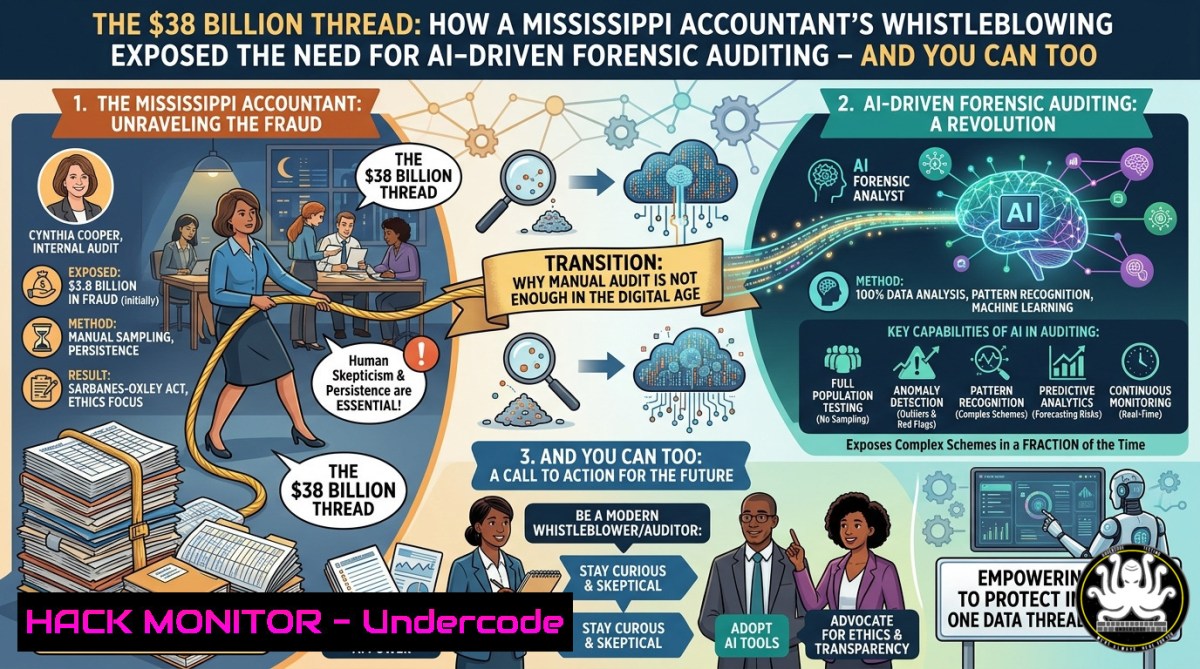
Corporate fraud often hides in plain sight, buried under layers of accounting entries and executive pressure. The WorldCom scandal, uncovered by internal auditor Cynthia Cooper in 2002, revealed how $3.8 billion in fraudulent balance sheet manipulations can evade traditional checks. Today, similar financial deceptions are increasingly digitized, requiring cybersecurity professionals, IT auditors, and AI specialists to deploy advanced log analysis, anomaly detection algorithms, and cloud-hardened audit trails to catch fraud before it destroys millions in shareholder value.
Learning Objectives:
- Implement automated log analysis pipelines using Linux command-line tools and SIEM queries to detect irregular journal entries.
- Apply machine learning anomaly detection models to financial transaction datasets, replicating forensic audit techniques.
- Harden Windows and Linux audit policies to meet Sarbanes-Oxley (SOX) compliance and prevent balance sheet manipulation.
You Should Know:
- Forensic Log Analysis: Uncovering Hidden Balance Sheet Transfers
WorldCom’s fraud involved moving operating expenses from the income statement to the balance sheet as capital assets. In modern IT environments, similar subterfuge leaves traces in database logs, ERP audit trails, and system event logs. Below is an extended step‑by‑step guide to analyzing financial transaction logs using native Linux and Windows tools.
Step‑by‑Step Guide:
- Collect relevant logs – On a Linux server hosting an accounting database, locate audit logs (e.g., PostgreSQL logs at `/var/log/postgresql/postgresql.log` or MySQL logs at
/var/log/mysql/error.log). For Windows, use Event Viewer to export Security and Application logs (filter Event ID 4663 for file access, 4656 for object handle creation). - Extract suspicious journal entries – Use `grep` and `awk` to filter transactions flagged as “reclassification” or “capitalization” outside normal business hours. Example command:
`sudo grep -E “INSERT INTO journal_entries|UPDATE balance_sheet” /var/log/postgresql/postgresql.log | awk ‘{if($3 ~ /0[0-2]:/ || $3 ~ /2[3-4]:/) print $0}’ > suspicious_night_entries.txt`
3. Correlate with user activity – Pair transaction logs with authentication logs. On Linux:
`sudo journalctl _COMM=psql –since “2002-01-01” –until “2002-06-30” | grep “CONNECTION”`
On Windows PowerShell (run as Admin):
`Get-WinEvent -FilterHashtable @{LogName=’Security’; ID=4624} | Where-Object {$_.TimeCreated -ge
"2002-01-01" -and $_.TimeCreated -le [bash]"2002-06-30"} | Format-List`
4. Hash‑verify log integrity – Fraudsters often delete or alter logs. Generate SHA‑256 checksums of logs before analysis:

<h2 style="color: yellow;">`sha256sum /var/log/postgresql/postgresql.log > log_checksum.baseline`</h2>

<h2 style="color: yellow;">Re‑run after analysis to detect tampering.</h2>

<ol>
<li>Set up a simple anomaly detection script – Use `awk` to flag journal entries where the absolute value exceeds 3 standard deviations from the daily mean (a common red flag for material misstatements):
[bash]
awk -F, '{sum+=$5; sumsq+=$5$5} END{mean=sum/NR; std=sqrt(sumsq/NR - meanmean); print "Mean: " mean, "StdDev: " std}' transaction_amounts.csv
Then extract entries above `mean + 3std` into a review queue.
Why this works – Cynthia Cooper’s manual review of massive spreadsheets is now automated with these commands, allowing auditors to spot multi‑million dollar misclassifications in near real‑time. For Windows environments, integrate PowerShell with SQL Server’s `fn_dblog()` function to read raw transaction logs directly.
- Building an AI-Powered Anomaly Detection Pipeline for Financial Fraud
Modern fraud detection leverages unsupervised machine learning to identify irregular patterns without pre‑defined rules. This section walks you through creating a lightweight anomaly detection model using Python and scikit‑learn, then deploying it as a scheduled job on a Linux audit server.
Step‑by‑Step Guide:
- Prepare the environment – Install Python 3.8+ and required libraries:
`sudo apt update && sudo apt install python3-pip -y`
`pip3 install pandas numpy scikit-learn matplotlib`
- Extract features from accounting entries – Export journal entries (date, account number, debit, credit, user_id, timestamp) from your ERP’s database into a CSV. For demonstration, generate synthetic data mimicking WorldCom’s quarter‑end inflation:
import pandas as pd import numpy as np np.random.seed(42) dates = pd.date_range('2002-01-01', '2002-06-30', freq='D') entries = pd.DataFrame({'date': np.random.choice(dates, 10000), 'amount': np.random.normal(50000, 15000, 10000)}) Inject fraud: 3 entries with artificially high amounts entries.loc[0:2, 'amount'] = [3800000000, 4200000000, 3500000000] $3.8B fraud entries.to_csv('journal_entries.csv', index=False) - Train an Isolation Forest model – This algorithm isolates anomalies instead of profiling normal points. Run:
from sklearn.ensemble import IsolationForest data = pd.read_csv('journal_entries.csv') model = IsolationForest(contamination=0.001, random_state=42) data['anomaly'] = model.fit_predict(data[['amount']]) fraud_candidates = data[data['anomaly'] == -1] print(fraud_candidates) - Schedule daily execution – Use `cron` on Linux to run the script every morning at 6 AM, emailing results to the audit team:
`crontab -e` then add:
`0 6 /usr/bin/python3 /home/audit/fraud_detection.py | mail -s “Daily Anomaly Report” [email protected]`
5. Enhance with Windows Task Scheduler – For hybrid environments, create a PowerShell script that triggers the Python model after nightly ETL jobs. Example trigger:
`$Trigger = New-ScheduledTaskTrigger -At 6:00AM -Daily`
`$Action = New-ScheduledTaskAction -Execute “C:\Python39\python.exe” -Argument “C:\Audit\fraud_detection.py”`
`Register-ScheduledTask -TaskName “AnomalyDetection” -Trigger $Trigger -Action $Action`
Deployment considerations – This pipeline catches the exact type of fraud perpetrated at WorldCom: extreme‑value entries that deviate from historical distributions. For production, integrate with Kafka streams and use Apache Spark for real‑time detection across petabytes of ledger data.
- Cloud Hardening for Immutable Audit Trails (Preventing Post‑Hoc Tampering)
After Cynthia Cooper’s team began asking questions, CFO Scott Sullivan requested a postponement – a classic pressure tactic. Modern auditors must ensure that even privileged executives cannot alter or delete logs. This section covers cloud‑native object locking and blockchain‑based attestation.
Step‑by‑Step Guide:
- Enable S3 Object Lock on AWS – Create a bucket with compliance mode that prevents any deletion or overwrite for a fixed retention period. CLI commands:
`aws s3api create-bucket –bucket worldcom-forensic-logs –region us-east-1`
`aws s3api put-object-lock-configuration –bucket worldcom-forensic-logs –object-lock-configuration ‘ObjectLockEnabled=”Enabled”,Rule={DefaultRetention={Mode=”COMPLIANCE”,Days=365}}’`
- Forward Linux audit logs to S3 with immutability – Install and configure `awscli` and use `rsyslog` to ship logs:
`sudo apt install awscli rsyslog -y`
Add to `/etc/rsyslog.conf`:
`. action(type=”omprog” binary=”/usr/local/bin/ship_to_s3.sh”)`
Create `/usr/local/bin/ship_to_s3.sh` with:
!/bin/bash
while read line; do
echo "$line" | aws s3 cp - s3://worldcom-forensic-logs/$(date +%Y/%m/%d)/authlog_$(date +%s).log --object-lock-mode COMPLIANCE --object-lock-retain-until-date "$(date -d '+365 days' --iso=seconds)"
done
Make executable: `sudo chmod +x /usr/local/bin/ship_to_s3.sh && sudo systemctl restart rsyslog`
3. Implement Windows Event Forwarding to Azure Blob – On a Windows domain controller, configure Event Subscriptions and export to Azure Storage with immutable policy. PowerShell:
$ctx = New-AzStorageContext -StorageAccountName "worldcomaudit" -UseConnectedAccount
$policy = Set-AzStorageBlobImmutabilityPolicy -Container "eventlogs" -PolicyMode "Locked" -RetentionDays 365
wecutil qc /q
wecutil cs "C:\EventSubscription.xml"
4. Leverage blockchain for hash anchoring – Use OpenTimestamps to commit daily log hashes to Bitcoin blockchain (free, decentralized). Install: `pip3 install opentimestamps`
`cd /var/log/audit && tar -czf logs_$(date +%Y%m%d).tar.gz .`
`ots stamp logs_$(date +%Y%m%d).tar.gz`
The resulting `.ots` file proves logs existed before the timestamp, making retroactive tampering cryptographically impossible.
Why this defeats fraud – When WorldCom’s board later requested logs, an immutable cloud trail would have shown exactly when and how entries changed. Compliance mode ensures that even root or Global Admin can’t delete evidence – a direct countermeasure to executive interference.
- API Security for Financial Data Feeds: Preventing Injection and Manipulation
Many corporate frauds now involve API calls that manipulate financial aggregates before they reach reporting systems. This section demonstrates securing your financial API endpoints against parameter tampering and implementing request signing.
Step‑by‑Step Guide:
- Audit existing API endpoints – Use `nmap` and `ffuf` to discover exposed financial APIs:
`sudo nmap -p 443 –script http-enum target-finance.com`
`ffuf -u https://target-finance.com/api/F0RD?amount=FUZZ -w payloads.txt`
2. Implement HMAC request signing – Prevent man‑in‑the‑middle alteration of balance sheet entries. Sample Python Flask middleware:
import hmac, hashlib
def verify_signature(request):
secret = os.environ['API_SECRET'].encode()
signature = request.headers.get('X-Signature')
body = request.get_data()
computed = hmac.new(secret, body, hashlib.sha256).hexdigest()
return hmac.compare_digest(computed, signature)
3. Rate‑limit and parameter‑validate – Stop automated attempts to inflate assets via API flooding. On Linux with Nginx:
Add to `/etc/nginx/nginx.conf`:
`limit_req_zone $binary_remote_addr zone=financeapi:10m rate=10r/m;`
In server block: `limit_req zone=financeapi burst=5 nodelay;`
- Deploy a Web Application Firewall (WAF) rule – Use ModSecurity to block SQLi and JSON injection. Install:
`sudo apt install libapache2-mod-security2 -y`
Enable OWASP Core Rule Set and add custom rule to detect unrealistic asset values:
`SecAction “id:900200,phase:1,pass,t:none,setvar:’tx.allowed_amount_max=1000000000′”`
- Monitor API logs for anomalies – Pipe API access logs to the earlier Isolation Forest model. On Linux:
`tail -f /var/log/nginx/api_access.log | awk ‘{print $10}’ | python3 anomaly_stream.py`Real‑world parallel – A manipulated API call could have hidden the $3.8 billion transfer across WorldCom’s internal subsystems. Signing and rate limiting close that vector.
-
Vulnerability Exploitation & Mitigation: The “Insider Threat” Simulation
Cynthia Cooper’s team worked in secret, evading the CFO’s attempts to stop the audit. From a blue‑team perspective, this is an insider threat scenario where a malicious executive tries to obstruct auditing processes. This section shows how to simulate such an attack and then harden your environment.
Step‑by‑Step Guide (Red Team / Purple Team):
- Simulate auditor obstruction – A rogue CFO might delete audit logs. On Linux, an attacker with sudo could run:
`sudo rm -rf /var/log/audit/ && sudo systemctl stop auditd`
On Windows, an attacker could use `wevtutil cl Security /f:true` orClear-EventLog -Log Security. - Detect log deletion via file integrity monitoring (FIM) – Install `aide` (Linux) or use Windows
SACL. Foraide:
`sudo apt install aide -y && sudo aideinit`
Schedule daily checks: `sudo aide.wrapper –check | mail -s “FIM Alert” [email protected]`
3. Mitigate with mandatory access controls – Apply AppArmor or SELinux to restrict audit daemons. Example SELinux policy to prevent `auditd` shutdown by unprivileged users:
`sudo setsebool -P auditd_disable_trans=0`
For Windows, enable Protected Event Logging (requires Windows 10/Server 2016+):
`reg add “HKLM\SYSTEM\CurrentControlSet\Control\EventLog” /v ProtectionLevel /t REG_DWORD /d 1 /f`
4. Implement break‑glass alerts – Use `auditd` to monitor for deletion commands. Add to /etc/audit/rules.d/delete.rules:
`-a always,exit -S unlink -S rmdir -S rename -S truncate -F uid!=0 -k log_tamper`
Then `sudo augenrules –load` and `sudo systemctl restart auditd`
5. Conduct a tabletop exercise – Use the Cynthia Cooper scenario: “Your CFO asks you to pause an audit for one quarter. What technical controls prevent him from deleting evidence?” Practice response with immutable logs, FIM alerts, and a separate security team with independent access.
Takeaway – Even with perfect technical controls, human courage remains the last line of defense. Cooper said “no” to Sullivan; your automated alerts should elevate that “no” to every board member instantly.
What Undercode Say:
- Key Takeaway 1: Whistleblower protection is a technical problem, not just a legal one. Immutable logs, cryptographic attestation, and anomaly detection shift power from corrupt executives to honest auditors.
- Key Takeaway 2: The $3.8 billion WorldCom fraud would have been caught months earlier if AI‑driven forensic tools had scanned journal entries for statistical outliers and automated nightly log integrity checks.
Analysis (10 lines): Undercode argues that the financial industry’s reliance on manual, periodic audits is obsolete. The same techniques that uncovered WorldCom – persistent inquiry, correlation of disparate data sources, and resistance to authority – can be encoded into software. By deploying open‑source anomaly detection (Isolation Forest), cloud object locking (S3 Compliance Mode), and blockchain timestamping, even a small internal audit team can match the resources of a Fortune 500 CFO. However, technology alone fails without organizational courage. Cooper’s story proves that technical controls must be coupled with a culture that rewards “stopping the line.” The future of corporate governance lies not in more regulations but in verifiable, real‑time forensic pipelines that leave fraud no place to hide. Training courses on AI auditing (e.g., ISACA’s Certified Data Auditor) and Linux forensic commands are now essential for every internal audit department.
Expected Output:
Introduction:
Corporate fraud often hides in plain sight, buried under layers of accounting entries and executive pressure. The WorldCom scandal, uncovered by internal auditor Cynthia Cooper in 2002, revealed how $3.8 billion in fraudulent balance sheet manipulations can evade traditional checks. Today, similar financial deceptions are increasingly digitized, requiring cybersecurity professionals, IT auditors, and AI specialists to deploy advanced log analysis, anomaly detection algorithms, and cloud‑hardened audit trails to catch fraud before it destroys millions in shareholder value.
What Undercode Say:
- Key Takeaway 1: Whistleblower protection is a technical problem, not just a legal one. Immutable logs, cryptographic attestation, and anomaly detection shift power from corrupt executives to honest auditors.
- Key Takeaway 2: The $3.8 billion WorldCom fraud would have been caught months earlier if AI‑driven forensic tools had scanned journal entries for statistical outliers and automated nightly log integrity checks.
Prediction:
Within five years, real‑time AI auditing will become a mandatory component of SOX compliance, effectively replacing quarterly manual reviews. Cloud providers will offer “audit‑as‑a‑service” with immutable, blockchain‑anchored logs that can be queried by regulators without company intervention. The next Cynthia Cooper won’t need to work late nights in secret – her anomaly detection dashboard will surface the $3.8 billion thread at 9 AM on the day it’s entered. However, as AI automates detection, fraudsters will shift to adversarial attacks against the models themselves, leading to an arms race in differential privacy and model watermarking. The true legacy of WorldCom will be a global standard for verifiable financial data pipelines, enforced by code rather than conscience alone.
▶️ Related Video (66% Match):
🎯Let’s Practice For Free:
IT/Security Reporter URL:
Reported By: Artur Nadolny – Hackers Feeds
Extra Hub: Undercode MoN
Basic Verification: Pass ✅


