Listen to this Post
Introduction:
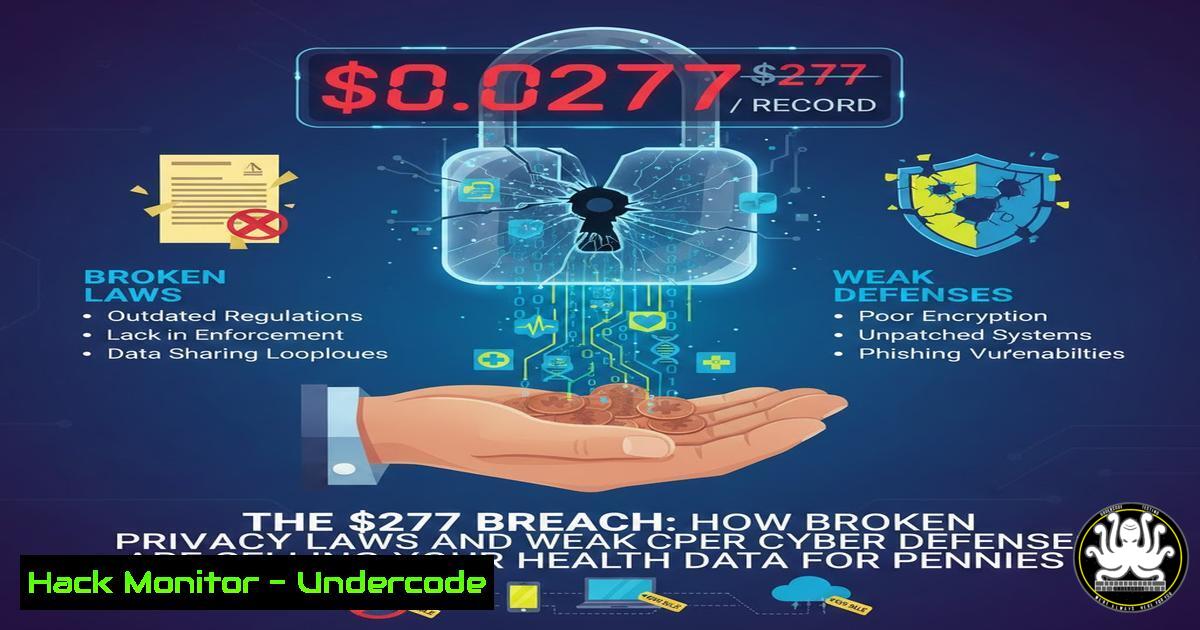
The recent Manage My Health data breach, exposing 126,000 individuals, has starkly highlighted a systemic failure in cybersecurity and privacy law. While companies suffer minimal financial penalties, affected individuals face a grueling process for negligible compensation, revealing a dangerous misalignment of incentives that prioritizes corporate convenience over citizen security. This incident underscores the critical need for both robust technical safeguards and legislative reform with real teeth.
Learning Objectives:
- Understand the technical and legal vulnerabilities exposed by the Manage My Health breach.
- Implement actionable security measures to protect sensitive health data in API and cloud environments.
- Analyze the gap between regulatory penalties and the true cost of a data breach.
You Should Know:
- Anatomy of a Modern Health Data Breach: Beyond the Headline
The Manage My Health hack likely involved exploiting vulnerabilities in internet-facing systems, potentially through unpatched software, misconfigured APIs, or compromised credentials. Attackers exfiltrate vast datasets, which are then sold on dark web markets or used for targeted phishing and fraud. The technical root cause often traces back to inadequate security hygiene and a failure to implement foundational controls.
Step‑by‑step guide explaining what this does and how to use it.
Step 1: Log Analysis & Threat Hunting: Investigate suspicious activity. On a Linux system hosting a web service, you can grep access logs for anomalies.
`sudo grep -E ‘(\/api\/|\/patient\/|\/health\/)’ /var/log/nginx/access.log | awk ‘{print $1, $7}’ | sort | uniq -c | sort -nr`
This command filters logs for API or health-related endpoints, showing the most frequent IP addresses and requested URLs, helping identify brute-force or scraping attempts.
Step 2: Hunt for Data Exfiltration: Look for large, unusual outbound transfers. On Windows using PowerShell, you can query network connections.
`Get-NetTCPConnection | Where-Object {$_.State -eq ‘Established’ -and $_.RemotePort -eq 443} | Select-Object LocalAddress, LocalPort, RemoteAddress, RemotePort, OwningProcess | Get-Process -Id {$_.OwningProcess} | Select-Object Name, Id`
This helps identify processes establishing secure connections, which could be legitimate or malicious data transfers.
- The Regulatory Gap: When “Prove Harm” Becomes the Weapon
As highlighted in the post’s comments, current privacy laws like New Zealand’s Privacy Act or similar frameworks globally often require individuals to prove tangible harm for compensation. This creates a “moral hazard” where businesses may calculate that investing in security exceeds the potential fine. The $2.77 per person payout is a mathematical proof of this failure, where statutory damages are woefully inadequate.
Step‑by‑step guide explaining what this does and how to use it.
Step 1: Map Your Data & Regulatory Obligations: Organizations must proactively classify data. Create an inventory. A simple SQL query can help catalog sensitive databases.
`SELECT table_schema, table_name, column_name FROM information_schema.columns WHERE column_name LIKE ‘%health%’ OR column_name LIKE ‘%patient%’ OR column_name LIKE ‘%ssn%’ OR column_name LIKE ‘%dob%’;`
This identifies tables holding sensitive information, forming the basis for compliance mapping (e.g., HIPAA, GDPR, CCPA).
Step 2: Conduct a Privacy Impact Assessment (PIA): Before deploying any new system, a PIA is crucial. Document: 1) The data collected and its sensitivity, 2) How it is stored (encrypted at rest?), 3) Who has access (principle of least privilege?), 4) Third-party sharing, 5) Data retention and deletion policies.
- Technical Hardening: Encrypting Data In Transit and At Rest
A fundamental technical failure in many breaches is poor encryption posture. Data must be encrypted not just in databases but also as it moves between services (APIs, microservices).
Step‑by‑step guide explaining what this does and how to use it.
Step 1: Enforce TLS 1.3 for All APIs: Configure web servers to use strong protocols. For an Nginx server, ensure the `ssl_protocols` directive is set:
server {
listen 443 ssl;
ssl_protocols TLSv1.2 TLSv1.3;
ssl_ciphers ECDHE-RSA-AES256-GCM-SHA512:ECDHE-RSA-AES256-GCM-SHA384;
 ... other config
}
Step 2: Implement Application-Level Encryption: For ultra-sensitive fields like medical diagnoses, use a library like `libsodium` to encrypt data before it hits the database. Example in Python:
from nacl.secret import SecretBox
import base64
key = SecretBox.generate_key()
box = SecretBox(key)
encrypted_data = box.encrypt(b"sensitive_health_record")
 Store `encrypted_data` and securely manage the `key` in a HSM or KMS.
4. Securing the API Attack Surface
APIs are the primary conduit for health data exchange and a major attack vector. The OWASP API Security Top 10 lists broken object-level authorization (BOLA) and excessive data exposure as critical risks.
Step‑by‑step guide explaining what this does and how to use it.
Step 1: Implement Strict Authorization Checks: Never trust client-provided IDs. Validate the authenticated user has the right to access the requested resource.
// Example Node.js/Express middleware
const checkPatientAccess = async (req, res, next) => {
const requestedPatientId = req.params.id;
const authenticatedUserId = req.user.id; // From JWT
const userRole = req.user.role;

if (userRole !== 'clinician' && authenticatedUserId !== requestedPatientId) {
return res.status(403).json({ error: 'Forbidden' });
}
next();
};
// Use on route: app.get('/api/patient/:id', checkPatientAccess, getPatient);
Step 2: Apply Data Filtering: Never return the full database object. Use DTOs (Data Transfer Objects) or serializers to explicitly define the output.
 Django REST Framework example
class MinimalPatientSerializer(serializers.ModelSerializer):
class Meta:
model = Patient
fields = ['id', 'first_name', 'last_initial', 'next_appointment']  Exclude SSN, full medical history
5. Cloud Storage Hardening: The S3 Bucket Fallacy
Misconfigured cloud storage (e.g., publicly readable Amazon S3 buckets, Azure Blob Containers) is a classic source of mass data leaks.
Step‑by‑step guide explaining what this does and how to use it.
Step 1: Audit Cloud Storage Permissions: Use the cloud provider’s CLI to find and fix public access.
`aws s3api get-bucket-policy-status –bucket YOUR-BUCKET-NAME` Check if public
`aws s3api put-public-access-block –bucket YOUR-BUCKET-NAME –public-access-block-configuration “BlockPublicAcls=true, IgnorePublicAcls=true, BlockPublicPolicy=true, RestrictPublicBuckets=true”`
Step 2: Enable Logging and Monitoring: Turn on access logging and feed logs to a SIEM (Security Information and Event Management) system.
`aws s3api put-bucket-logging –bucket SOURCE-BUCKET –bucket-logging-status ‘{“LoggingEnabled”: {“TargetBucket”: “LOG-BUCKET”, “TargetPrefix”: “s3-logs/”}}’`
6. Building an Incident Response Plan That Doesn’t Fail Victims
The year-long, stressful process mentioned is a symptom of a poor incident response (IR) plan. A robust IR plan is technical, legal, and communicative.
Step‑by‑step guide explaining what this does and how to use it.
Step 1: Containment & Eradication – Isolate the System: On a compromised Linux server, if you cannot immediately rebuild, take it offline and isolate it.
`sudo systemctl stop apache2 nginx postgresql` Stop services
`sudo iptables -A INPUT -s 0.0.0.0/0 -j DROP` Block all inbound traffic (if safe to do so)
Step 2: Forensic Evidence Collection: Preserve logs and memory for analysis. Create a bit-for-bit disk image using dd.
`sudo dd if=/dev/sda1 of=/mnt/secure_evidence/disk_image.img bs=4M status=progress`
Note: This should be done by or in consultation with a forensic expert to maintain chain of custody.
What Undercode Say:
- The True Cost is Externalized: Current cybersecurity and privacy frameworks allow organizations to externalize the real cost of breaches—stress, identity theft, lifelong privacy loss—onto individuals and society. The $2.77 figure is not an anomaly; it’s the logical outcome of a broken economic model for data security.
- Technical Debt Translates to Human Debt: Every unpatched system, misconfigured API, and weak encryption standard is not just a “technical debt” but a future human cost, quantified in stress and fraud. Security is no longer an IT cost center but a fundamental ethical and fiduciary duty.
Analysis: The conversation between the security professionals pinpoints the core issue: incentive structures. When the penalty for failure is a manageable fine rather than existential liability, underinvestment in security becomes a rational business decision. This creates a perverse race to the bottom where only the most egregious breaches face any scrutiny. The path forward requires a dual-pronged approach: 1) Legislatively, moving towards strict liability models (like GDPR) with substantial, mandatory penalties calculated as a percentage of global turnover, and 2) Technically, mandating and auditing foundational security practices (encryption, MFA, patch management) as a baseline cost of doing business with sensitive data. The Manage My Health breach is a canary in the coal mine, signaling the urgent need to recalibrate both law and technology around the principle that personal data is an extension of the person, not a cheap commodity.
Prediction:
In the next 2-3 years, public outrage over incidents like Manage My Health will catalyze significant legislative reforms globally. We will see a shift from “prove harm” models to presumptive liability for data custodians, especially in critical sectors like healthcare. This will be coupled with the rise of cyber liability insurance becoming prohibitively expensive or outright unavailable for organizations with poor security postures, forcing market-driven corrections. Technologically, “privacy by design” and “zero-trust architecture” will evolve from best practices to regulatory requirements, with mandated independent audits. The era of trivial fines for monumental failures is coming to an end, driven by citizen demand for accountability in the digital age.
▶️ Related Video (72% Match):
🎯Let’s Practice For Free:
IT/Security Reporter URL:
Reported By: Katjafeldtmann Heres – Hackers Feeds
Extra Hub: Undercode MoN
Basic Verification: Pass ✅


