Listen to this Post
Introduction
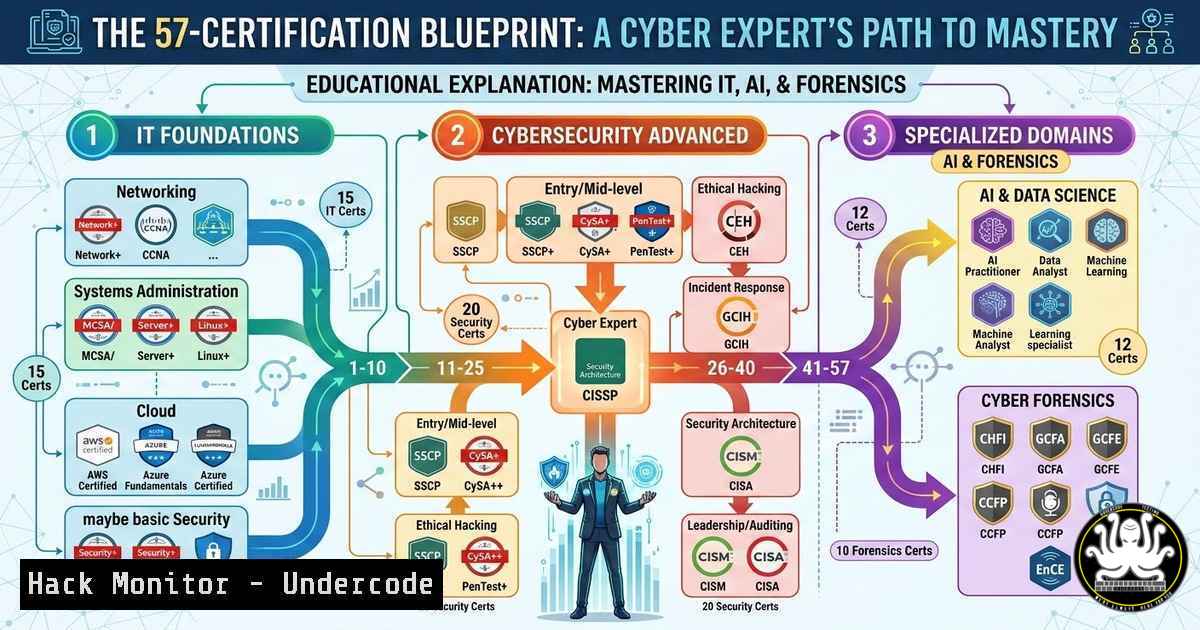
In an era where digital infrastructure is increasingly intertwined with artificial intelligence, the traditional silos of IT and cybersecurity are collapsing. Professionals must now navigate a landscape where securing a cloud API is as critical as understanding the kernel of a Linux system. The profile of a multi-certified expert—spanning forensics, programming, and AI engineering—serves as a roadmap for this convergence. This article deconstructs the technical pathways and hands-on methodologies required to build a hybrid skillset capable of defending modern networks, exploiting vulnerabilities, and hardening systems against advanced persistent threats.
Learning Objectives:
- Understand the command-line tools and frameworks essential for system hardening and vulnerability assessment across Linux and Windows environments.
- Learn how to configure and audit AI-driven security tools and cloud infrastructures.
- Identify key forensic methodologies for incident response and data recovery.
You Should Know:
1. System Hardening: The Linux Command-Line Arsenal
System hardening is the process of reducing the attack surface by eliminating unnecessary services and enforcing strict permissions. In a Linux environment, this begins with a minimal installation. Post-installation, security professionals immediately audit running services using `systemctl` and `ss` (or netstat).
To identify listening ports, the command `ss -tulpn` is used. Any service not required for the server’s function—such as CUPS printing services on a web server—should be stopped and disabled with `sudo systemctl stop cups` and sudo systemctl disable cups. File permissions are tightened using `chmod` and chown. For world-writable files, a find command is critical: `find / -type f -perm -0002 -exec ls -l {} \; 2>/dev/null` identifies files that could be exploited for privilege escalation. The final step often involves configuring `fail2ban` to protect against brute-force attacks by editing `/etc/fail2ban/jail.local` to monitor SSH and HTTP logs.
2. Windows Enterprise Security: Auditing with PowerShell
Windows environments require a different approach, focusing on Active Directory security and Group Policy. Modern IT security experts utilize PowerShell for rapid auditing. To list all local users and administrators, the command `Get-LocalUser` and `Get-LocalGroupMember -Group “Administrators”` are foundational.
For detecting lateral movement vectors, security professionals scan for exposed SMB shares using Get-SmbShare. Hardening involves disabling legacy protocols like SMBv1. This is done via PowerShell: Set-SmbServerConfiguration -EnableSMB1Protocol $false -Force. Furthermore, auditing event logs for suspicious logins requires parsing Security logs with `Get-WinEvent -FilterHashtable @{LogName=’Security’; ID=4625}` to find failed login attempts, which are indicators of password spraying attacks.
- AI and API Security: Securing the Machine Learning Pipeline
With the integration of AI into business logic, APIs have become the primary attack vector. Securing an AI model’s inference endpoint involves strict input validation to prevent prompt injection and model exfiltration. A key technique is rate limiting and implementing robust authentication using OAuth 2.0 with short-lived tokens.
From a defensive coding perspective, when deploying a model using Flask or FastAPI, developers must sanitize inputs. For example, using libraries like `bert-as-service` requires ensuring that input strings are stripped of control characters. A practical step is to configure a Web Application Firewall (WAF) like ModSecurity with rules to block common injection patterns targeting AI APIs. In the cloud, such as on AWS SageMaker, Identity and Access Management (IAM) roles must be scoped to the least privilege, preventing the model endpoint from accessing the underlying training data S3 buckets. -
Vulnerability Exploitation and Mitigation: The Penetration Testing Cycle
Understanding the attacker’s mindset is crucial for defense. Using tools like Metasploit or manual exploitation techniques allows professionals to verify vulnerabilities. For instance, testing for an SMBGhost (CVE-2020-0796) vulnerability involves using a Nmap script:nmap --script smb-vuln-cve2020-0796 -p445 <target>.
If a system is vulnerable, the mitigation is immediate patching or disabling compression via PowerShell. In a lab environment, exploitation can be demonstrated using a Python script that crafts a malicious packet, emphasizing why regular patch management is non-negotiable. Post-exploitation, the focus shifts to mitigating privilege escalation by ensuring services run with the least privileges and that the Linux kernel is updated to prevent Dirty Pipe (CVE-2022-0847) vulnerabilities.
5. Cloud Hardening: Terraform and Infrastructure as Code
Cloud security relies on Infrastructure as Code (IaC) to prevent misconfigurations. Tools like `tfsec` or `Checkov` scan Terraform scripts for security flaws before deployment. A common mistake is creating a publicly accessible S3 bucket. A hardened Terraform script includes an `aws_s3_bucket_public_access_block` resource:
resource "aws_s3_bucket_public_access_block" "example" {
bucket = aws_s3_bucket.example.id
block_public_acls = true
block_public_policy = true
ignore_public_acls = true
restrict_public_buckets = true
}
This ensures that even if a bucket policy is misconfigured, the data remains private. Auditing the cloud environment continuously with tools like Prowler or ScoutSuite provides a compliance overview against standards like CIS.
6. Digital Forensics: Capturing and Analyzing Memory
When a breach occurs, incident responders capture volatile data first. On a compromised Linux system, the command `lime` (Linux Memory Extractor) is used to dump RAM for analysis. The syntax is typically insmod lime.ko "path=/cases/memory.dump format=lime". For Windows, tools like DumpIt or WinPmem are standard.
Once the memory dump is acquired, analysis with Volatility 3 is critical. To see active network connections at the time of the breach, the command `vol -f memory.dump windows.netscan` reveals hidden or injected connections not visible to the running OS. This analysis helps identify the malware’s Command and Control (C2) server IP, allowing for network-level blocking.
What Undercode Say:
- Certifications Validate Methodology, Not Just Knowledge: The pursuit of 57 certifications signifies a mastery of structured methodologies—from the CISSP’s security frameworks to the CEH’s attack vectors. It proves the ability to apply a repeatable process to unknown problems.
- The Convergence is Real: The separation between IT, AI, and Cybersecurity is obsolete. Hardening an AI model requires understanding Python code, cloud APIs, and network security simultaneously. The modern defender is a polyglot, fluent in the languages of development, operations, and security.
The analysis of this expert’s profile reveals that true cybersecurity resilience is built on a foundation of diverse, hands-on practice. It’s not about knowing a single operating system but understanding the interplay between them. By mastering the specific commands and configurations outlined above—from locking down a Linux server to securing an AI inference point—professionals can transition from theoretical knowledge to active defense. The depth of this expertise lies in the ability to simulate an attacker’s every move while simultaneously building barriers that are both invisible to the user and impenetrable to the adversary.
Prediction:
As generative AI becomes embedded in critical infrastructure, the next wave of cyber conflict will target the machine learning supply chain. We will see a rise in “model poisoning” and “training data extraction” attacks. Future cybersecurity training will pivot heavily toward “Adversarial Machine Learning,” requiring experts to not only know firewalls and SIEMs but also to understand gradient descent and neural network architectures to effectively defend the digital nervous system of the future.
▶️ Related Video (84% Match):
🎯Let’s Practice For Free:
IT/Security Reporter URL:
Reported By: Wow Share – Hackers Feeds
Extra Hub: Undercode MoN
Basic Verification: Pass ✅


