Listen to this Post
Introduction:
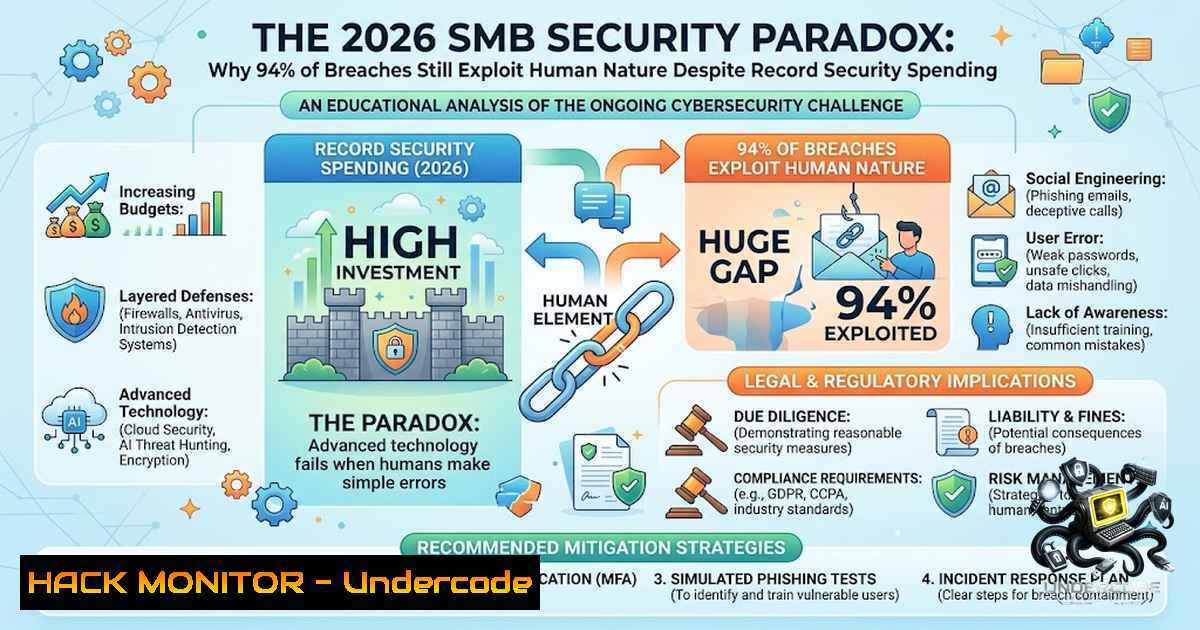
In 2026, the cybersecurity industry has never been more advanced—and small businesses have never been more exposed. While 92% of SMBs have implemented cybersecurity measures with average annual investments of £43,000, Verizon’s 2026 Data Breach Investigations Report confirms that the human element remains present in 62% of all confirmed breaches. Google Cloud’s Cybersecurity Forecast goes further, attributing 94% of successful incidents to human behavior. As Elizabeth Boateng of EBWALL Cyber Consult LLC aptly observed, most cyberattacks don’t begin with sophisticated hacking tools—they begin with simple human moments: a rushed click, a reused password, an email that looks just convincing enough.
Learning Objectives:
- Understand the five most critical cybersecurity threats facing small businesses in 2026 and their real-world impact
- Master practical, budget-friendly defense strategies including phishing-resistant MFA, password hygiene, and employee awareness programs
- Build a sustainable security culture that transforms employees from the weakest link into an organization’s first line of defense
You Should Know:
- The 2026 Threat Landscape: AI-Enabled Attacks Targeting the Human Layer
The threat landscape for small and medium-sized businesses has transformed dramatically. ESET’s 2026 SMB Cyber Readiness Index, surveying 4,400 SMB decision makers across 13 countries, found that 45% of SMBs experienced a cybersecurity incident in the past 12 months, with 14% experiencing more than one incident. A majority (61%) report being seriously concerned about cyberattacks.
Perhaps most alarming is the rise of AI-powered threats. Kaspersky researchers detected over 33,300 cyberattacks targeting SMBs disguised as popular AI tools in just the first four months of 2026—nearly five times more than in 2025. ChatGPT topped the list at 44% of phishing attempts, followed by Claude at 11%. AI-generated phishing attacks surged 14x over the 2025 holiday period, with 60% of recipients acting on AI-generated phishing emails compared to just 12% for traditional attempts.
Beyond email, attackers are exploiting programmatic advertising networks, with ad-based malware delivery now exceeding email as a primary infection vector. AI voice cloning and deepfake video attacks have made small businesses—particularly those under 250 employees—account for over 40% of vishing victims.
- The Password Crisis: One Credential to Rule Them All
Despite years of security awareness campaigns, password hygiene among small business employees remains dangerously poor. Research reveals that 70% of users reuse passwords across multiple accounts, and nearly 60% use six or fewer passwords in total—a pattern that could leave an estimated 32 million people vulnerable if a single breached service exposes other accounts.
Kaspersky research further reveals that 68% of modern passwords can be cracked by hackers within a day, with 60.2% falling in about an hour. Even more concerning, 28% of passwords used weekly by employees are considered risky, with 16% already compromised in known data breaches and still in active use.
To address this, organizations should implement NIST SP 800-63B-4 guidelines:
Linux/Unix Password Policy (/etc/security/pwquality.conf):
 Minimum password length - 15 characters recommended
minlen = 15
 Require at least one digit
dcredit = -1
 Require at least one uppercase
ucredit = -1
 Require at least one special character
ocredit = -1
 Disallow dictionary words
dictcheck = 1
 Maximum password age (90 days)
maxrepeat = 3
Windows Password Policy via Group Policy:
Navigate to `Computer Configuration → Windows Settings → Security Settings → Account Policies → Password Policy` and configure:
– Minimum password length: 15 characters
– Password must meet complexity requirements: Enabled
– Enforce password history: 24 passwords remembered
– Minimum password age: 1 day
– Maximum password age: 90 days
- Phishing and Business Email Compromise: The Costliest Entry Point
Phishing remains the leading entry path for small business compromise, accounting for 33.8% of all small business breaches. Business Email Compromise (BEC)—while representing only 11% of attack volume—averages $123,005 per incident, making it far costlier per event than high-volume phishing. The FBI’s Internet Crime Report recorded $2.77 billion in BEC-related losses across 21,442 complaints.
More than half (54.9%) of North American SMBs lack basic email security protections such as SPF and DMARC, dramatically increasing their exposure. To harden email defenses:
Configure SPF (Sender Policy Framework) Record:
Add to your domain’s DNS TXT record:
v=spf1 mx include:spf.protection.outlook.com -all
Configure DKIM (DomainKeys Identified Mail):
Enable DKIM signing in your email platform and publish the public key in DNS.
Configure DMARC (Domain-based Message Authentication):
Start with a monitoring policy:
v=DMARC1; p=none; rua=mailto:[email protected]
Once confident, move to quarantine or reject:
v=DMARC1; p=quarantine; rua=mailto:[email protected]
- MFA: Not All Multi-Factor Authentication Is Created Equal
Standard MFA is no longer sufficient. Attackers in 2026 are routinely bypassing SMS-based and app-based MFA through adversary-in-the-middle (AiTM) phishing kits, MFA fatigue attacks, session token theft, and SIM swapping. Commercial Phishing-as-a-Service frameworks like Starkiller use headless browsers running inside Docker containers to proxy real login pages in real time, defeating both signature-based detection and legacy MFA including SMS one-time passwords.
Phishing-Resistant MFA Implementation:
Step 1: Eliminate SMS and voice MFA entirely as fallback options
Step 2: Move all administrators and privileged users to FIDO2 hardware security keys (approximately $40 per device)
Step 3: Move all general users to number-matching push or app-based MFA at minimum
Step 4: For Microsoft 365 environments, enforce phishing-resistant authentication via Conditional Access:
 PowerShell command to require FIDO2 for admins
Set-AzureADPolicy -Definition @('{"AuthenticationMethodsPolicy":{"AdminAuthenticationMethods":[{"AuthenticationMethod":"fido2"}]}}')
- Building a Security Awareness Program That Actually Works
The good news is that security awareness training delivers measurable results. KnowBe4’s 2026 Phishing by Industry Benchmarking Report found that one year of security awareness training slashes phishing susceptibility from 17.1% to just 4.2%. Organizations with consistent training programs see a 79% reduction in global phishing susceptibility.
Step-by-Step Awareness Program Implementation:
Step 1: Baseline Assessment
Run a simulated phishing campaign to establish your organization’s baseline Phish-Prone Percentage (PPP). Small businesses typically start at 24.7% compared to 39.5% for large enterprises.
Step 2: Bite-Sized Training
Keep every training session under ten minutes. Use short video clips instead of text-heavy documents. Create a dedicated five-minute Friday security tip.
Step 3: Quarterly Phishing Simulations
Conduct phishing simulations quarterly, not just once a year. Focus on realistic scenarios including:
– AI-generated email impersonations
– Fake invoice fraud
– Urgent payment requests from “executives”
– Credential harvesting login pages
Step 4: Establish Clear Reporting Channels
Employees must know exactly how to report suspicious emails. Create a dedicated email alias (e.g., [email protected]) and ensure reports are investigated promptly.
Step 5: Leadership Modeling
When leadership demonstrates security-conscious behavior, employees follow suit. Have executives participate in training and simulations alongside staff.
6. Practical Defense-in-Depth for Budget-Constrained SMBs
Small businesses can dramatically reduce cyber risk with practical, low-cost measures:
Endpoint Protection:
Deploy endpoint protection on every device, not just office workstations. For Linux systems:
 Install and configure ClamAV (free open-source antivirus)
sudo apt-get install clamav clamav-daemon
sudo freshclam  Update virus definitions
sudo systemctl enable clamav-daemon
sudo systemctl start clamav-daemon
Patch Management:
Keep all systems and software updated to reduce exposure to known vulnerabilities:
 Linux automated patching (Ubuntu/Debian)
sudo apt update && sudo apt upgrade -y
 Schedule via cron for weekly updates
0 2   0 sudo apt update && sudo apt upgrade -y
 Windows automated patching via PowerShell
Install-Module PSWindowsUpdate
Get-WindowsUpdate -Install -AcceptAll -AutoReboot
Incident Response Plan:
Develop and test an incident response plan—not just write one. Include:
– Who to contact (internal and external)
– How to isolate affected systems
– Backup restoration procedures
– Regulatory reporting requirements
Backup Strategy:
Implement the 3-2-1 backup rule: 3 copies, 2 different media types, 1 offsite. Test backups regularly.
What Undercode Say:
- Human error is not a people problem—it’s a process problem. Elizabeth Boateng’s insight that most attacks begin with “simple human moments” underscores a critical truth: organizations that blame employees for security failures miss the point entirely. The Verizon DBIR’s finding that 62% of breaches involve the human element isn’t an indictment of human nature—it’s a call to design systems that account for human behavior.
-
Awareness without action is theater. While 87% of SMBs view employee education as critical to cyber resilience, there remains a dangerous gap between confidence and readiness. Many organizations have security tools but don’t use them correctly. The question isn’t whether you have MFA or awareness training—it’s whether you’ve validated that they actually work against today’s AI-enabled threats.
Analysis: Elizabeth Boateng’s reflection cuts to the heart of modern cybersecurity’s greatest paradox. We’ve spent billions on firewalls, security tools, and compliance frameworks, yet the human factor remains the dominant variable in breach outcomes. For small businesses in particular—which often lack dedicated security teams but face the same threats as enterprises—the solution isn’t more technology; it’s better implementation of existing controls paired with genuine security culture transformation.
The rise of AI-powered attacks has made awareness training more critical than ever. Generative tools can now produce phishing emails indistinguishable from legitimate communications at scale. Traditional “spot the red flags” training is insufficient when there are no red flags to spot. Organizations must move beyond annual compliance training to continuous, contextual security education that simulates real-world attacks employees actually face.
Crucially, small businesses must recognize that budget constraints don’t excuse basic security failures. Phishing-resistant MFA (FIDO2 hardware keys at $40 per admin), free email authentication standards (SPF, DKIM, DMARC), and open-source endpoint protection are accessible to organizations of any size. The barrier isn’t cost—it’s awareness and consistent execution.
Prediction:
- +1 Small businesses that invest in phishing-resistant MFA and continuous awareness training by Q1 2027 will reduce their breach risk by over 70%, potentially saving an average of $123,000 per avoided BEC incident. The ROI on security awareness training—79% phishing susceptibility reduction after one year—makes it one of the most cost-effective security investments available.
-
-1 Organizations that continue relying on SMS-based MFA and annual compliance training will face a 300%+ increase in successful account takeovers by late 2027 as AiTM phishing kits become commoditized and accessible to novice attackers. The window to migrate to phishing-resistant authentication is closing rapidly.
-
+1 The growing awareness of AI-powered threats will drive consolidation in the SMB security market, with managed security service providers (MSPs) offering integrated packages combining phishing-resistant MFA, continuous awareness training, and 24/7 monitoring. This democratization of enterprise-grade security will benefit the 47% of very small businesses currently operating with no cybersecurity budget.
-
-1 The 54.9% of North American SMBs lacking basic email authentication (SPF/DMARC) represent a ticking time bomb. As attackers increasingly exploit misconfigured email infrastructure for brand impersonation and BEC, these businesses will face not only direct financial losses but also reputational damage and potential regulatory penalties under evolving data protection frameworks.
▶️ Related Video (74% Match):
https://www.youtube.com/watch?v=2AjcnqbWOyY
🎯Let’s Practice For Free:
🎓 Live Courses & Certifications:
Join Undercode Academy for Verified Certifications
🚀 Request a Custom Project:
Secure, high-velocity infrastructure and disruptive technological engineering. Contact our engineering team for high-tier development and proprietary systems:
[email protected]
💎 Smart Architecture | 🛡️ Secure by Design | ⭐ Trusted by Thousands
IT/Security Reporter URL:
Reported By: Elizabeth Boateng – Hackers Feeds
Extra Hub: Undercode MoN
Basic Verification: Pass ✅


