
Listen to this Post
Introduction
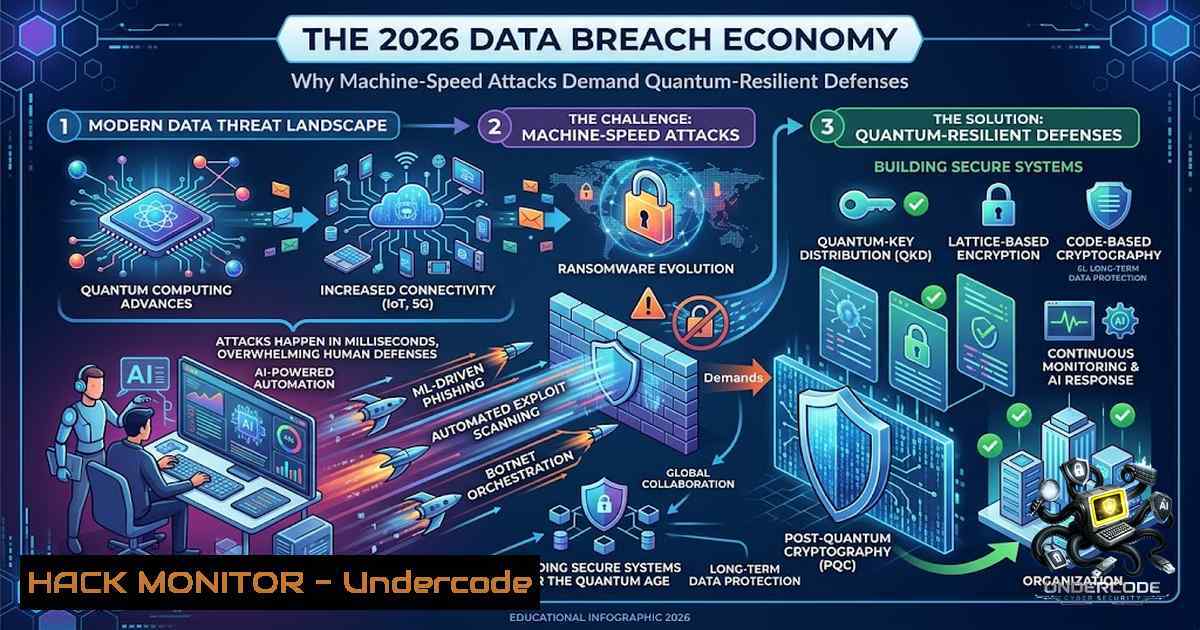
The cybersecurity landscape has entered a new epoch where the velocity of AI-driven attacks now outpaces the human-led response capabilities of most organizations. IBM’s Cost of a Data Breach Report 2026 reveals a fundamental asymmetry: while frontier AI models enable adversaries to automate vulnerability discovery and exploit deployment at machine speed, defensive postures remain anchored in legacy, manual processes that simply cannot keep pace【1†L1-L3】. This widening gap between attack velocity and organizational resilience is redefining the economics of breach response, pushing the average cost of a data breach to unprecedented levels and forcing security leaders to reconsider their entire technology stack, from quantum-safe cryptography to AI-powered autonomous response systems【1†L4-L5】.
Learning Objectives
- Understand the financial and operational impact of frontier AI on data breach economics and incident response timelines.
- Evaluate the role of AI automation, governance frameworks, and quantum-safe cryptography in reducing breach costs.
- Implement practical defensive measures across Linux, Windows, cloud, and API security to counter machine-speed threats.
You Should Know
- The AI Attack Surface: Automated Exploitation and the 200-Day Detection Window
The 2026 report highlights a disturbing trend: organizations leveraging AI for defense saw breach costs reduced by an average of $1.8 million compared to those without AI deployment【1†L4-L5】. However, the same AI capabilities are now weaponized by threat actors to accelerate every phase of the attack lifecycle. Machine-speed attacks—where AI models scan for misconfigurations, brute-force credentials, and craft polymorphic payloads in seconds—have compressed the average time to compromise from hours to minutes.
The critical metric: Organizations that identified breaches through their own security teams (rather than external notification) saved over $1.2 million on average. Yet the report indicates that only 33% of breaches are self-detected, meaning the majority rely on attackers or third parties to disclose the incident—a lag that compounds both financial and reputational damage.
Linux Hardening Against AI-Driven Reconnaissance:
AI-powered scanners systematically probe for common misconfigurations. Implement the following to reduce your attack surface:
 Audit open ports and running services - AI scanners target these first
sudo ss -tulpn | grep LISTEN

Restrict SSH to key-based authentication only (prevents AI brute-force)
sudo sed -i 's/^PasswordAuthentication yes/PasswordAuthentication no/' /etc/ssh/sshd_config
sudo sed -i 's/^PermitRootLogin yes/PermitRootLogin prohibit-password/' /etc/ssh/sshd_config
sudo systemctl restart sshd

Install and configure fail2ban to rate-limit repeated authentication failures
sudo apt-get install fail2ban -y
sudo systemctl enable fail2ban && sudo systemctl start fail2ban

Use auditd to monitor for suspicious file access patterns
sudo auditctl -w /etc/passwd -p wa -k identity_changes
sudo auditctl -w /etc/shadow -p wa -k identity_changes
Windows Defense Against Automated Credential Stuffing:
 Enforce account lockout policies to defeat AI brute-force
Set-ADDefaultDomainPasswordPolicy -LockoutDuration 30 -LockoutThreshold 5 -LockoutObservationWindow 15

Enable PowerShell logging to detect suspicious script execution
Set-ItemProperty -Path "HKLM:\SOFTWARE\Policies\Microsoft\Windows\PowerShell\ScriptBlockLogging" -1ame "EnableScriptBlockLogging" -Value 1

Block SMBv1 to prevent legacy protocol exploitation
Set-SmbServerConfiguration -EnableSMB1Protocol $false -Force
- The Governance Imperative: Automating Compliance in the Age of Frontier AI
The 2026 report emphasizes that organizations with mature governance frameworks—including automated policy enforcement, continuous compliance monitoring, and AI-driven risk scoring—experienced breach costs 40% lower than those with ad-hoc governance【1†L4-L5】. Governance is no longer a checkbox exercise; it is the connective tissue between security operations, data privacy, and business continuity.
Step-by-Step: Implementing Automated Compliance Scanning with OpenSCAP (Linux)
1. Install OpenSCAP:
sudo apt-get install openscap-scanner scap-security-guide -y
- Run a compliance scan against the CIS benchmark:
sudo oscap xccdf eval --profile xccdf_org.ssgproject.content_profile_cis --results scan-results.xml /usr/share/xml/scap/ssg/content/ssg-ubuntu2004-ds.xml
3. Generate an HTML report:
sudo oscap xccdf generate report scan-results.xml > compliance-report.html
4. Schedule automated scans via cron:
sudo crontab -e
 Add: 0 2    /usr/bin/oscap xccdf eval --profile xccdf_org.ssgproject.content_profile_cis --results /var/log/compliance/scan-$(date +\%Y\%m\%d).xml /usr/share/xml/scap/ssg/content/ssg-ubuntu2004-ds.xml
Windows: Automated Security Baseline Enforcement with PowerShell DSC
 Install PowerShell Desired State Configuration
Install-Module -1ame PSDesiredStateConfiguration -Force

Create a DSC configuration for security baseline
Configuration SecurityBaseline {
Node "localhost" {
WindowsFeature Laps {
Name = "LAPS"
Ensure = "Present"
}
Registry PasswordPolicy {
Key = "HKLM:\SYSTEM\CurrentControlSet\Services\Netlogon\Parameters"
ValueName = "DisablePasswordChange"
ValueData = 0
ValueType = "DWord"
}
}
}
SecurityBaseline
Start-DscConfiguration -Path .\SecurityBaseline -Wait -Verbose
3. Quantum-Safe Cryptography: Preparing for the Post-Quantum Breach
The report explicitly calls out the intersection of frontier AI and quantum computing as an emerging threat vector【1†L4-L5】. While large-scale quantum computers capable of breaking RSA-2048 are not yet operational, adversaries are already executing “store now, decrypt later” attacks—harvesting encrypted data today with the intent to decrypt it once quantum capabilities mature. Organizations must begin migrating to quantum-safe cryptographic algorithms (NIST-approved: CRYSTALS-Kyber for key encapsulation, CRYSTALS-Dilithium for digital signatures).
Linux: Enabling Post-Quantum Cryptography in OpenSSL 3.0+
 Install OpenSSL 3.0 with quantum-safe provider
wget https://github.com/open-quantum-safe/openssl/archive/refs/tags/OQS-OpenSSL_3_0_0-stable.tar.gz
tar -xzf OQS-OpenSSL_3_0_0-stable.tar.gz
cd openssl-OQS-OpenSSL_3_0_0-stable
./configure --prefix=/usr/local/openssl-oqs
make -j$(nproc)
sudo make install

Generate a quantum-safe test certificate using Kyber
/usr/local/openssl-oqs/bin/openssl req -x509 -1ewkey kyber512 -keyout kyber-key.pem -out kyber-cert.pem -days 365 -1odes
Windows: Configuring Schannel for Quantum-Safe Cipher Suites
 Enable post-quantum cipher suites in Windows Schannel (requires Windows 11 22H2+)
New-ItemProperty -Path "HKLM:\SOFTWARE\Policies\Microsoft\Cryptography\Configuration\SSL\00010002" -1ame "Functions" -Value "TLS_ECDHE_KYBER_WITH_AES_256_GCM_SHA384" -PropertyType String -Force
- API Security: The Unseen Attack Vector in AI-Driven Ecosystems
Modern enterprises average over 15,000 APIs, each representing a potential entry point for machine-speed attacks. The 2026 report correlates poor API security with breach costs exceeding $5 million per incident. AI models now automatically scan API documentation, Swagger files, and GraphQL endpoints to identify injection points, broken object-level authorization (BOLA), and excessive data exposure.
Step-by-Step: Securing APIs with Rate Limiting, Authentication, and Anomaly Detection
- Deploy an API Gateway (Kong/KrakenD) with rate limiting to defeat AI-driven brute-force:
Kong plugin configuration for rate limiting
plugins:</li>
</ol>

- name: rate-limiting
config:
minute: 100
hour: 1000
policy: redis
- Implement OAuth 2.0 with PKCE for all public-facing APIs:
Generate a secure code verifier and challenge
openssl rand -base64 32 | tr -d '\n' > code_verifier.txt
openssl sha256 -binary code_verifier.txt | base64 | tr -d '\n' > code_challenge.txt
-
Deploy an API security scanner (like 42Crunch or Salt Security) to continuously monitor for BOLA vulnerabilities:
Run an automated API security audit
docker run -v $(pwd):/api 42crunch/api-security-audit --openapi /api/openapi.yaml --output /api/audit-report.json
-
Enable anomaly detection using machine learning on API call patterns:
Pseudocode: ML-based API anomaly detection
from sklearn.ensemble import IsolationForest
import numpy as np
Feature: request frequency, payload size, endpoint entropy
X = np.array([[req_freq, payload_size, entropy]])
model = IsolationForest(contamination=0.01)
anomalies = model.fit_predict(X)  -1 indicates anomaly
-
Cloud Hardening: Identity and Zero-Trust in a Multi-Cloud World
The report emphasizes that cloud misconfigurations remain the leading cause of breaches, with an average cost of $4.5 million per incident. Frontier AI models now scan public cloud buckets, IAM roles, and security groups at scale, identifying exposed S3 buckets, overly permissive IAM policies, and unpatched container images within seconds.
AWS: Automated IAM Least-Privilege Enforcement
 Use AWS CLI to generate an IAM policy report
aws iam get-account-authorization-details --filter Entity,Local --output json > iam-report.json

Identify unused IAM roles (potential attack surface)
aws iam list-roles --query 'Roles[?RoleLastUsed==null]' --output table

Enforce S3 bucket public access blocking
aws s3api put-public-access-block --bucket my-secure-bucket --public-access-block-configuration "BlockPublicAcls=true,IgnorePublicAcls=true,BlockPublicPolicy=true,RestrictPublicBuckets=true"
Azure: Implementing Just-In-Time (JIT) VM Access
 Enable JIT access policy for VMs
Set-AzJitNetworkAccessPolicy -ResourceGroupName "myRg" -Location "eastus" -1ame "default" -VirtualMachine @{
Id = "/subscriptions/<sub-id>/resourceGroups/myRg/providers/Microsoft.Compute/virtualMachines/myVM"
Ports = @(
@{ number = 22; protocol = "TCP"; allowedSourceAddressPrefix = "10.0.0.0/24"; maxRequestAccessDuration = "PT3H" }
)
}
Kubernetes: Pod Security Standards and Network Policies
 Enforce restricted Pod Security Standard
apiVersion: v1
kind: Namespace
metadata:
name: secure-app
labels:
pod-security.kubernetes.io/enforce: restricted
pod-security.kubernetes.io/audit: restricted

Network policy to block east-west traffic by default
apiVersion: networking.k8s.io/v1
kind: NetworkPolicy
metadata:
name: default-deny
spec:
podSelector: {}
policyTypes:
- Ingress
- Egress
6. AI-Powered Autonomous Response: Closing the Detection-to-Containment Gap
The report’s most striking finding is that organizations using AI and automation for incident response reduced breach lifecycle duration by 74 days compared to those without【1†L4-L5】. Autonomous response—where SOAR platforms ingest threat intelligence, correlate alerts, and execute containment playbooks without human intervention—is no longer optional; it is the only way to match machine-speed attacks.
Step-by-Step: Building a SOAR Playbook with TheHive and Cortex
1. Deploy TheHive (incident response platform) :
docker run -d --1ame thehive -p 9000:9000 -v /data/thehive:/data strangebee/thehive:latest
2. Integrate Cortex (automated analyzer) :
docker run -d --1ame cortex -p 9001:9001 -v /data/cortex:/data thehiveproject/cortex:latest
3. Create an automated containment playbook (pseudocode):
 Triggered on high-severity alert
def auto_contain(alert):
if alert.type == "malware_detection":
 Isolate infected host via EDR API
edr.isolate_host(alert.host_id)
 Revoke IAM tokens
aws.iam.revoke_sessions(alert.user_arn)
 Create firewall block rule
iptables_rule = f"iptables -A INPUT -s {alert.src_ip} -j DROP"
subprocess.run(iptables_rule, shell=True)
 Log incident
thehive.create_case(title=f"Auto-Containment: {alert.id}", severity="critical")
4. Schedule regular playbook testing (chaos engineering):
 Simulate a ransomware alert to test response time
curl -X POST http://thehive:9000/api/alert -H "Content-Type: application/json" -d '{"type":"simulation","source":"chaos-engineering"}'
What Undercode Say
- Key Takeaway 1: The 2026 report confirms that AI is a double-edged sword—organizations that deploy AI defensively reduce breach costs by millions, but those who delay adoption will find themselves outpaced by adversaries who already weaponize the same technology.
-
Key Takeaway 2: Governance and automation are no longer “nice-to-have” but existential requirements. The data is unequivocal: mature governance frameworks and autonomous response systems directly correlate with shorter breach lifecycles and lower financial impact.
Analysis: The report’s emphasis on quantum-safe cryptography signals a paradigm shift. While many CISOs view post-quantum migration as a distant concern, the “store now, decrypt later” threat is immediate and actionable. Organizations must begin inventorying cryptographic assets, prioritizing high-value data, and piloting hybrid classical-quantum schemes today. Furthermore, the integration of AI into SIEM and SOAR platforms is not merely about efficiency—it is about survival. Machine-speed attacks demand machine-speed responses. The 74-day reduction in breach lifecycle for AI-enabled organizations is not incremental; it is transformational. However, the report also cautions against over-reliance on black-box AI models without human oversight, as adversarial AI can poison training data and corrupt decision-making. The optimal posture is a symbiotic human-AI partnership where AI handles velocity and scale, while human analysts focus on strategic threat hunting and anomaly interpretation.
Prediction
- +1 By 2028, quantum-safe cryptography will become a mandatory compliance requirement for financial services and healthcare, driving a $50 billion market for post-quantum migration services and hardware security modules.
-
-1 The proliferation of frontier AI models will enable a new class of “adaptive malware” that mutates its attack vector in real-time based on defensive responses, rendering static signature-based detection completely obsolete within 24 months.
-
+1 Autonomous SOAR platforms will evolve into “self-healing networks” that not only detect and contain breaches but also automatically patch vulnerabilities and reconfigure cloud architectures without human intervention, reducing mean time to remediate from days to minutes.
-
-1 Organizations that fail to implement AI-driven governance and automation will see their breach costs exceed $10 million per incident by 2027, with a corresponding 300% increase in ransomware payments as attackers leverage AI to identify the exact financial threshold for each victim.
-
+1 The integration of large language models into security operations will democratize threat intelligence, enabling small and medium enterprises to access enterprise-grade detection capabilities, effectively leveling the playing field against nation-state adversaries.
Access the full report: https://bit.ly/4wiRyhF【1†L5】
This article is based on the IBM Cost of a Data Breach Report 2026 and incorporates practical implementation guidance for security practitioners across Linux, Windows, cloud, and API environments.
▶️ Related Video (86% Match):
🎯Let’s Practice For Free:
🎓 Live Courses & Certifications:
Join Undercode Academy for Verified Certifications
🚀 Request a Custom Project:
Secure, high-velocity infrastructure and disruptive technological engineering. Contact our engineering team for high-tier development and proprietary systems:
[email protected]
💎 Smart Architecture | 🛡️ Secure by Design | ⭐ Trusted by ThousandsIT/Security Reporter URL:
Reported By: Hemalbhatt Thegapis – Hackers Feeds
Extra Hub: Undercode MoN
Basic Verification: Pass ✅🔐JOIN OUR CYBER WORLD [ CVE News • HackMonitor • UndercodeNews ]
📢 Follow UndercodeTesting & Stay Tuned:
- Implement OAuth 2.0 with PKCE for all public-facing APIs:


