Listen to this Post
Introduction:
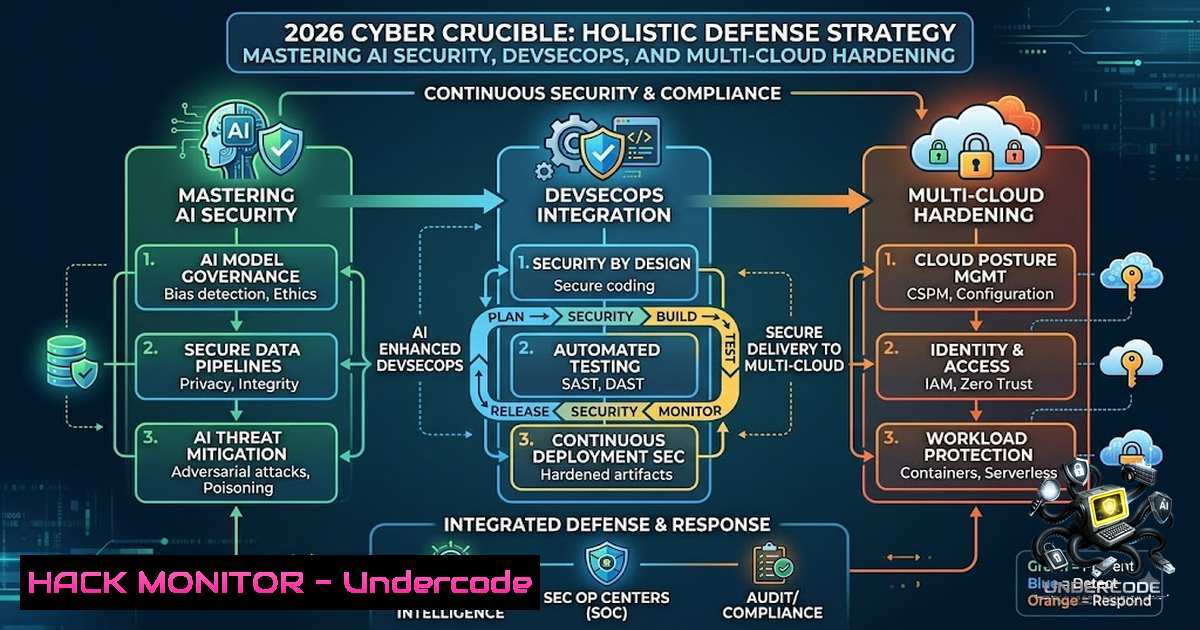
The technology landscape is evolving at an unprecedented pace, with Generative AI, cloud computing, and cybersecurity converging into a single, complex battlefield. As highlighted by industry leaders like SkyStates LLC, the demand for professionals who can navigate AI-driven threats, secure CI/CD pipelines, and harden multi-cloud environments has never been more critical. This article provides a comprehensive, hands-on guide to the essential skills and technical configurations required to stay ahead in 2026, focusing on the intersection of AI security, DevSecOps, and cloud infrastructure.
Learning Objectives:
- Understand and mitigate the OWASP Top 10 risks for Large Language Model (LLM) applications.
- Implement security gates and best practices within a DevSecOps CI/CD pipeline.
- Apply cloud infrastructure hardening techniques across AWS, Azure, and GCP.
- Master essential penetration testing and ethical hacking tools for 2026.
- Securing the AI Frontier: OWASP Top 10 for LLMs and GenAI
The rapid adoption of Generative AI and LLMs has introduced a new class of security vulnerabilities. The OWASP Top 10 for LLM Applications (2026) provides a critical framework for identifying and mitigating these risks. Key threats include Prompt Injection, where malicious inputs manipulate model outputs, and Excessive Agency, where an AI system is given too much autonomous power. The core recommendation from security experts is to stop trying to build an immune model and instead improve the surrounding system so that when the model is fooled—which it will be—nothing critical breaks.
Step-by-Step Guide: Implementing an LLM Security Stack
To defend against these threats, a defense-in-depth strategy is essential. Here is a practical five-layer stack:
- Input/Output Guardrails: Implement filters to sanitize and validate all prompts and responses. This includes blocking known malicious patterns and preventing data leakage.
- Continuous Evaluation: Regularly assess the model’s behavior to detect anomalies or deviations from expected performance.
- AI Security Posture Management (AI-SPM): Discover and inventory all AI models and agents running in your environment.
- Trace-Level Observability: Gain full visibility into each request to understand how the model arrives at its outputs.
- Identity and Access Control: Enforce strict, least-privilege access to models and their training data.
Linux Command for AI Log Analysis:
 Monitor and analyze LLM API logs for anomalies in real-time
tail -f /var/log/llm-api/access.log | grep -E "error|anomaly|injection" | awk '{print $1, $9, $10}'
2. DevSecOps: Hardening the CI/CD Pipeline
CI/CD pipelines are the backbone of modern software delivery but are prime targets for attackers. A robust DevSecOps strategy shifts security left, integrating checks as early as the IDE and pre-commit stage. The 2026 State of DevSecOps study emphasizes that security must be a continuous, automated process, not a final gate.
Step-by-Step Guide: Building a Secure CI/CD Pipeline
- Shift Left (IDE & Pre-Commit): Integrate security scanning tools into developers’ IDEs to catch vulnerabilities before code is committed.
- CI Security (Build & Static Analysis): Implement Software Composition Analysis (SCA) to scan for vulnerable dependencies and Static Application Security Testing (SAST) to find code flaws.
- Artifact Integrity: Generate a Software Bill of Materials (SBOM) for every build and sign artifacts to ensure provenance and prevent tampering.
- Secrets Management: Replace static credentials with short-lived, job-specific tokens issued through OIDC federation.
- Runtime Monitoring: Use Cloud-1ative Application Protection Platforms (CNAPP) to monitor for threats even after deployment.
Key GitHub Actions Security Practice:
GitHub strongly recommends pinning actions to a specific, immutable commit SHA instead of a version tag to prevent supply chain attacks.
 Instead of:
 - uses: actions/checkout@v3
 Use:
- uses: actions/checkout@a81bbbf8298c0fa03ea29cdc473d45769f953675
3. Multi-Cloud Hardening: AWS, Azure, and GCP
With 83% of cybersecurity roles now requiring hands-on experience, mastering cloud security is non-1egotiable. Multi-cloud strategies are the new norm, requiring professionals to understand the unique security controls of AWS, Azure, and GCP. The CIS Benchmarks provide a comprehensive set of configuration guidelines for each platform.
Step-by-Step Guide: Core Cloud Hardening Controls
- Identity and Access Management (IAM): Enforce the principle of least privilege. Use cloud-specific IAM roles and policies to restrict access. For GCP, use workload identity federation.
- Network Security: Implement strict network segmentation using Virtual Private Clouds (VPCs), subnets, and security groups. For example, restrict SSH/RDP access to specific IP ranges.
- Encryption: Ensure all data is encrypted in transit using TLS 1.2+ and at rest using managed encryption keys.
- Logging and Monitoring: Centralize logs (e.g., AWS CloudTrail, Azure Activity Log, GCP Cloud Audit Logs) and set up alerts for suspicious activity.
- OS Hardening: Use tools like `hardbox` to apply CIS-compliant hardening profiles to virtual machines at first boot.
Azure CLI Command for VM Hardening:
 Deploy an Azure VM with a hardened configuration using a custom script extension
az vm extension set \
--resource-group MyResourceGroup \
--vm-1ame MySecureVM \
--1ame customScript \
--publisher Microsoft.Azure.Extensions \
--settings '{"commandToExecute": "bash harden-vm.sh"}'
4. The Ethical Hacker’s Arsenal: Tools for 2026
Penetration testing remains a cornerstone of cybersecurity, and the toolset for 2026 is more powerful than ever. While established tools like Nmap, Metasploit, and Burp Suite remain essential, the rise of AI is transforming the field. Autonomous AI penetration testing agents like Lyrie.ai can now run end-to-end pentests, and AI-powered assistants like PentestGPT can guide professionals through reconnaissance and exploitation.
Step-by-Step Guide: A Basic Penetration Testing Workflow
- Reconnaissance: Use `Nmap` to scan for open ports and services.
nmap -sV -sC -O -A <target-ip>
- Vulnerability Scanning: Use `Nessus` or `OpenVAS` to identify known vulnerabilities.
- Web Application Testing: Use `Burp Suite` or `OWASP ZAP` to intercept and modify web traffic, testing for flaws like SQL injection and XSS.
- Exploitation: Use the `Metasploit Framework` to develop and execute exploit code against a vulnerable target.
msfconsole
use exploit/windows/smb/ms17_010_eternalblue
set RHOSTS <target-ip>
exploit
- Password Cracking: Use `John the Ripper` or `Hashcat` to crack password hashes.
-
Future-Ready Skills: Navigating the 2026 Cybersecurity Career Landscape
The skills required for a successful cybersecurity career have evolved dramatically. Employers are no longer just looking for theoretical knowledge; they demand demonstrable, hands-on experience. Key areas of focus for 2026 include AI Security, Cloud Security Architecture, and Security Automation. Furthermore, the ability to collaborate with and validate AI-generated outputs is becoming a core skill.
What Undercode Say:
- AI Fluency is Non-1egotiable: Understanding how to secure AI systems and leverage AI for security tasks is no longer optional; it’s a baseline requirement.
- Hands-On Experience Trumps Certifications: While certifications are valuable, the ability to demonstrate practical skills through labs, projects, and real-world scenarios is what sets candidates apart.
- The Convergence of Domains: Cybersecurity roles are becoming cross-domain by default. A cloud security engineer must understand CI/CD, and an AI security specialist must understand cloud infrastructure. This trend is accelerating, creating a need for T-shaped professionals with deep expertise in one area and broad knowledge across many.
Analysis:
The lines between development, security, and operations are blurring faster than ever. The rise of AI is not just creating new threats but also new opportunities for automation and defense. Professionals who can bridge these gaps—who can write a secure Terraform script, harden a Kubernetes cluster, and mitigate a prompt injection attack—will be the most sought-after in the coming years. The key is to adopt a mindset of continuous learning and practical application, moving beyond theory to build, break, and secure real systems.
Prediction:
- +1 The integration of AI into DevSecOps will lead to a new generation of “self-healing” systems that can automatically detect and remediate vulnerabilities in real-time, significantly reducing the mean time to resolution (MTTR).
- +1 The demand for professionals with expertise in AI security and multi-cloud architecture will continue to outpace supply, leading to significant salary increases and new, specialized job titles.
- -1 The sophistication of AI-powered cyberattacks, such as automated phishing and vulnerability discovery, will outpace the defensive capabilities of many organizations, leading to a surge in high-profile data breaches.
- -1 The skills gap will widen as the pace of technological change accelerates, leaving many traditional IT professionals struggling to keep up and creating a critical shortage of qualified cybersecurity talent.
▶️ Related Video (86% Match):
🎯Let’s Practice For Free:
🎓 Live Courses & Certifications:
Join Undercode Academy for Verified Certifications
🚀 Request a Custom Project:
Secure, high-velocity infrastructure and disruptive technological engineering. Contact our engineering team for high-tier development and proprietary systems:
[email protected]
💎 Smart Architecture | 🛡️ Secure by Design | ⭐ Trusted by Thousands
IT/Security Reporter URL:
Reported By: https://lnkd.in/p/eZKQdSfP – Hackers Feeds
Extra Hub: Undercode MoN
Basic Verification: Pass ✅


