Listen to this Post
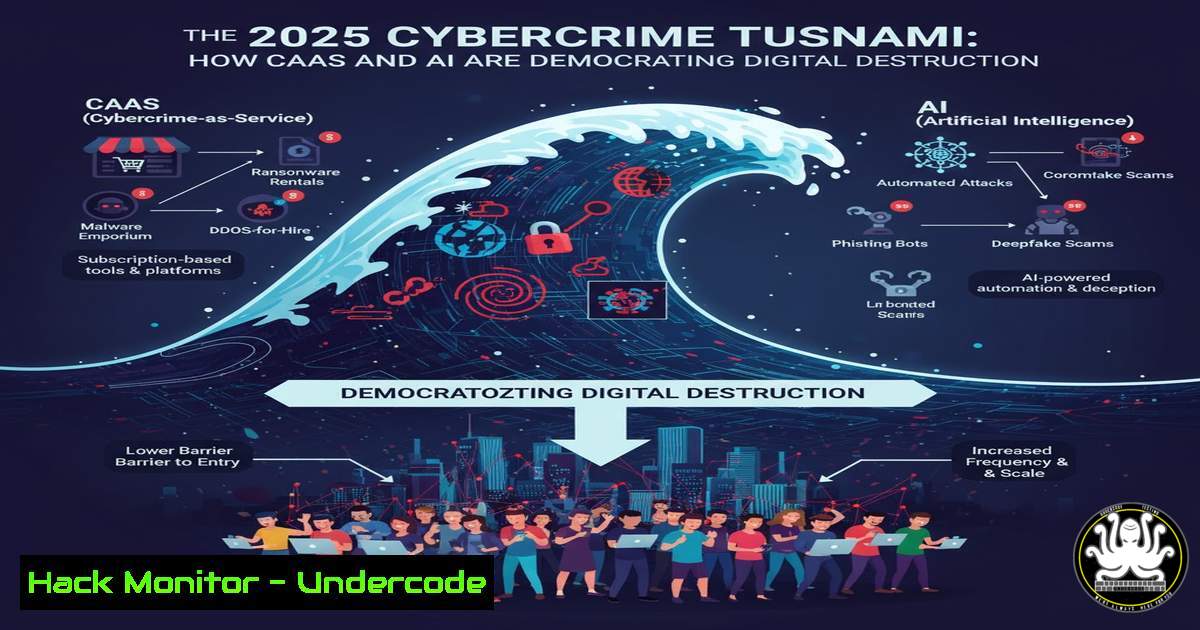
Introduction:
The 2025 COMCyber-MI Annual Cybercrime Report reveals a threat landscape fundamentally transformed. Cybercrime has industrialized, evolving into a mature economy powered by Cybercrime-as-a-Service (CaaS) platforms and augmented by generative AI, enabling low-skilled actors to launch sophisticated, scalable attacks that threaten organizations of all sizes and across all sectors.
Learning Objectives:
- Understand the operational mechanics of prevalent CaaS offerings like Phishing-as-a-Service and Ransomware-as-a-Service.
- Learn practical command-line and tool-based techniques to detect, mitigate, and investigate AI-augmented attacks.
- Implement proactive hardening measures for cloud, API, and identity infrastructure based on current threat intelligence.
You Should Know:
1. Dissecting a Phishing-as-a-Service Kit
Phishing-as-a-Service (PhaaS) platforms provide attackers with ready-made login pages, email templates, and backend hosting, drastically lowering the barrier to entry for credential harvesting campaigns.
` Check for suspicious processes often associated with PhaaS kits (Linux)`
`ps aux | grep -E ‘(php|cgi|python|node)’ | grep -v grep`
` Investigate network connections from web server processes`
`lsof -i -P | grep -E ‘(httpd|apache2|nginx|php|node)’ | grep LISTEN`
Step-by-step guide: The first command lists all running processes and filters for common web scripting languages that PhaaS kits utilize. The second command, lsof, lists all open network files (sockets), filtering for common web server processes and showing which ports they are listening on. An unexpected service like a Node.js application running on a non-standard port on a web server could indicate a compromised account hosting a PhaaS kit. Regularly audit your web server for unauthorized applications and services.
2. Hunting for AI-Generated Phishing Lures
Generative AI can create highly personalized and grammatically flawless phishing emails. Defenders must look for new indicators of compromise beyond traditional spelling errors.
` Using the ‘file’ command to inspect email headers for inconsistencies`
`cat phishing_email.eml | grep -i ‘from:\|reply-to:\|return-path’`
` Using ‘dig’ to verify sender’s domain reputation`
`dig +short MX example-suspicious-domain.com`
Step-by-step guide: Analyze the headers of a suspicious email. The `grep` command extracts the “From,” “Reply-To,” and “Return-Path” headers, which attackers often manipulate. A mismatch between these fields is a strong indicator of spoofing. Subsequently, use `dig` to query the Mail Exchange (MX) records of the sender’s domain. A new domain or one with a poor reputation score (which can be checked with threat intelligence platforms) adds credibility to the phishing hypothesis.
3. Detecting Ransomware-as-a-Service (RaaS) Network Activity
RaaS affiliates often use standard tools for initial access and lateral movement, making command-line auditing crucial for early detection.
` Windows command to audit successful network logons (Event ID 4624)`
`Get-WinEvent -FilterHashtable @{LogName=’Security’; ID=4624} | Where-Object { $_.Properties[bash].Value -eq 2 } | Select-Object -First 10`
` Linux command to monitor for mass file encryption (inotifywatch)`
`inotifywait -m -r -e modify,create,delete /sensitive/data/path/ | tee -a file_changes.log`
Step-by-step guide: The PowerShell command queries the Windows Security log for successful network logons (Event ID 4624, Logon Type 2), which are common in RaaS attacks for lateral movement. The Linux command uses `inotifywait` to monitor a directory recursively (-r) for file modifications, creations, and deletions, writing output to a log file. A sudden, rapid spike in these events is a classic signature of ransomware file encryption in progress.
4. Hardening Cloud APIs Against Automated Reconnaissance
CaaS operators heavily target misconfigured cloud APIs. Locking down identity and access management (IAM) is a primary defense.
` AWS CLI command to list all IAM users and their attached policies`
`aws iam list-users`
`aws iam list-attached-user-policies –user-name `
` Azure CLI command to list service principals and their permissions`
`az ad sp list –show-mine true –query “[].{displayName:displayName, appId:appId}”`
Step-by-step guide: Regularly audit your cloud identities. The AWS commands list all IAM users and then, for a specific user, show the managed policies attached to them. Look for users with excessive permissions, such as AdministratorAccess. The Azure CLI command lists all service principals (non-human identities) and their Application IDs. Ensure each principal follows the principle of least privilege.
5. Mitigating AI-Powered Password Spraying Attacks
AI can generate context-aware password lists and automate spraying attacks against identity providers like Active Directory and cloud SSO.
` PowerShell to audit Azure AD/Active Directory for accounts without MFA`
`Get-MsolUser -All | Where-Object { $_.StrongAuthenticationMethods.Count -eq 0 } | Select-Object DisplayName, UserPrincipalName`
` Windows command to review failed logon attempts (Event ID 4625)`
`Get-WinEvent -FilterHashtable @{LogName=’Security’; ID=4625} | Group-Object -Property {$_.Properties[bash].Value} | Sort-Object Count -Descending`
Step-by-step guide: The first PowerShell command (for the MSOnline module) lists all users who do not have any multi-factor authentication (MFA) methods configured, making them prime targets for password spraying. The second command groups failed logon attempts (Event ID 4625) by account name, allowing you to identify which accounts are under active attack. A high count of failures on multiple accounts from a single IP indicates a password spraying campaign.
6. Analyzing Malicious Documents with OSINT and Sandboxing
CaaS often delivers payloads via weaponized documents. Static and dynamic analysis is key.
` Using ‘strings’ and ‘exiftool’ to analyze a suspicious PDF`
`strings suspicious_document.pdf | grep -i ‘javascript\|http://\|https://’`
`exiftool suspicious_document.pdf | grep -i ‘creator\|author’`
` Isolated sandbox execution with Wireshark for network analysis`
` (Conceptual) wireshark -i eth0 -w capture.pcap`
Step-by-step guide: The `strings` command extracts human-readable text from the binary PDF file, searching for indicators like “javascript” or URLs. `exiftool` reads the document’s metadata, which can reveal suspicious author names or creation software. For dynamic analysis, execute the document in a isolated virtual machine while running a packet capture tool like Wireshark to observe any outbound callbacks to C2 servers.
7. Proactive Container Security and Vulnerability Scanning
The cloud-native attack surface is a prime target. Scanning for vulnerabilities and misconfigurations in container images is essential.
` Using Trivy to scan a container image for vulnerabilities`
`trivy image `
` Using Docker Bench Security to audit a host’s configuration`
`git clone https://github.com/docker/docker-bench-security.git`
`cd docker-bench-security && sudo ./docker-bench-security.sh`
Step-by-step guide: `Trivy` is a simple, comprehensive scanner that will list all Common Vulnerabilities and Exposures (CVEs) found in your container image, categorized by severity. The Docker Bench Security script checks a host against hundreds of best practices defined by the CIS Docker Benchmark, highlighting configuration weaknesses that could be exploited by attackers to break out of a container.
What Undercode Say:
- The industrialization of cybercrime via CaaS is the single most significant force reshaping the threat landscape, creating a permanent asymmetry between attackers and defenders.
- Generative AI is not a future threat; it is a present-day force multiplier that is already being used to enhance the scale, speed, and believability of social engineering and automated exploitation.
The 2025 COMCyber-MI report makes it unequivocally clear that we are no longer fighting individual hackers but a global, efficient, and profit-driven criminal industry. The “as-a-Service” model has commoditized advanced attack capabilities, allowing financial motivation to directly purchase technical prowess. In this environment, traditional perimeter-based defense is obsolete. Security must be intrinsic, data-centric, and assume compromise. The strategic imperative is to shift from merely building higher walls to creating resilient systems that can detect, respond, and recover from an incident faster than the attacker can achieve their objectives. This requires deep integration of behavioral analytics, widespread MFA, zero-trust architecture, and above all, a security culture that understands the industrial nature of the adversary.
Prediction:
The convergence of industrialized CaaS and advanced AI will lead to the emergence of fully autonomous “Dark AI” attack cycles within the next 3-5 years. These systems will be capable of self-directed reconnaissance, vulnerability discovery, weaponization, and exploitation with minimal human intervention, overwhelming traditional, human-scale defense processes. This will force a counter-evolution towards AI-driven defensive systems that can autonomously patch vulnerabilities, isolate compromised segments, and launch countermeasures, fundamentally changing cybersecurity from a human-on-human conflict to an AI-on-AI battleground.
🎯Let’s Practice For Free:
IT/Security Reporter URL:
Reported By: Richard Chetory – Hackers Feeds
Extra Hub: Undercode MoN
Basic Verification: Pass ✅


