Listen to this Post
Introduction:
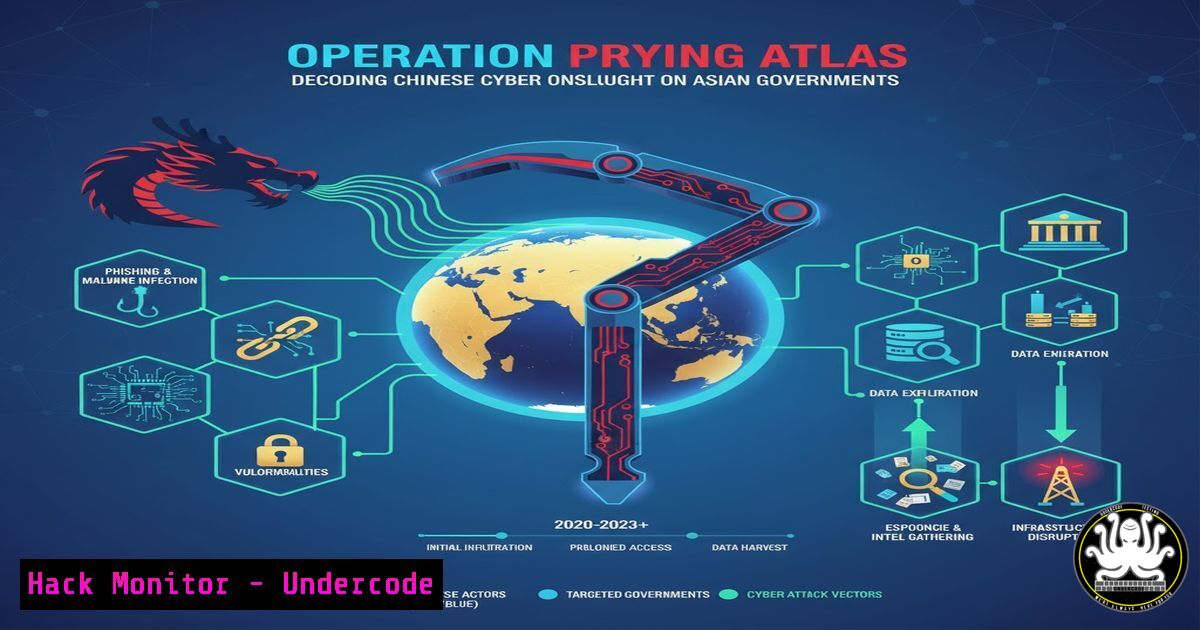
A sophisticated cyber espionage campaign, dubbed “Operation Prying Atlas,” has been systematically targeting high-level government agencies across Asia. Leveraging a cleverly disguised malicious SDK within a seemingly legitimate VPN application, threat actors have successfully infiltrated sensitive networks, exfiltrating critical data and establishing persistent footholds. This operation highlights a dangerous trend in software supply chain attacks and underscores the critical need for robust third-party risk management.
Learning Objectives:
- Understand the technical mechanics of the Operation Prying Atlas supply chain attack, from initial infection to data exfiltration.
- Learn how to identify and analyze malicious Android Package Kit (APK) components using open-source tools.
- Implement defensive strategies and detection rules to protect your organization from similar SDK-based threats.
You Should Know:
1. The Anatomy of a Trojanized SDK
The core of this attack lies in the “SDK SP,” a malicious software development kit embedded within a VPN application. This SDK operates with a modular design, allowing it to carry out a wide array of malicious activities while masquerading as legitimate software. Its primary function is to act as a sophisticated data harvesting tool, specifically configured to target government and military entities.
Step-by-step guide explaining what this does and how to use it.
Step 1: Initial Compromise. The victim downloads and installs the trojanized VPN application from a third-party website or a targeted spear-phishing link. The app appears functional, building user trust.
Step 2: Silent Payload Deployment. Upon launch, the embedded SDK SP initializes. It communicates with a Command and Control (C2) server to retrieve its configuration, which dictates its subsequent actions.
Step 3: Permission Abuse. The SDK leverages the broad permissions granted to the VPN app (e.g., READ_EXTERNAL_STORAGE, ACCESS_FINE_LOCATION, READ_PHONE_STATE) to access sensitive data without raising immediate suspicion.
Step 4: Data Harvesting. The module begins systematically collecting data from the infected device, including SMS messages, contact lists, GPS location, device information (IMEI, model), and files from specific directories.
- Technical Deep Dive: APK Analysis and IOC Extraction
To defend against such threats, security teams must be proficient in dissecting APK files. This process allows you to extract Indicators of Compromise (IOCs) and understand the malware’s capabilities.
Step-by-step guide explaining what this does and how to use it.
Step 1: Acquire the APK. Use a tool like `apkleaks` to download the APK from a given URL, or pull it from a test device using adb.
`adb shell pm path com.example.malicious.vpn`
`adb pull /path/to/base.apk`
Step 2: Decompile the APK. Use `jadx-gui` or `apktool` to decompile the APK into readable Java/Kotlin source code and resources.
`jadx-gui base.apk`
Step 3: Analyze the Manifest. Inspect the `AndroidManifest.xml` for suspicious permissions, services, and receivers. Look for requests for non-standard permissions or receivers that trigger on system events like BOOT_COMPLETED.
Step 4: Search for IOCs. Scan the decompiled code for hardcoded strings, domains, and IP addresses. Key IOCs from this campaign include the C2 server `sdk-security.org` and various SHA256 hashes of the malicious APKs.
3. Network Traffic Analysis and C2 Communication
The malware’s communication with its C2 server is often the most detectable aspect of an infection. Understanding this protocol is key to building network defenses.
Step-by-step guide explaining what this does and how to use it.
Step 1: Traffic Capture. Use a tool like Wireshark or `tcpdump` on a network gateway or a sandboxed device running the malware to capture network traffic.
`tcpdump -i any -w prying_atlas_capture.pcap`
Step 2: Protocol Identification. The malware in Operation Prying Atlas communicates over HTTP/HTTPS. Look for POST requests to domains like sdk-security.org. The data is often encrypted or encoded (e.g., Base64) to evade simple detection.
Step 3: Create Detection Signatures. Use the identified patterns to create Intrusion Detection System (IDS) rules. For example, a Snort rule might look like:
`alert tcp any any -> any any (msg:”Suspected Prying Atlas C2 Communication”; content:”sdk-security.org”; nocase; sid:1000001; rev:1;)`
Step 4: Monitor for Beaconing. Look for regular, periodic HTTP requests from internal hosts to unknown external domains, which is a classic sign of a C2 beacon.
4. Endpoint Detection and Response on Mobile Devices
While traditional EDR is for endpoints, the principles apply to Mobile Device Management (MDM) and security solutions.
Step-by-step guide explaining what this does and how to use it.
Step 1: Behavioral Analysis. Monitor for applications that request permissions incongruent with their stated purpose. A VPN app should not need to read SMS or contacts.
Step 2: Process Monitoring. Use MDM solutions to flag applications that spawn unusual processes or establish network connections immediately upon installation and launch.
Step 3: File System Monitoring. Deploy agents that can detect the creation of malicious files in application data directories, a common technique for storing downloaded secondary payloads.
5. Mitigation and Hardening Strategies
Proactive defense is crucial to prevent the success of such campaigns.
Step-by-step guide explaining what this does and how to use it.
Step 1: Strict Application Sourcing. Enforce policies that prevent the installation of applications from untrusted third-party app stores. Mandate the use of official enterprise app catalogs or Google Play Protect.
Step 2: Principle of Least Privilege. Scrutinize and restrict application permissions at the MDM policy level. Does a productivity app truly need access to the microphone or location?
Step 3: Network Segmentation. Implement strict firewall rules and network segmentation. Devices used for sensitive work should have limited outbound internet access, blocking connections to non-business-critical domains.
Step 4: Security Awareness Training. Continuously educate employees on the dangers of downloading software from unverified sources, especially via spear-phishing emails.
What Undercode Say:
- Supply Chain is the New Battlefield. The most significant takeaway is the shift from direct exploitation to subverting the software supply chain. Trust in third-party code, even within seemingly legitimate applications, can no longer be assumed.
- Offensive Capabilities are Matched by Defensive Diligence. This campaign was uncovered not by a single silver bullet, but through meticulous forensic analysis and threat intelligence correlation. Defense is a process, not a product.
The Operation Prying Atlas campaign is a stark reminder that nation-state actors are increasingly relying on subtle, persistent methods over loud, destructive ones. By weaponizing a trusted software component, the attackers lowered their target’s guard significantly. The technical analysis reveals a well-resourced operation designed for long-term intelligence gathering. For defenders, this underscores the non-negotiable requirement for robust application vetting processes, deep technical analysis capabilities, and a security posture that assumes breach. The focus must expand from perimeter defense to continuous monitoring of internal network and application behavior.
Prediction:
The success of Operation Prying Atlas will catalyze a wave of imitative and more advanced software supply chain attacks. We predict a rise in malicious code being injected into open-source libraries, developer tools, and even CI/CD pipelines, making the attack surface more diffuse and harder to defend. Furthermore, AI will be leveraged to generate more convincing fake applications and to dynamically obfuscate malicious code within SDKs, making static analysis less effective. The future battleground will be the integrity of the software development lifecycle itself, forcing a industry-wide pivot towards software bill of materials (SBOMs) and zero-trust development environments.
🎯Let’s Practice For Free:
IT/Security Reporter URL:
Reported By: Natalia Spinu – Hackers Feeds
Extra Hub: Undercode MoN
Basic Verification: Pass ✅


