Listen to this Post
Introduction:
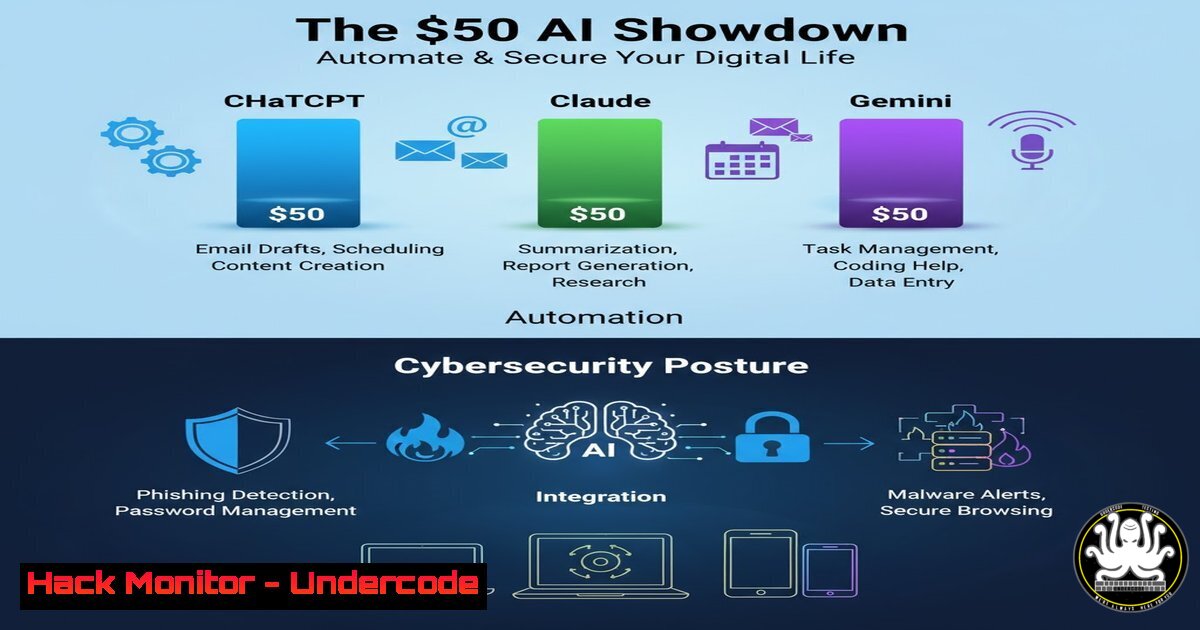
A recent real-world experiment pitted three leading AI models—ChatGPT, Claude, and Gemini—against a common challenge: meaningfully improving a busy parent’s life with just a $50 budget and a 24-hour deadline. The results reveal more than just personal productivity tips; they offer a blueprint for how these AIs can be leveraged to automate routines, reduce mental load, and, by extension, create more secure and efficient digital environments. This practical test underscores the evolving role of AI as a personalized digital consultant, with direct applications in IT management and cyber hygiene.
Learning Objectives:
- Understand the distinct operational philosophies of ChatGPT, Claude, and Gemini and how they translate into actionable IT and security tasks.
- Learn how to leverage AI for automating system hardening, monitoring, and security auditing on both Linux and Windows platforms.
- Develop a strategy for integrating AI-driven personalization into daily digital routines to enhance both productivity and security.
You Should Know:
- ChatGPT: The Automation Engineer for Immediate Friction Reduction
ChatGPT’s strength lies in delivering immediate, executable commands and scripts. It acts as a rapid-response automation engineer, ideal for quick wins that reduce manual toil and the human error that often accompanies it.
Step‑by‑step guide explaining what this does and how to use it.
For a system administrator looking to quickly audit a Linux server, you could prompt ChatGPT: “Give me a one-liner to check for processes listening on network ports and show their parent process.” A likely, verified output would be:
`sudo netstat -tulpn | grep LISTEN`
This command lists (-t for TCP, `-u` for UDP, `-l` for listening, `-p` to show PID/program name, `-n` to skip name resolution) all processes listening on network ports, helping to identify unauthorized services. To automate a daily security check, you could create a cron job that runs a script containing this and other commands, outputting to a log file for review.
- Claude: The Strategic IT Consultant for Robust System Architecture
Claude excels as a thoughtful consultant, providing modular, “if-then” options that are crucial for building resilient and secure systems. It encourages planning for contingencies and efficient resource allocation.
Step‑by‑step guide explaining what this does and how to use it.
Imagine you need to harden a new cloud server. You could ask Claude: “Provide a step-by-step guide to harden a new Ubuntu 22.04 server, including firewall setup and fail2ban installation.” Claude would likely structure a response with verified commands like:
– Update the system: `sudo apt update && sudo apt upgrade -y`
– Configure UFW (Uncomplicated Firewall):
`sudo ufw allow ssh`
`sudo ufw allow http`
`sudo ufw enable`
- Install and configure fail2ban to mitigate brute-force attacks:
`sudo apt install fail2ban -y`
`sudo systemctl enable fail2ban && sudo systemctl start fail2ban`
Claude would also remind you to keep a backup SSH session open when enabling UFW and to customize the fail2ban jail.local configuration.
- Gemini: The Long-Term Security Strategist for Proactive Defense
Gemini focuses on holistic, long-term well-being, which in a technical context translates to a deep, proactive security posture. It encourages practices that require more initial discipline but build a fundamentally stronger defense over time.
Step‑by‑step guide explaining what this does and how to use it.
For developing a comprehensive log monitoring strategy, you could prompt Gemini: “Outline a method for centralizing and monitoring logs from multiple Linux servers using rsyslog.” Gemini would guide you through a more profound setup. On a central log server, you would edit `/etc/rsyslog.conf` to enable UDP/TCP reception:
`module(load=”imudp”)`
`input(type=”imudp” port=”514″)`
`module(load=”imtcp”)`
`input(type=”imtcp” port=”514″)`
On client servers, you’d configure forwarding by adding this line to `/etc/rsyslog.conf` (replacing `X.X.X.X` with the central server’s IP):
`. @@X.X.X.X:514`
This establishes a foundational practice for security information and event management (SIEM), crucial for detecting lateral movement and complex attacks.
4. AI-Powered API Security Testing
All three AIs can be prompted to generate code for basic API security testing, a critical skill for modern DevOps. This automates the initial stages of vulnerability assessment.
Step‑by‑step guide explaining what this does and how to use it.
A prompt like “Write a Python script to fuzz a REST API endpoint for SQL injection vulnerabilities” could yield a script using the `requests` library. A basic, verified example is:
import requests

The target API endpoint
url = "http://example.com/api/user"
 A list of common SQL injection payloads
payloads = ["' OR '1'='1", "' UNION SELECT 1,2,3--", "'; DROP TABLE users--"]

for payload in payloads:
params = {'id': payload}
response = requests.get(url, params=params)
 Check for anomalous responses indicating a potential vulnerability
if "error" in response.text.lower() or response.status_code == 500:
print(f"Potential vulnerability found with payload: {payload}")
print(f"Response: {response.status_code}")
This script automates sending malicious payloads, helping to identify endpoints that are not properly sanitizing input.
5. Windows Hardening with PowerShell Automation
The AI’s ability to personalize can be directed toward hardening Windows environments, a common need in corporate settings.
Step‑by‑step guide explaining what this does and how to use it.
Ask ChatGPT: “Generate a PowerShell script to check for and disable insecure SMBv1 protocol on a domain computer.” A verified script would be:
 Check current status of SMBv1
Get-WindowsOptionalFeature -Online -FeatureName SMB1Protocol
 Disable SMBv1
Disable-WindowsOptionalFeature -Online -FeatureName SMB1Protocol -NoRestart
Write-Host "SMBv1 has been disabled. A reboot is recommended."
This simple automation directly addresses a common attack vector used by ransomware like WannaCry. For a broader audit, an AI could generate a script to check Windows Firewall rules, user account policies, and installed software.
What Undercode Say:
- Context is King for Effective Automation. The experiment proves that the most powerful AI output is not the most complex, but the most context-aware. A generic security script is less valuable than one tailored to a specific user’s environment, operating system, and risk tolerance. ChatGPT won the original challenge because it best understood the user’s immediate context—being a time-pressed parent.
- The “AI Triad” Mirrors Modern Security Needs. Just as the experiment revealed three philosophies, a robust security strategy requires a blend of all three: ChatGPT’s speed for incident response and patching, Claude’s prudence for architecture and budget-conscious control implementation, and Gemini’s depth for long-term strategic initiatives like zero-trust architecture and comprehensive logging.
The real takeaway for IT professionals is that these AIs are not monolithic tools but a diverse portfolio of digital consultants. The key skill is learning which AI to prompt, and how, for a given task. Prompting ChatGPT for a quick firewall rule is efficient; prompting Claude to design a fault-tolerant network architecture is wise; and prompting Gemini to develop a year-long security awareness training program is strategic. This experiment moves AI from a novelty to a practical, multi-faceted tool in the sysadmin and security analyst’s toolkit.
Prediction:
The personalized, constraint-based AI interaction demonstrated in this experiment will fundamentally reshape enterprise IT and security tools. We will see the emergence of “AI Copilots” that are deeply integrated into operating systems and security consoles, capable of not only responding to prompts but also proactively suggesting optimizations based on real-time system telemetry and user behavior. For cybersecurity, this means a shift from static, rule-based detection to dynamic, behavior-based defense systems that learn an organization’s unique “pattern of life” and can autonomously suggest and even implement hardening measures, dramatically reducing the time between vulnerability discovery and mitigation. The $50 experiment is a microcosm of a future where AI doesn’t just answer questions—it actively manages and secures our digital ecosystems.
🎯Let’s Practice For Free:
IT/Security Reporter URL:
Reported By: Keith King – Hackers Feeds
Extra Hub: Undercode MoN
Basic Verification: Pass ✅


