Listen to this Post
Introduction:
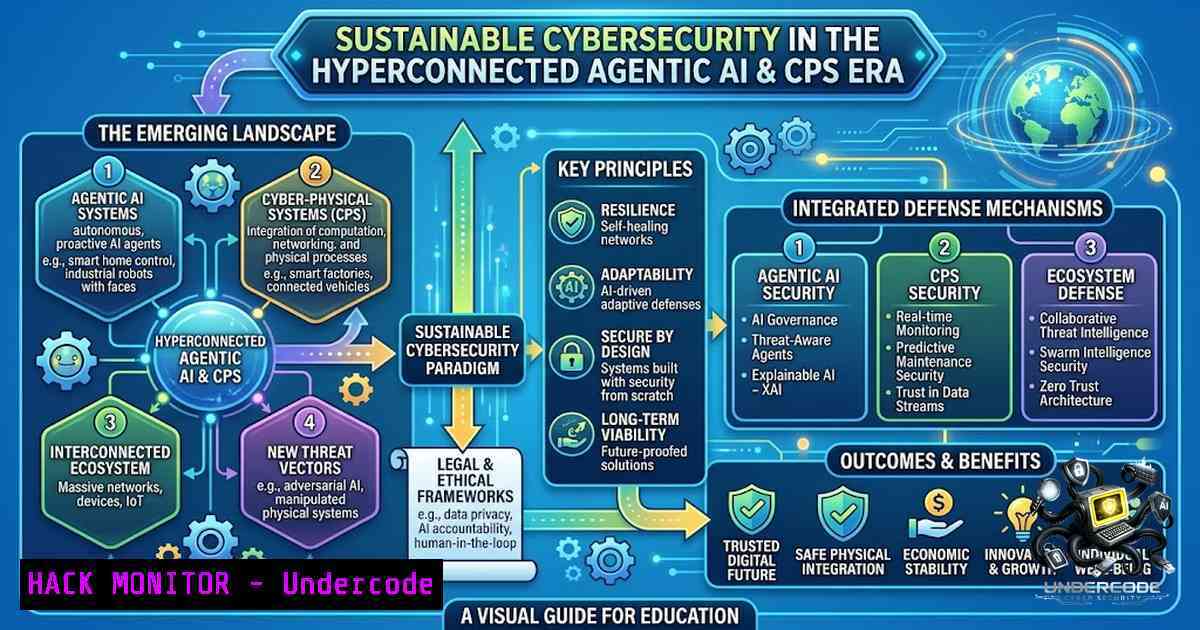
The convergence of agentic artificial intelligence, hyperconnected digital ecosystems, and cyber-physical systems (CPS) is fundamentally reshaping the cybersecurity landscape. As autonomous AI agents gain the ability to independently execute multi-step operations, they introduce both unprecedented efficiency gains and novel attack surfaces that traditional security models cannot adequately address. At the IEEE Cyber Security & Resilience conference, Ryan H. from Palo Alto Networks delivered an industry-oriented keynote on “Sustainable Cybersecurity in the Era of Hyperconnected Agentic AI and Cyber-Physical Systems,” outlining a framework for building resilient defenses that can adapt and endure in this new paradigm.
Learning Objectives:
- Understand the architectural shifts introduced by agentic AI and their implications for cyber-physical system security
- Master the implementation of zero-trust principles in environments where machine identities outnumber human users 109:1
- Deploy practical security controls across the agentic AI lifecycle, from development to runtime
You Should Know:
- The Agentic AI Threat Landscape and Defense Paradigm Shift
The transition from “AI-assisted” to “AI-1ative” marks a critical inflection point where autonomous agents with reasoning, action, and memory capabilities define a new era of both attack and defense. By 2026, the majority of advanced cyberattacks will employ AI to execute dynamic, multilayered attacks that can adapt instantaneously to defensive measures. This escalation transforms cybersecurity into a continuous AI cyber arms race where resilience—not just prevention—becomes the primary differentiator.
For security teams, the widespread enterprise adoption of AI agents provides a long-awaited “force multiplier,” but only if properly governed and secured. Palo Alto Networks defines this new landscape through a unified identity platform that harmonizes access visibility across all human and machine identities. The fundamental challenge lies in securing autonomous systems that operate at machine speed while maintaining human accountability.
Step‑by‑step guide for assessing agentic AI risk in your environment:
- Inventory all AI agents and machine identities – Use identity governance tools to discover and catalog every autonomous agent operating across your cloud, SaaS, and on-premises environments. Machine identities now dominate network traffic, making this visibility essential.
-
Map agent-to-agent communication flows – Document how agents interact with each other, with APIs, and with human users. Traditional security models built for human latency are insufficient to counter automated data exfiltration that can occur in minutes.
-
Implement continuous behavioral baselining – Establish normal operational patterns for each agentic workflow. Anomaly detection must account for the dynamic, adaptive nature of agentic systems.
-
Deploy agentic AI red teaming – Simulate context-aware agentic attacks to discover AI-related vulnerabilities and recommend runtime security policies.
Linux/Windows Commands for AI Agent Monitoring:
 Linux: Monitor for unauthorized AI agent processes
ps aux | grep -E "python|node|tensorflow|pytorch|agent" | grep -v grep

Linux: Track outbound API calls from AI agents
sudo tcpdump -i any -1 'port 443 and (host api.openai.com or host anthropic.com)'

Linux: Audit agent configuration files for security misconfigurations
find /etc /opt /home -1ame "config.json" -o -1ame "agent.yaml" 2>/dev/null | xargs grep -E "api_key|secret|token|password"

Windows PowerShell: List all running processes associated with AI frameworks
Get-Process | Where-Object { $_.ProcessName -match "python|node|tensorflow" }

Windows PowerShell: Monitor agent network connections
Get-1etTCPConnection | Where-Object { $_.State -eq "Established" } | Select-Object LocalAddress, LocalPort, RemoteAddress, RemotePort, OwningProcess
- Securing the Agentic AI Lifecycle with Prisma AIRS 3.0
Palo Alto Networks’ Prisma AIRS 3.0 represents the industry’s first platform designed to secure the entire agentic AI lifecycle. This unified security platform provides end-to-end protection for AI enterprises through several key capabilities.
The AI Agent Gateway serves as a central control plane to enforce agent runtime and identity security, governance, and observability. This gateway provides critical visibility into agent behavior and enables policy enforcement at scale. Agentic Endpoint Security extends protection to endpoints, governing how agents interact with local systems, files, and workflows. This is particularly important as agentic AI becomes localized to endpoints, creating a new category of protection requirements.
Step‑by‑step guide for implementing agentic AI security controls:
- Deploy an AI Agent Gateway – Establish a central control plane that intercepts and inspects all agent communications. Configure runtime policies that restrict agent actions based on identity, context, and behavioral patterns.
-
Implement agentic endpoint security – Extend protection to every endpoint running AI agents. Govern how agents interact with local files, system resources, and workflows.
-
Enable AI red teaming capabilities – Regularly test your agentic systems against context-aware attacks that simulate real-world adversary behaviors.
-
Establish continuous observability – Monitor agent behavior in real-time, with automated alerting for anomalous activities that deviate from established baselines.
Configuration Example for AI Agent Gateway Policy (JSON):
{
"policy": {
"name": "agent-runtime-security",
"enforcement": "block",
"rules": [
{
"id": "rule-001",
"agent_type": "coding-agent",
"allowed_actions": ["read_repo", "write_repo", "test_execution"],
"blocked_actions": ["prod_deployment", "secret_access"],
"rate_limits": {"requests_per_minute": 100}
},
{
"id": "rule-002",
"agent_type": "data-analysis-agent",
"allowed_data_sources": ["data-lake-dev", "data-lake-qa"],
"blocked_data_sources": ["data-lake-prod"],
"encryption_required": true
}
],
"observability": {
"log_level": "debug",
"audit_trail": true,
"anomaly_detection": true
}
}
}
3. Zero-Trust Architecture for Cyber-Physical Systems
Cyber-physical systems represent a critical frontier where security failures have physical consequences. The hyperconnected nature of modern CPS—spanning industrial control systems, smart grids, autonomous vehicles, and medical devices—demands a zero-trust approach that never assumes implicit trust.
The fundamental principle is that identity is no longer primarily a human problem. As AI agents, APIs, and autonomous systems proliferate, machine identities are becoming the new attack surface. Organizations must implement continuous verification of every access request, regardless of source, and enforce least-privilege access for all machine-to-machine communications.
Step‑by‑step guide for implementing zero-trust in CPS environments:
- Inventory all cyber-physical assets and their communication patterns – Create a comprehensive asset register that includes every sensor, actuator, controller, and gateway device.
-
Segment OT and IT networks – Implement network segmentation that isolates critical control systems from enterprise networks and the internet.
-
Deploy continuous authentication for machine identities – Implement certificate-based authentication and continuous validation for all device-to-device communications.
-
Enforce least-privilege access controls – Restrict every device and agent to only the resources and actions required for its specific function.
-
Implement real-time monitoring and anomaly detection – Deploy intrusion detection systems that can identify behavioral anomalies in both cyber and physical domains.
Linux Commands for OT/ICS Network Security:
 Monitor industrial protocol traffic (Modbus, DNP3, IEC 61850)
sudo tcpdump -i any -1 'port 502 or port 20000 or port 2404'

Analyze network segmentation and identify unauthorized cross-segment traffic
sudo nft list ruleset | grep -E "forward|accept|drop"

Monitor for unauthorized device additions to the network
sudo arp-scan --localnet | grep -v "known_device_mac"

Scan for open industrial control ports
nmap -p 502,20000,2404,44818,2222 --open <subnet_range>

Monitor system logs for unauthorized access attempts to control systems
sudo journalctl -f -u sshd -u modbus -u opcua
- AI-Driven Defense and the Year of the Defender
Palo Alto Networks predicts that 2026 will mark the “Year of the Defender,” where AI-driven defenses tip the scale in the defense’s favor. This shift is driven by AI-powered security operations that drive down response times, reduce complexity, and increase visibility to quickly respond to cyberattacks.
Precision AI, which leverages machine learning and generative AI to automate threat detection, represents a significant advancement in defensive capabilities. Deep learning enables predictive threat assessments, while a library of over 4,000 ML models provides comprehensive coverage across the attack surface. The key differentiator is the convergence of network enforcement, browser-level visibility, AI runtime controls, endpoint agent monitoring, and machine identity governance into a single control and action plane.
Step‑by‑step guide for building an AI-driven security operations center:
- Deploy AI-1ative security operations platforms – Implement solutions that embed AI throughout the security operations workflow, not just as an add-on feature.
-
Automate threat detection and response – Configure AI agents to autonomously investigate and remediate threats, moving from reactive to proactive security.
-
Implement predictive threat intelligence – Use machine learning models to anticipate attacks before they occur, based on behavioral patterns and threat intelligence feeds.
-
Establish continuous improvement loops – Feed incident data back into AI models to improve detection accuracy and reduce false positives over time.
5. Sustainable Security Practices for the Agentic Era
Sustainability in cybersecurity extends beyond environmental considerations to encompass operational sustainability—building security programs that can scale and adapt as the threat landscape evolves. The key principles include platformization, automation, and continuous governance.
Platformization involves consolidating security tools into unified platforms that provide comprehensive visibility and control. Automation reduces the burden on security teams while improving response times. Continuous governance ensures that security policies evolve alongside the technology they protect.
Step‑by‑step guide for building sustainable security practices:
- Consolidate security tools into unified platforms – Reduce complexity by moving from point solutions to integrated platforms that provide end-to-end visibility.
-
Automate routine security operations – Implement AI agents to handle alert triage, incident investigation, and initial response actions.
-
Establish continuous compliance monitoring – Deploy automated tools that continuously assess security posture against regulatory and internal standards.
-
Build a security culture that embraces AI – Train security teams on AI-1ative tools and foster a mindset of continuous adaptation.
-
Measure and optimize security effectiveness – Track key performance indicators for security operations and continuously refine processes based on data.
What Undercode Say:
-
The convergence of agentic AI and cyber-physical systems creates both unprecedented risks and opportunities for defenders. Organizations that embrace AI-1ative security architectures will gain a significant advantage in the evolving threat landscape.
-
The shift from “AI-assisted” to “AI-1ative” represents a fundamental change in how security must be approached. Traditional perimeter-based defenses are no longer sufficient—security must be embedded into every layer of the technology stack, from development to runtime.
-
Machine identities now outnumber human users by a factor of 109:1, making identity governance the cornerstone of modern security strategy. Organizations must prioritize visibility and control over all autonomous entities operating within their environments.
-
The “Year of the Defender” is not just a prediction but a call to action. Security teams must invest in AI-driven defenses that can operate at machine speed, matching the pace of AI-powered attacks.
-
Sustainable cybersecurity requires a platform-based approach that reduces complexity, automates routine tasks, and provides comprehensive visibility across the entire attack surface.
Prediction:
-
+1 Organizations that successfully implement agentic AI security frameworks will achieve significant reductions in mean time to detection (MTTD) and mean time to response (MTTR), potentially reducing breach costs by 40-60% through automated threat hunting and remediation.
-
+1 The convergence of network security, identity governance, and AI runtime controls into unified platforms will drive a consolidation wave in the security industry, reducing operational complexity and improving security outcomes for enterprises of all sizes.
-
-1 The proliferation of autonomous AI agents will create new classes of vulnerabilities that traditional vulnerability management programs cannot address, leading to a surge in agent-specific attacks targeting AI supply chains and runtime environments.
-
-1 Organizations that fail to adapt their security architectures for the agentic era will face escalating breach costs and regulatory penalties, as machine-speed attacks outpace human-led defenses.
-
+1 The development of AI red teaming and agentic security testing frameworks will mature into a distinct cybersecurity discipline, creating new career opportunities and certification paths for security professionals.
-
+1 Regulatory frameworks will evolve to mandate agentic AI security controls, driving widespread adoption of standardized security practices across industries and creating a more resilient global digital ecosystem.
▶️ Related Video (88% Match):
https://www.youtube.com/watch?v=-00eCQlxxMg
🎯Let’s Practice For Free:
🎓 Live Courses & Certifications:
Join Undercode Academy for Verified Certifications
🚀 Request a Custom Project:
Secure, high-velocity infrastructure and disruptive technological engineering. Contact our engineering team for high-tier development and proprietary systems:
[email protected]
💎 Smart Architecture | 🛡️ Secure by Design | ⭐ Trusted by Thousands
IT/Security Reporter URL:
Reported By: Alexios Lekidis – Hackers Feeds
Extra Hub: Undercode MoN
Basic Verification: Pass ✅


