
Listen to this Post
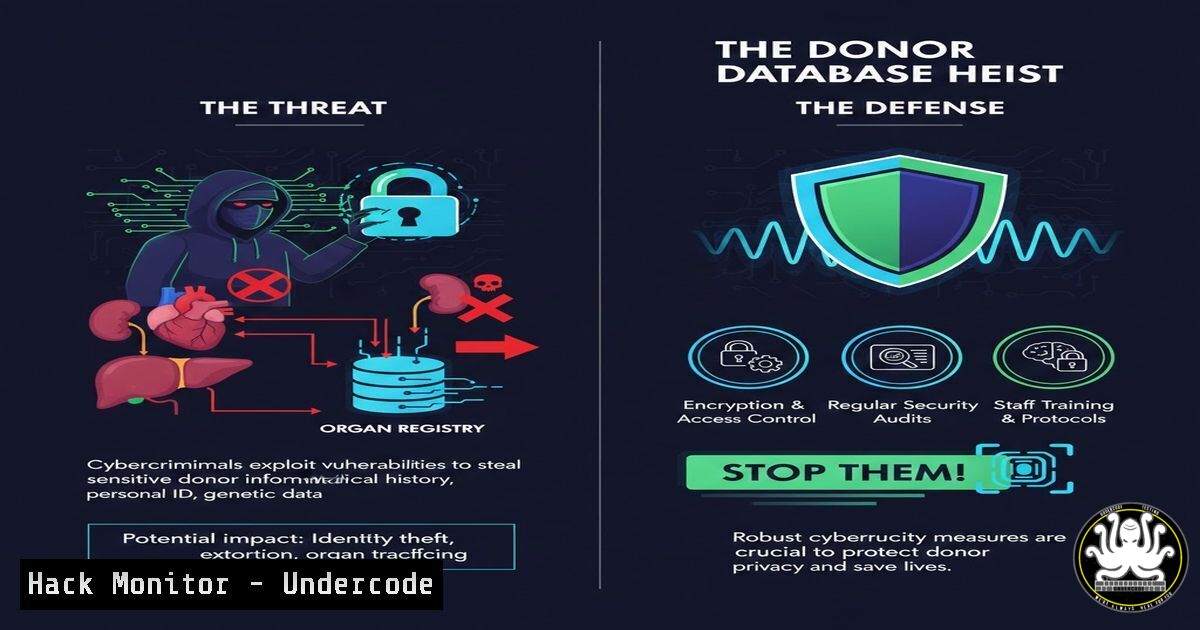
Introduction:
A recent social media discussion on organ donor registration unveiled a deep-seated, albeit fictional, fear: that malicious actors could weaponize donor data to target individuals. While the cinematic plot of hunting donors is speculative, it highlights a critical, real-world cybersecurity truth—any centralized database containing sensitive personal and health information is a prime target for advanced persistent threats (APTs) and identity-based attacks. This article explores the hypothetical attack vectors on such a registry and outlines the concrete cybersecurity measures needed to defend them.
Learning Objectives:
- Understand the potential attack surface of a national health registry, focusing on API, web application, and social engineering vulnerabilities.
- Learn actionable steps for OSINT (Open-Source Intelligence) gathering and footprinting a target organization’s digital estate.
- Implement defensive hardening techniques for web applications and cloud infrastructure to protect sensitive citizen data.
You Should Know:
1. Footprinting the Digital Estate: The Reconnaissance Phase
Before any attack, threat actors map the target’s online presence. For a registry like NOTTO (National Organ & Tissue Transplant Organisation), this starts with identifying all associated digital assets.
Step‑by‑step guide:
Subdomain Enumeration: Use tools like `amass` or `subfinder` to discover all subdomains.
amass enum -d notto.abdm.gov.in
Technology Stack Identification: Use `Wappalyzer` (browser extension) or `whatweb` to identify web frameworks, servers, and technologies.
whatweb https://notto.abdm.gov.in
Cloud Infrastructure Discovery: Search for misconfigured public buckets, exposed API keys, or GitHub repositories linked to the organization using tools like `s3scanner` or manual searches on GitHub.
2. Web Application & API Vulnerability Assessment
The donor portal is the primary interface. Its security is paramount. Attackers would probe for common OWASP Top 10 vulnerabilities.
Step‑by‑step guide:
Automated Scanning: Use `OWASP ZAP` or `Nuclei` to run baseline scans for SQLi, XSS, and broken access controls.
nuclei -u https://notto.abdm.gov.in -t ~/nuclei-templates/
API Endpoint Discovery & Testing: Use `Burp Suite` or `Postman` to intercept requests, map all API endpoints (/api/donor, /api/match), and test for missing authentication, excessive data exposure, and injection flaws.
SQL Injection Test: A basic manual test for error-based SQLi on a search parameter.
' OR '1'='1' --
3. Exploiting Identity and Access Management (IAM) Weaknesses
A breach often starts with compromised credentials. Attackers might target weak admin passwords or misuse legitimate credentials.
Step‑by‑step guide:
Password Spraying: Using a tool like `Spray` against the login portal with common passwords, avoiding account lockouts.
python3 spray.py -u https://notto.abdm.gov.in/login -U users.txt -P passwords.txt
Privilege Escalation Testing: If a low-privilege user account is compromised, test for horizontal/vertical privilege escalation by manipulating session tokens or direct object references (IDOR) in API calls.
4. Data Exfiltration and Lateral Movement
Once inside, the goal is to access and extract the donor database.
Step‑by‑step guide:
Database Dump via SQLi: If a vulnerability is found, use `sqlmap` to automate extraction.
sqlmap -u "https://notto.abdm.gov.in/search?id=1" --dump
Lateral Movement in Cloud Environments: In a cloud scenario (e.g., AWS), use stolen credentials to enumerate S3 buckets and EC2 instances using the AWS CLI.
aws s3 ls
aws ec2 describe-instances
5. Defensive Hardening: Securing the Registry
This is the crucial mitigation phase, outlining how to build a robust defense.
Step‑by‑step guide:
Implement Web Application Firewall (WAF): Deploy and configure a WAF like ModSecurity with updated OWASP CRS rules.
 Example ModSecurity rule to detect SQLi
SecRule ARGS "@detectSQLi" "id:1001,deny,status:403"
Harden Cloud Configuration (AWS S3 Example): Ensure all data buckets are private and have no public access.
aws s3api put-public-access-block --bucket donor-registry-bucket --public-access-block-configuration "BlockPublicAcls=true,IgnorePublicAcls=true,BlockPublicPolicy=true,RestrictPublicBuckets=true"
Enable Multi-Factor Authentication (MFA) Enforceably: Require MFA for all admin and user accounts, using time-based one-time passwords (TOTP).
What Undercode Say:
- The Threat is Data, Not Organs: The real-world risk is not a cinematic “organ mafia,” but sophisticated cybercriminals or state-sponsored groups seeking to exfiltrate vast datasets of personally identifiable information (PII) and protected health information (PHI) for identity theft, insurance fraud, or targeted phishing.
- Security is a Architecture, Not a Feature: A system of this sensitivity must be built on a zero-trust architecture. This means mandatory encryption for data at rest and in transit, strict principle of least privilege access, robust API security with rate-limiting, and continuous vulnerability management integrated into the SDLC.
Prediction:
The convergence of healthcare digitization and advanced cyber threats will make national health registries a persistent high-value target. Future attacks will likely leverage AI for hyper-realistic social engineering (deepfake audio/video) to manipulate staff and for automating the discovery of complex, chained vulnerabilities. The defensive response will equally evolve, adopting AI-driven anomaly detection systems that monitor for unusual data access patterns in real-time, potentially stopping breaches before significant data loss occurs. The public discussion, as seen on social media, underscores the profound need for transparent, communicable security practices to maintain public trust in these essential systems.
▶️ Related Video (78% Match):
🎯Let’s Practice For Free:
IT/Security Reporter URL:
Reported By: Riya Nair – Hackers Feeds
Extra Hub: Undercode MoN
Basic Verification: Pass ✅


