Listen to this Post
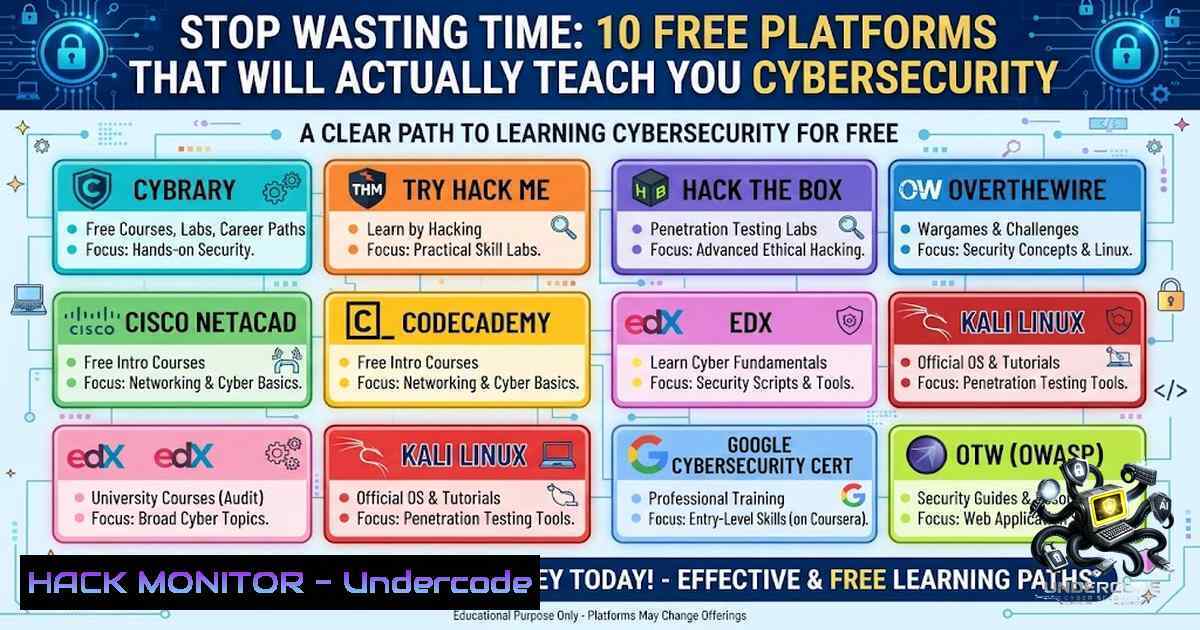
Introduction:
The path to becoming a cybersecurity professional is often clouded by misleading advice that emphasizes expensive degrees and certifications over practical, hands-on experience. A common pitfall for beginners is the “tutorial hell” trap, where months are spent passively watching videos without ever applying the knowledge. The most effective way to build real, marketable skills is through active learning—engaging with labs, wargames, and simulations that replicate real-world security scenarios and force you to think like both an attacker and a defender.
Learning Objectives:
- Understand the importance of practical, hands-on learning over passive content consumption in cybersecurity.
- Identify and utilize ten free, high-quality platforms for building offensive, defensive, and foundational security skills.
- Develop a structured approach to continuous skill development, from Linux basics to advanced SOC operations.
You Should Know:
1. The Foundation: Networking and Linux Basics
Before you can hack or defend, you need to understand the battlefield. A strong grasp of networking protocols and the Linux operating system is non-1egotiable, as most enterprise servers and security tools run on Linux. Two of the recommended platforms excel in this area: Cisco Networking Academy and OverTheWire: Bandit.
OverTheWire’s Bandit is particularly effective. It is a wargame designed to teach Linux fundamentals through practical challenges. You start by connecting via SSH and must use Linux commands to find passwords hidden in files, directories, or system variables to progress to the next level. It forces you to learn commands like ls, cd, cat, find, and `grep` in a realistic, problem-solving context.
Step-by-Step Guide: Starting with OverTheWire Bandit
1. Open your terminal (Linux/macOS) or PowerShell/WSL (Windows).
- Connect to the Bandit server using SSH:
ssh [email protected] -p 2220.
3. Use the password `bandit0` to log in.
- For Level 0 → Level 1, the password is stored in a file named `readme` in the home directory. Use the `ls` command to list files and `cat readme` to view the content.
- Use the retrieved password to connect to the next level:
ssh [email protected] -p 2220.
2. Building Offensive Security Skills
To defend a system, you must understand how to attack it. TryHackMe and Hack The Box (HTB) are the industry gold standards for learning offensive security. TryHackMe provides a structured, beginner-friendly path with guided rooms that teach everything from web application vulnerabilities (like SQL Injection and XSS) to network exploitation. HTB offers a more advanced, less-guided experience, where you must enumerate targets, find vulnerabilities, and exploit them to capture “flags.”
Step-by-Step Guide: Practical Web Application Hacking with TryHackMe
TryHackMe often uses a “deployable machine” to practice on. For example, in a room on SQL Injection:
1. Navigate to a TryHackMe room focused on OWASP Top 10 or SQL Injection.
2. Click the “Start Machine” button to deploy a vulnerable web server.
3. Use a tool like `Burp Suite` or your browser’s developer tools to intercept the web request.
4. Identify an input field (like a login or search bar) and inject a SQL payload, such as `’ OR 1=1 –` to bypass authentication.
5. Observe the system’s response to extract database information, which often leads to finding hidden data or a flag.
6. Document the vulnerability and the steps taken to exploit it as part of your learning.
3. Defensive Security & SOC Operations
For those interested in the “Blue Team” or Security Operations Center (SOC), Blue Team Labs Online is an invaluable resource. It provides realistic incident response scenarios. You might find yourself analyzing a suspicious email attachment, investigating a malicious PowerShell script, or hunting for a threat actor’s lateral movement within a network. This platform is essential for building the investigative mindset needed for a SOC analyst role.
Step-by-Step Guide: Investigating Suspicious PowerShell Activity in Windows
Often, labs will provide you with a Windows event log or a memory dump.
1. Access a lab that provides a `.evtx` (Windows Event Log) file from a compromised machine.
2. Open the log in Event Viewer or use a command-line tool like Wevtutil to parse the data.
3. Filter for Event ID 4688 (Process Creation) to see what commands were run.
4. Look for a suspicious process like `powershell.exe` with a long encoded command.
5. Decode the Base64 command using PowerShell: `[System.Text.Encoding]::UTF8.GetString([System.Convert]::FromBase64String(“encoded_string”))`.
- Analyze the decoded command to understand the attacker’s objective, such as downloading a payload or establishing persistence.
4. Structured Learning and Certifications
While practical labs are crucial, having a structured curriculum helps ensure you don’t miss the fundamentals. Cybrary and the Google Cybersecurity Certificate offer comprehensive, video-based courses that cover a wide range of domains, from risk management to network security. These are excellent for building a theoretical backbone to complement your practical labs. The Google certificate, accessible via Coursera with financial aid, is also a great résumé builder for entry-level positions.
Step-by-Step Guide: Using Cybrary to Build a Study Path
1. Create a free account on Cybrary.
- Navigate to the “Career Paths” section and select a role like “SOC Analyst” or “Penetration Tester.”
- Begin with the foundational courses, taking notes on key concepts like the CIA Triad and TCP/IP model.
- After completing a video module on, say, “Malware Analysis,” immediately apply that knowledge by opening a related lab on TryHackMe or Blue Team Labs Online.
- This cyclical process of theory → practical application is the most effective way to retain knowledge.
5. The Community and Open-Source Resources
The cybersecurity community is one of its greatest assets. Platforms like SecurityTube, PicoCTF, and Null Byte are built on a culture of sharing knowledge. PicoCTF, developed by Carnegie Mellon University, provides fun, interactive challenges that are perfect for beginners. SecurityTube offers a massive library of video presentations and tutorials from security conferences and experts. Engaging with these communities, attending virtual meetups, and reading walkthroughs from other learners is an essential part of the journey.
Step-by-Step Guide: Setting Up a Homelab for Practice
- Install VirtualBox or VMware Workstation Player on your Windows/Linux machine.
- Download a vulnerable virtual machine like Metasploitable 2 or DVWA (Damn Vulnerable Web Application).
- On your host machine (or another VM), install Kali Linux.
- Use tools in Kali, like `nmap` for network scanning, to discover your vulnerable VM:
nmap -sV 192.168.1.100. - Use `gobuster` or `dirb` to discover hidden directories on the web server:
gobuster dir -u http://192.168.1.100 -w /usr/share/wordlists/dirb/common.txt. - Document each finding and the exploitation steps. This replicates the exact environment of a professional penetration test.
What Undercode Say:
- Key Takeaway 1: The greatest barrier to entry in cybersecurity is often the belief that you need a perfect roadmap, expensive certifications, or a formal degree. These platforms prove that high-quality, hands-on training is available for free.
- Key Takeaway 2: “Learning by doing” is not just a motto; it is the most efficient learning methodology. Building a homelab, engaging in CTFs, and simulating incident responses are what separate a passive learner from a professional.
- Key Takeaway 3: Consistency is more important than intensity. Spending 30 minutes a day on a platform like TryHackMe or OverTheWire is more effective than an 8-hour binge once a month. The skills compound over time.
- The cybersecurity field is vast; you don’t have to master everything at once. Choose a niche—offensive, defensive, GRC, or cloud security—and use the relevant platforms to build deep expertise in that area.
Prediction:
- +1 The democratization of cybersecurity training through platforms like TryHackMe and HTB will continue to shrink the skills gap, bringing a more diverse talent pool into the industry who are ready to hit the ground running.
- +1 We will see a rise in “practice-first” hiring, where employers prioritize demonstrable skills from these practical platforms over traditional degrees or certs during the initial screening phase.
- -1 As these platforms become mainstream, some individuals may collect certifications and “badges” without developing deep problem-solving skills, leading to a superficial understanding that is easily exploited by sophisticated attackers. This will create a new class of “paper tigers” in the industry.
- +1 The gamification of cybersecurity education will improve retention and interest in STEM fields, ultimately producing a more capable generation of defenders who are better prepared to handle the complexity of modern cloud and IoT environments.
▶️ Related Video (78% Match):
🎯Let’s Practice For Free:
🎓 Live Courses & Certifications:
Join Undercode Academy for Verified Certifications
🚀 Request a Custom Project:
Secure, high-velocity infrastructure and disruptive technological engineering. Contact our engineering team for high-tier development and proprietary systems:
[email protected]
💎 Smart Architecture | 🛡️ Secure by Design | ⭐ Trusted by Thousands
IT/Security Reporter URL:
Reported By: Kushlendrasingh Cybersecurity – Hackers Feeds
Extra Hub: Undercode MoN
Basic Verification: Pass ✅


