
Listen to this Post
Introduction:
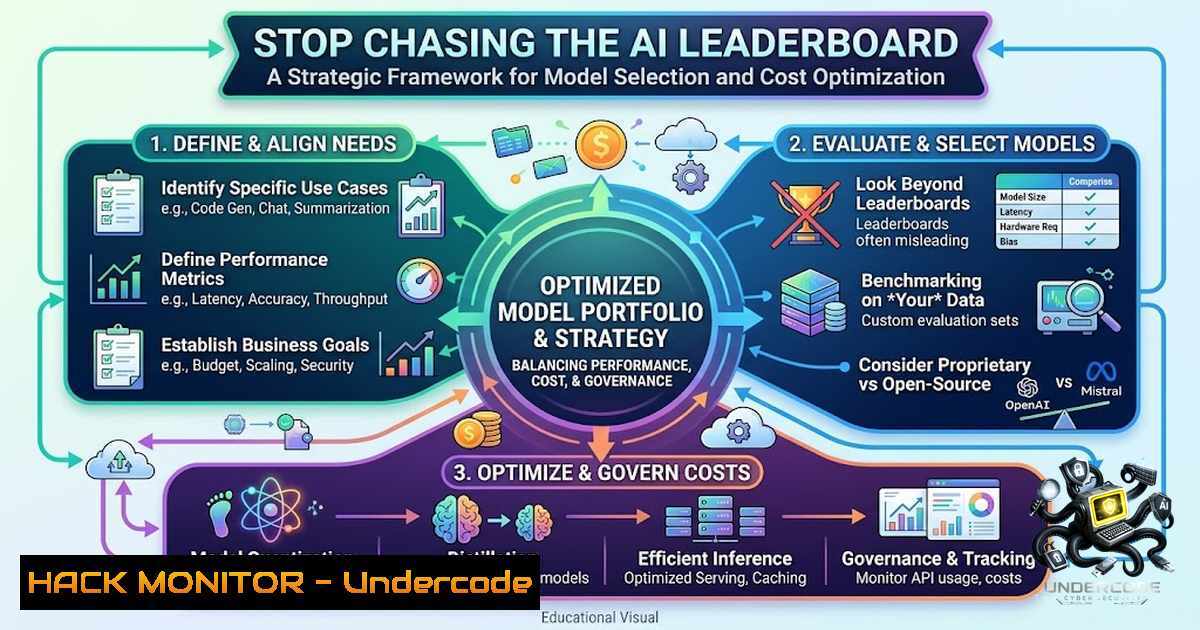
The artificial intelligence landscape is experiencing an unprecedented acceleration in model development, with performance leaderboards shifting at weekly intervals. Anthropic’s recent release of Fable 5.1 exemplifies this volatility, resetting benchmarks and creating decision paralysis among enterprises and individual users alike. This article provides a systematic framework for evaluating AI models based on task-specific requirements rather than transient benchmark performances, incorporating practical implementation strategies, cost-optimization techniques, and infrastructure hardening approaches for AI integration in secure environments.
Learning Objectives & Secrets:
- Objective 1: Master task-based model selection criteria by mapping specific workload requirements (reasoning depth, response latency, context window needs) to appropriate AI architectures, avoiding the common pitfall of subscription redundancy.
- Objective 2: Leverage hidden cost-optimization strategies including bundled enterprise agreements, carrier-provided AI access, and multi-model aggregation platforms that reduce operational expenditure by up to 70% compared to individual subscriptions.
- Objective 3: Implement API security hardening and usage monitoring to prevent unauthorized access, data leakage, and cost overruns when deploying multiple AI services across development and production environments.
You Should Know:
1. Model Benchmarking and Task-Requirement Mapping Protocol
The Fable 5.1 release demonstrates why raw benchmark scores fail to translate into practical utility. To establish an effective selection methodology, organizations must implement a systematic evaluation framework. Begin by categorizing all AI use cases within your workflow into discrete task types: reasoning-intensive tasks (complex problem decomposition, multi-step logic), creative generation (marketing copy, narrative development), code synthesis (debugging, documentation, refactoring), and information retrieval (research summarization, data extraction).
For each category, define success metrics beyond general benchmarks. For reasoning tasks, evaluate using the MMLU-Pro or GPQA datasets while measuring token efficiency and response consistency across multiple attempts. For code generation, implement HumanEval pass rates while monitoring hallucination frequencies in API calls. This dual-metric approach ensures you’re measuring what actually matters for your specific domain.
Implementation Guide:
 Task-Routing Script for AI Model Selection
import requests
import json

def evaluate_model_performance(model_endpoint, test_prompts, task_type):
"""
Evaluate model performance on task-specific prompts.
Returns latency, accuracy, and cost metrics.
"""
results = []
for prompt in test_prompts:
start_time = time.time()
response = requests.post(
model_endpoint,
headers={"Authorization": "Bearer YOUR_API_KEY"},
json={"prompt": prompt, "max_tokens": 1000}
)
elapsed = time.time() - start_time
results.append({
"prompt": prompt,
"response": response.json(),
"latency_ms": elapsed  1000,
"tokens_used": response.json().get("usage", {}).get("total_tokens", 0)
})
return results

Command-line evaluation for Linux environment
 curl -X POST https://api.anthropic.com/v1/messages \
 -H "x-api-key: YOUR_API_KEY" \
 -H "anthropic-version: 2023-06-01" \
 -H "content-type: application/json" \
 -d '{"model":"claude-3-opus-20240229","max_tokens":1000,"messages":[{"role":"user","content":"Test reasoning prompt"}]}'
2. API Security Hardening for Multi-Model Deployments
When managing multiple AI subscriptions simultaneously, API key exposure becomes a critical attack vector. Implement a key rotation schedule using HashiCorp Vault or AWS Secrets Manager to automatically rotate credentials every 48 hours. Configure IP whitelisting at the network edge to restrict API access to approved subnets only. Additionally, implement rate limiting and usage anomaly detection to prevent credential compromise from escalating into massive operational costs.
Step-by-Step Security Configuration:
Linux Environment:
 Set up environment variables with restricted permissions
export ANTHROPIC_API_KEY=$(aws secretsmanager get-secret-value --secret-id anthropic-key --query SecretString --output text)
export OPENAI_API_KEY=$(aws secretsmanager get-secret-value --secret-id openai-key --query SecretString --output text)

Implement IP table restrictions for API endpoints
sudo iptables -A OUTPUT -d api.anthropic.com -j ACCEPT
sudo iptables -A OUTPUT -d api.openai.com -j ACCEPT
sudo iptables -P OUTPUT DROP

Install auditd for monitoring API calls
sudo apt-get install auditd
sudo auditctl -w /etc/environment -p wa -k api_key_access
Windows PowerShell Configuration:
 Store encrypted credentials
$credential = Get-Credential
$credential.Password | ConvertFrom-SecureString | Set-Content "C:\secure\anthropic_encrypted.txt"

Set restricted environment variables
 Configure Windows Firewall outbound rules
New-1etFirewallRule -DisplayName "Block AI API except approved" -Direction Outbound -Action Block -RemoteAddress 0.0.0.0/0
New-1etFirewallRule -DisplayName "Allow Anthropic API" -Direction Outbound -Action Allow -RemoteAddress "199.232.0.0/16"
3. Cost-Optimization Architecture with Model Aggregation Services
Modern AI aggregation platforms like OpenRouter or Poe provide unified API interfaces to multiple models with pay-per-use pricing. This eliminates the need for individual subscriptions and enables dynamic routing to the cheapest model capable of handling a given task. Implement a fallback routing mechanism: query a cost-efficient model first, evaluate confidence scores, and escalate to premium models only when confidence falls below a threshold.
Implementation Example:
 Multi-model router with cost and quality balancing
class AIModelRouter:
def <strong>init</strong>(self):
self.models = {
"fast": {"endpoint": "https://api.openrouter.ai/v1", "model": "gpt-3.5-turbo", "cost_per_token": 0.000001},
"balanced": {"endpoint": "https://api.anthropic.com/v1", "model": "claude-3-haiku", "cost_per_token": 0.0000025},
"premium": {"endpoint": "https://api.openai.com/v1", "model": "gpt-4o", "cost_per_token": 0.00001}
}

def route_request(self, prompt, required_quality=0.8):
if self.estimate_complexity(prompt) < required_quality:
model = self.models["fast"]
elif self.estimate_complexity(prompt) < 0.9:
model = self.models["balanced"]
else:
model = self.models["premium"]
return self.call_model(model, prompt)

def estimate_complexity(self, prompt):
 Complexity scoring heuristic based on prompt length and keyword analysis
score = len(prompt.split()) / 200
if "reason" in prompt.lower() or "logic" in prompt.lower():
score += 0.3
return min(score, 1.0)
4. Enterprise Bundle Discovery and Carrier Integration
Revolut’s integration of ChatGPT Go and telecom providers bundling Perplexity Pro represent an emerging trend in embedded AI services. Organizations should conduct quarterly audits of existing vendor relationships to identify dormant AI access. For financial services, examine existing agreements with payment processors, cloud providers, and even telecommunications carriers, as many now include AI credits as part of enterprise tiers.
Discovery Automation Script:
!/bin/bash
 Audit script for discovering bundled AI services in current subscriptions

echo "Checking cloud provider AI credits..."
aws ce get-cost-and-usage --time-period Start=2026-08-01,End=2026-09-01 --granularity MONTHLY --filter '{"Dimensions":{"Key":"SERVICE","Values":["Amazon SageMaker"]}}'

echo "Checking for carrier AI promotions..."
curl -X GET "https://api.att.com/enterprise/v1/services" -H "Authorization: Bearer $ATT_API_TOKEN" | jq '.services[] | select(.name | contains("AI"))'

echo "Scanning financial service bundles..."
curl -X GET "https://api.revolut.com/enterprise/subscriptions" -H "Authorization: Bearer $REVOLUT_TOKEN" | jq '.subscriptions[] | select(.features | contains("ChatGPT"))'
5. Usage Analytics and Performance Monitoring
Deploy OpenTelemetry for distributed tracing across all AI model API calls to aggregate latency, token consumption, and error rates. Configure custom dashboards in Grafana to visualize model performance over time, enabling data-driven decisions when benchmark leaderboards shift. Implement automated alerts when model performance degrades below historical baselines, triggering automatic failover to secondary models.
Grafana Dashboard Configuration:
 Prometheus metrics collection for AI model usage
apiVersion: v1
kind: ConfigMap
metadata:
name: ai-metrics-config
data:
prometheus.yml: |
global:
scrape_interval: 15s
scrape_configs:
- job_name: 'ai_api_gateway'
static_configs:
- targets: ['ai-gateway:8080']
metrics_path: '/metrics'
params:
model: ['claude-3-haiku', 'gpt-3.5-turbo', 'fable-5.1']
6. Model Versioning and A/B Testing Framework
To avoid disruption when models like Fable 5.1 reset leaderboards, implement a canary deployment strategy for AI integrations. Route 5% of production traffic to new model versions for 48 hours while comparing output quality against the incumbent. Use BLEU scores for translation tasks, ROUGE for summarization, and custom evaluation scripts for domain-specific outputs.
A/B Testing Implementation:
 Canary deployment router for AI model versions
import random
from datetime import datetime, timedelta

class CanaryRouter:
def <strong>init</strong>(self):
self.incumbent_model = "claude-3-opus"
self.canary_model = "fable-5.1"
self.canary_traffic_percent = 0.05
self.canary_start_time = datetime.now()

def route(self, request):
 Gradually increase canary traffic if performance metrics are positive
elapsed_hours = (datetime.now() - self.canary_start_time).total_seconds() / 3600
if elapsed_hours > 48 and self.performance_evaluation() > 0.9:
self.canary_traffic_percent = min(1.0, self.canary_traffic_percent  1.1)

if random.random() < self.canary_traffic_percent:
return self.canary_model
return self.incumbent_model

def performance_evaluation(self):
 Placeholder for actual evaluation logic comparing incumbent vs canary
return 0.95  hypothetical performance score
What Undercode Say:
- Key Takeaway 1: The transient nature of AI model leadership requires shifting from benchmark-chasing to task-specific evaluation frameworks, where success is measured by practical utility rather than theoretical performance metrics.
-
Key Takeaway 2: Most organizations already possess more AI access than they realize through existing enterprise agreements, telecommunications bundles, and financial service partnerships—failing to audit these relationships results in unnecessary subscription expenses and operational inefficiencies.
-
Key Takeaway 3: API security and cost monitoring must scale alongside multi-model deployments, as credential exposure and usage anomalies become amplified across multiple service providers and billing systems.
Prediction:
- +1 Organizations adopting task-routing architectures will achieve 40-60% cost reduction within six months while maintaining comparable output quality.
- +1 The trend of embedding AI services into non-tech platforms will accelerate, with enterprise software suites, telecommunications carriers, and financial institutions becoming major AI distribution channels.
- -1 The rapid benchmark cycling will create vendor lock-in risks as organizations over-invest in specific models, struggling to migrate workflows when their chosen model falls behind.
- -1 Without proper API security hardening, multi-model deployments will become prime targets for credential harvesting, leading to data breaches and exorbitant cost incidents.
- +1 The integration of AI aggregation services will mature into a de facto standard, enabling seamless model switching and forcing providers to compete on specialized capabilities rather than general benchmarks.
▶️ Related Video (80% Match):
https://www.youtube.com/watch?v=0HWbzA_i2oA
🎯Let’s Practice For Free:
🎓 Live Courses & Certifications:
Join Undercode Academy for Verified Certifications
🚀 Request a Custom Project:
Secure, high-velocity infrastructure and disruptive technological engineering. Contact our engineering team for high-tier development and proprietary systems:
[email protected]
💎 Smart Architecture | 🛡️ Secure by Design | ⭐ Trusted by Thousands
IT/Security Reporter URL:
Reported By: https://lnkd.in/p/eVTrNdWa – Hackers Feeds
Extra Hub: Undercode MoN
Basic Verification: Pass ✅


