Listen to this Post
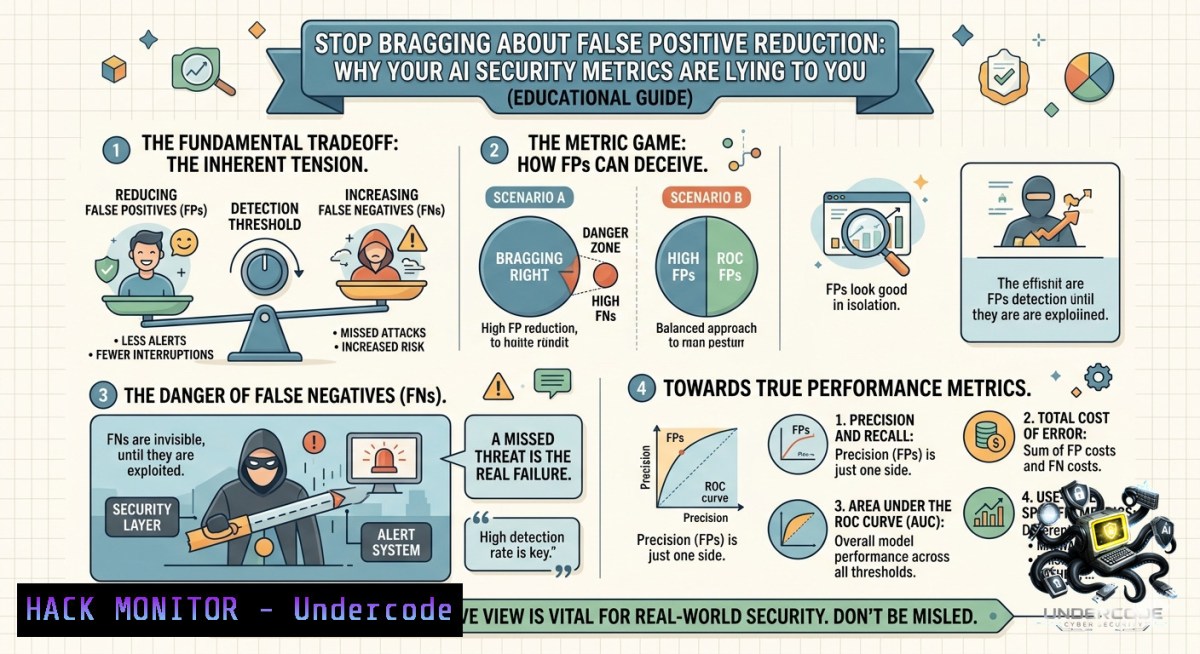
Introduction:
In cybersecurity, alert fatigue is real—over 95% of security alerts are false positives, making it dangerously easy to claim AI success simply by reducing that noise. However, focusing only on false positive reduction ignores the most critical failure mode: false negatives, where real threats slip through undetected. Security leaders must shift their metrics to prioritize true positive rates and, above all, false negative visibility to genuinely measure detection efficacy.
Learning Objectives:
- Differentiate between false positives, true positives, false negatives, and true negatives in SOC alerting
- Calculate and interpret detection metrics using Python, SIEM queries, and confusion matrices
- Implement hands-on validation techniques (Atomic Red Team, Sysmon, auditd) to uncover hidden false negatives
You Should Know:
- Why False Positive Reduction Is a Deceptive Metric
Most security tools generate alerts based on signatures, rules, or anomalies. With a typical false positive rate of 95–99%, even a random classifier that labels every alert as “false positive” will be correct 95% of the time. That means simply turning off alerts or ignoring them yields the same “success” rate. The real danger lies in false negatives—attacks that never trigger an alert. If your AI misses a credential dumping event because it was tuned to silence noise, you have no visibility.
Step‑by‑step guide – Calculate your baseline false positive probability:
1. Export one week of SIEM alerts (e.g., from Splunk, Sentinel, or ELK).
2. Manually review 100 random alerts to label true/false positives.
3. Run this Python snippet to compute naive accuracy:
alerts = 10000
false_pos = 9500
true_pos = 400
false_neg = 100  actual attacks missed
 Random classifier guessing "FP" every time
random_fp_correct = false_pos / alerts  95% accuracy
print(f"Random FP guess accuracy: {random_fp_correct:.2%}")
2. Building a Confusion Matrix for Security Alerts
A confusion matrix breaks down all four outcomes: TP (real attack → alert), FP (benign → alert), TN (benign → no alert), FN (real attack → no alert). Most SOCs track only FP and TP, ignoring FN. But FN is the silent killer—it represents undetected breaches.
Step‑by‑step guide – Generate a confusion matrix from a detection rule:
1. Collect labeled event data (e.g., from MITRE ATT&CK evaluations or your red team exercises).
2. Run your detection rule against the dataset.
3. Use this Python code:
from sklearn.metrics import confusion_matrix
y_true = [1,0,1,1,0,1]  1=attack, 0=benign
y_pred = [1,0,0,1,0,0]  rule output
tn, fp, fn, tp = confusion_matrix(y_true, y_pred).ravel()
print(f"TP: {tp}, FP: {fp}, FN: {fn}, TN: {tn}")
print(f"False Negative Rate: {fn/(fn+tp):.2%}")
- Hunting False Negatives with Sysmon (Windows) and auditd (Linux)
False negatives are invisible in standard alert dashboards. You must proactively hunt for them by comparing process creation, network connections, and file writes against known attack patterns.
Windows (Sysmon + PowerShell):
 Install Sysmon with SwiftOnSecurity config
.\Sysmon64.exe -accepteula -i sysmonconfig.xml
 Hunt for LSASS memory access (often missed by EDR)
Get-WinEvent -FilterHashtable @{LogName='Microsoft-Windows-Sysmon/Operational'; ID=10} | Where-Object {$_.Message -like "lsass.exe"}
Linux (auditd + ausearch):
sudo auditctl -w /usr/bin/wget -p x -k suspicious_download
sudo auditctl -w /etc/passwd -p wa -k passwd_mod
 Search for unauthorized access to /etc/shadow
sudo ausearch -k shadow_access --format raw | aureport -f -i
Step‑by‑step hunt for a common false negative – Mimikatz execution:
– Simulate Mimikatz (or use Invoke-Mimikatz in memory).
– Check if your SIEM generated an alert. If not, that’s a false negative.
– Write a Sigma rule to detect it, test offline, then deploy.
4. Validating Detection Coverage with Atomic Red Team
You cannot measure false negatives without knowing what real attacks look like. Atomic Red Team provides small, automated tests for MITRE techniques. Run these tests, then verify alerting.
Step‑by‑step guide – Install and run Atomic Red Team on Windows/Linux:
 Windows (PowerShell as Admin)
Install-Module -1ame AtomicRedTeam -Force
Import-Module AtomicRedTeam
Get-AtomicTechnique -Technique T1003  OS credential dumping
Invoke-AtomicTest T1003 -TestNames "Dump LSASS.exe memory using Microsoft signed binary"

Linux (using Invoke-AtomicRedTeam via Docker)
docker pull rnwood/atomic-red-team:latest
docker run -it --rm rnwood/atomic-red-team:latest /bin/bash
cd /opt/atomic-red-team/atomics/T1003
./T1003.yaml -t "Dump LSASS via comsvcs.dll"
After each test, query your SIEM for any alert. Document every technique that produced zero alerts—those are your false negatives.
- Tuning AI/ML Models to Reduce False Negatives, Not Just False Positives
Most ML security models are optimized for precision (low FP). This comes at the cost of recall (high FN). To catch more threats, adjust your model’s decision threshold or use cost‑sensitive learning.
Step‑by‑step – Adjust detection threshold in a random forest model:
from sklearn.ensemble import RandomForestClassifier
model = RandomForestClassifier()
model.fit(X_train, y_train)
 Default threshold 0.5 → low recall
y_pred_default = (model.predict_proba(X_test)[:,1] >= 0.5).astype(int)
 Lower threshold to 0.2 → catch more attacks (reduce FN)
y_pred_recall = (model.predict_proba(X_test)[:,1] >= 0.2).astype(int)
Windows/Linux command – Simulate threshold change in a SIEM rule:
– In Splunk: `| where score > 0.2` instead of `> 0.8`
– In Elastic: `”threshold”: 20` (lower the count threshold to trigger on fewer events)
- Building a False Negative Dashboard with ELK or Azure Sentinel
To track false negatives over time, create a dashboard that correlates red team / Atomic Red Team results with SIEM alerts.
Step‑by‑step using Elastic Stack:
- Index your Atomic test results (JSON) into Elasticsearch.
- Create a saved search for “techniques executed” and another for “alerts generated”.
- Use a Kibana Vega visualization to overlay missing alerts per MITRE tactic.
// Query to find techniques with zero alerts in last 24h
{
"query": {
"bool": {
"must_not": { "exists": { "field": "alert_id" } },
"filter": { "term": { "test_type": "atomic_red_team" } }
}
}
}
For Azure Sentinel: Use KQL to join TestData with SecurityAlert:
let ExecutedTests = datatable(Technique:string)["T1003","T1059","T1078"];
let AlertsGenerated = SecurityAlert | where TimeGenerated > ago(1d) | project Technique;
ExecutedTests | join kind=leftanti AlertsGenerated on Technique
7. Incident Response Drills Focused on False Negatives
Once per month, run a “stealth breach” simulation where the red team uses only techniques that historically produce false negatives. The response team must hunt without alerts.
Step‑by‑step drill guide:
- Collect 10 techniques from your false negative list (from step 4).
- Red team executes one technique every 30 minutes (e.g.,
T1552 – Unsecured Credentials). - Blue team uses raw logs (Sysmon, auditd, network flows) to detect without SIEM.
- After drill, create new detection rules for each missed technique.
Linux – simulate T1552 by grepping .bash_history for passwords
echo "mysql -u root -p P@ssw0rd" >> ~/.bash_history
Windows – simulate unsecured credentials in registry
reg add HKLM\SOFTWARE\Temp /v db_password /t REG_SZ /d "Sup3rS3cret"
Document which techniques stayed invisible—these define your next detection engineering sprint.
What Undercode Say:
- Key Takeaway 1: A 95% false positive rate makes trivial “success” inevitable; true innovation is measured by how few false negatives you produce.
- Key Takeaway 2: Without rigorous testing (Atomic Red Team, Sysmon/auditd analysis, and threshold tuning), your AI security metrics are dangerously misleading, hiding the breaches you’re missing every day.
Analysis (10 lines):
Mehmet E.’s post cuts through the hype around AI in cybersecurity. Most vendors proudly announce “90% false positive reduction” without acknowledging that a coin flip would achieve similar results. The real, unsexy work is identifying false negatives—the attacks that your stack never even considered suspicious. This requires a fundamental shift from reactive alert management to proactive validation. By building confusion matrices, running Atomic Red Team tests, and lowering ML thresholds, defenders can actually measure detection gaps. The post also implies a cultural problem: SOCs are rewarded for closing tickets (mostly FPs), not for hunting invisible threats. Microsoft’s own security MVPs, like Mehmet, consistently remind us that missing one true positive is worse than handling a thousand false positives. His advice—show success with true positive and false negative metrics—should be embedded in every security KPI dashboard.
Prediction:
- -1 Organizations that continue to brag about false positive reduction without disclosing false negative rates will face catastrophic breaches that were never alerted, leading to regulatory fines and loss of customer trust.
- +1 Security teams that adopt false-1egative hunting, automated validation frameworks (like Atomic Red Team), and ML recall tuning will outpace attackers and reduce dwell time from months to hours, gaining a competitive advantage.
▶️ Related Video (78% Match):
🎯Let’s Practice For Free:
🎓 Live Courses & Certifications:
Join Undercode Academy for Verified Certifications
🚀 Request a Custom Project:
Secure, high-velocity infrastructure and disruptive technological engineering. Contact our engineering team for high-tier development and proprietary systems:
[email protected]
💎 Smart Architecture | 🛡️ Secure by Design | ⭐ Trusted by Thousands
IT/Security Reporter URL:
Reported By: Mehmetergene Showing – Hackers Feeds
Extra Hub: Undercode MoN
Basic Verification: Pass ✅


