Listen to this Post
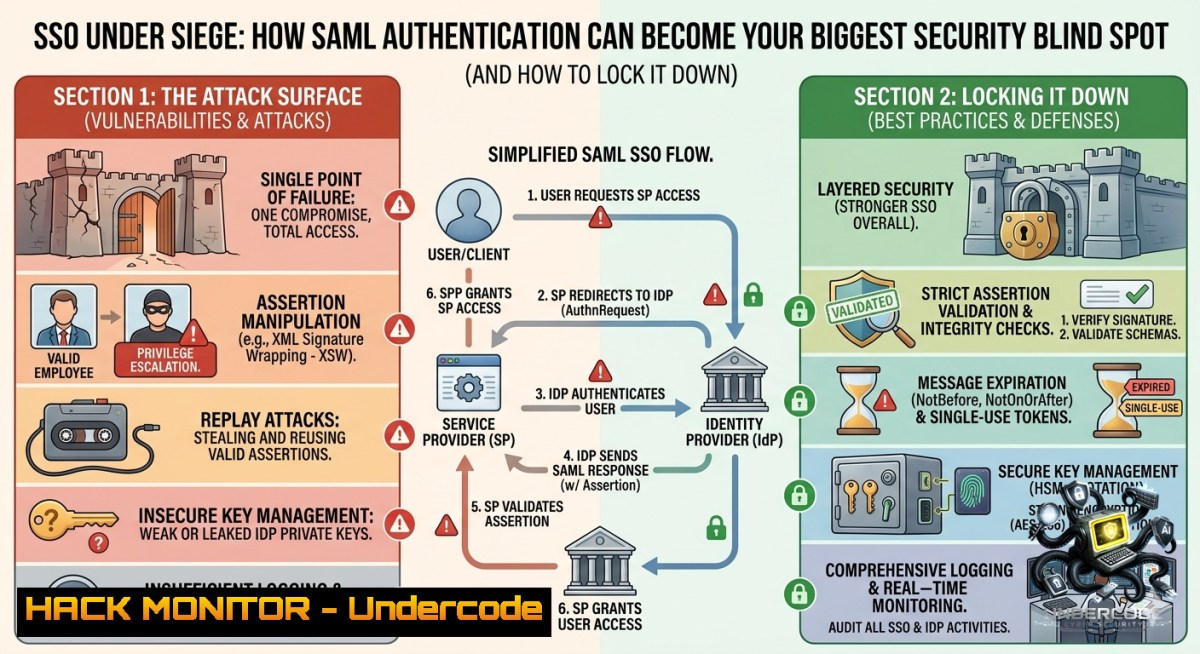
Introduction:
Single Sign-On (SSO) powered by SAML (Security Assertion Markup Language) is the backbone of modern enterprise access, enabling users to authenticate once and seamlessly access dozens of cloud applications. However, this convenience introduces a high‑stakes attack surface: a single misconfigured Identity Provider (IdP) or an unsigned SAML assertion can hand attackers the keys to your entire ecosystem. Understanding how SAML works, where it fails, and how to test and harden it is no longer optional—it’s a core incident‑prevention skill for every cybersecurity team.
Learning Objectives:
- Analyze the SAML authentication flow and identify critical trust boundaries between IdP and SP.
- Execute manual and automated SAML attacks (XML signature wrapping, assertion replay, token modification) using open‑source tools.
- Apply hardening measures including strict certificate validation, short‑lived assertions, and monitoring for anomalous SSO logins.
You Should Know:
- How SAML Authentication Really Works (With Packet‑Level Visibility)
Step‑by‑step guide to tracing a live SAML flow and inspecting assertions.
What this does: Allows you to capture and decode SAML messages between your browser, the SP, and the IdP—essential for debugging and spotting tampering.
How to use it:
- Linux/macOS: Use `tcpdump` or browser dev tools. Install SAML‑tracer (Firefox/Chrome extension) or Burp Suite.
- Windows: F12 Developer Tools → Network tab, filter “SAML” or “SAMLResponse”.
Commands (decoding a base64‑encoded SAML response on Linux):
 Extract SAMLResponse from a POST request (example using grep and cut)
echo "PHNhbWxwOlJlc3BvbnNl..." | base64 -d | xmllint --format -

Or use samlraider (install via gem)
gem install samlraider
samlraider decode -f saml_response.txt
Step‑by‑step:
- Log in to an SSO‑enabled app (e.g., Salesforce, AWS Console) with SAML.
- Open browser dev tools → Network tab → Preserve log.
- Look for a POST request containing `SAMLResponse` in the form data.
- Copy the encoded assertion and run the base64 decode command above.
- Examine the `
Issuer,Subject, `Conditions` (NotBefore/NotOnOrAfter), and `Signature` elements.
2. Exploiting Weak SAML Configurations (Signature Bypass Attack)
Step‑by‑step guide to performing an XML Signature Wrapping (XSW) attack—the classic SAML exploit.
What this does: Demonstrates how an attacker can add a forged assertion while keeping the original valid signature, tricking the SP into accepting fake user attributes (e.g., privilege escalation).
How to use it (lab environment only):
- Target: An SP with a vulnerable SAML parser (e.g., old versions of Shibboleth, SimpleSAMLphp).
- Tool: Burp Suite Community with SAML Raider extension.
Step‑by‑step:
1. Intercept a legitimate SAMLResponse using Burp.
- Send it to SAML Raider (right‑click → Extensions → SAML Raider → Send to SAML Raider).
- Click “Add Wrapped Assertion” – the tool creates a duplicate `
[email protected]). - The original signed assertion remains intact, but the SP processes the first (forged) assertion due to parser confusion.
- Forward the modified request. If vulnerable, you gain admin access.
Mitigation commands (Apache/IIS):
- Enforce strict XPath evaluation and reject assertions with more than one
<saml:Assertion>. - For Linux (modifying `saml20-idp-remote.php` in SimpleSAMLphp):
// Add assertion count validation
if (count($assertions) !== 1) {
throw new Exception('Invalid SAML: Multiple assertions');
}
- Hardening Your IdP and SP Using Command‑Line Tools
Step‑by‑step guide to validating SAML certificates and configuring secure assertion lifetimes.
What this does: Ensures your SAML exchange uses strong cryptography and short exposure windows.
Windows (PowerShell) – Validate IdP certificate from metadata:
 Download IdP metadata
Invoke-WebRequest -Uri "https://your-idp.com/metadata" -OutFile idp_metadata.xml

Extract certificate and check expiration
[bash]$meta = Get-Content idp_metadata.xml
$certBase64 = $meta.EntityDescriptor.IDPSSODescriptor.KeyDescriptor.KeyInfo.X509Data.X509Certificate
$certBytes = [bash]::FromBase64String($certBase64)
$cert = New-Object System.Security.Cryptography.X509Certificates.X509Certificate2($certBytes)
Write-Host "Certificate expires on: $($cert.NotAfter)"
Linux – Force short‑lived assertions (edit IdP configuration):
- For Keycloak: Set `SAML assertion lifetime` to 300 seconds (max).
- For Shibboleth IdP: Edit
conf/assertion-config.xml:<bean id="shibboleth.AssertionLifetime" class="java.time.Duration" factory-method="ofMinutes" c:minutes="5"/>
Step‑by‑step:
- Verify all SAML certificates use at least RSA 2048 and SHA‑256.
- Set `NotOnOrAfter` to ≤ 5 minutes from
NotBefore. - Disable unsupported bindings (HTTP‑Artifact if not used) in SP configuration.
4. Detecting SAML Attacks with SIEM and Logging
Step‑by‑step guide to writing detection rules for SAML abuse.
What this does: Turns raw SAML logs into alerts for replay, brute‑force, or assertion tampering.
Linux – Monitor IdP logs for repeated `AuthnInstant` timestamps (replay attack):
sudo journalctl -u keycloak | grep "AuthnInstant" | awk '{print $NF}' | sort | uniq -c | sort -1r | head -10
 Look for duplicate timestamps from different sessions
Windows – Use PowerShell to parse SAML audit logs (Azure AD):
 Export Azure AD sign‑ins (requires MSOnline module)
Get-AzureADAuditSignInLogs -All $true | Where-Object { $_.TokenIssuerType -eq "SAML" } |
Select-Object CreatedDateTime, UserPrincipalName, AuthenticationRequirement, Status |
Export-Csv -Path "SAML_logins.csv"
Step‑by‑step detection rule (Splunk/ELK):
- Rule: Count of identical `saml:Subject` + `AuthnInstant` across different IPs within 60 seconds → replay.
- Rule: Multiple SPs with same `NameID` but differing `Issuer` → possible IdP spoofing.
- Hardening the SP with Inline Signature Validation (Code Snippet)
Step‑by‑step guide to adding custom validation logic in your application (when using a SAML library).
What this does: Prevents XSW, XML external entity (XXE), and canonicalization attacks.
Python example (using python3‑saml):
from onelogin.saml2.auth import OneLogin_Saml2_Auth
from onelogin.saml2.utils import OneLogin_Saml2_Utils

def verify_saml_response(saml_response, req):
auth = OneLogin_Saml2_Auth(req, custom_base_path='/path/to/saml/settings')
auth.process_response()
errors = auth.get_errors()

Extra checks beyond library defaults
if not auth.is_authenticated():
raise Exception("SAML auth failed")

Validate that the assertion's NotOnOrAfter is not too far in the future
session_exp = auth.get_session_expiration()
if session_exp - time.time() > 300:
raise Exception("Assertion lifetime exceeds 5 minutes")

Ensure only one assertion (custom)
if len(auth.get_last_response().get_assertions()) != 1:
raise Exception("Multiple assertions detected")

return auth.get_attributes()
Step‑by‑step:
- Never disable signature validation for debugging in production.
- Always verify the `Destination` URL matches your SP endpoint.
3. Use a allowlist of acceptable `Issuer` URIs.
What Undercode Say:
- Key Takeaway 1: SAML is a powerful SSO standard, but its reliance on XML parsing and signature verification introduces subtle, high‑impact vulnerabilities—especially XML Signature Wrapping and assertion replay. Most organizations assume “SAML is secure because it’s signed,” but without strict assertion parsing and short time windows, the signature offers false confidence.
- Key Takeaway 2: Hardening SAML is not just about enabling it—it requires continuous monitoring of assertion timestamps, certificate rotation every 1–2 years, and testing your SP’s tolerance to malformed assertions. Tools like samlraider, Burp, and even basic base64 decoding should be part of every penetration tester’s and blue teamer’s checklist.
Analysis: The post correctly highlights SAML’s central role in identity security, but stops short of showing how quickly a single misconfigured SP can be exploited. Real-world breaches (e.g., Coinbase 2021 SAML misconfiguration, numerous SSO bypasses) underscore that convenience without rigorous validation is a liability. Teams need to move beyond “we use SAML, so we’re safe” and implement layered detection, regular assertion fuzzing, and IdP‑SP binding audits. The commands and steps above empower defenders to both attack and defend their own SAML implementations, closing the gap between theory and active security posture.
Prediction:
+1 SAML will remain the dominant enterprise SSO protocol for the next five years, but we will see a rise in automated SAML fuzzing tools integrated into CI/CD pipelines—every SP update will be stress‑tested against XSW and replay attacks before reaching production.
-1 As organizations adopt passkeys and OIDC with FIDO2, legacy SAML 2.0 implementations may become the new “weak link” in hybrid identity architectures, especially where IdPs are outsourced and SPs are maintained by different teams with no shared threat model.
+1 Cloud providers (AWS, Azure, GCP) will introduce mandatory SAML assertion lifetime caps and automatic anomaly detection for login patterns, reducing the window for replay attacks from minutes to seconds.
-1 The complexity of SAML XML signatures will continue to cause integration errors—human error in certificate renewal or metadata exchange will remain the 1 cause of SSO outages and, ironically, emergency bypasses that weaken security.
▶️ Related Video (70% Match):
🎯Let’s Practice For Free:
🎓 Live Courses & Certifications:
Join Undercode Academy for Verified Certifications
🚀 Request a Custom Project:
Secure, high-velocity infrastructure and disruptive technological engineering. Contact our engineering team for high-tier development and proprietary systems:
[email protected]
💎 Smart Architecture | 🛡️ Secure by Design | ⭐ Trusted by Thousands
IT/Security Reporter URL:
Reported By: Sso Saml – Hackers Feeds
Extra Hub: Undercode MoN
Basic Verification: Pass ✅


