
Listen to this Post
Introduction:
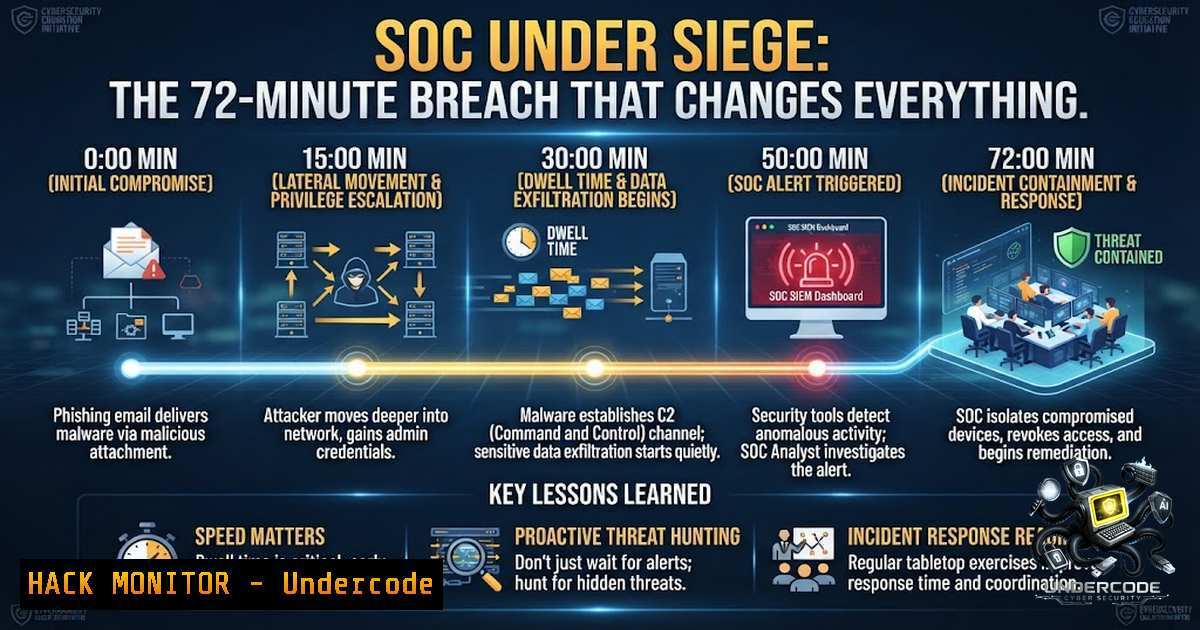
The modern Security Operations Center (SOC) is facing an unprecedented challenge as attack timelines collapse from days to minutes. According to Palo Alto Networks Unit 42’s 2026 Global Incident Response Report, adversaries are now moving from initial access to data exfiltration in just 72 minutes—a fourfold acceleration over the past year. This speed gap has become a defining operational crisis, as manual triage and fragmented workflows leave defenders operating on a timeline that attackers have already outpaced. With 65% of initial access now driven by identity-based techniques and AI automating attack lifecycles, closing this gap requires a fundamental restructuring of how SOCs operate.
Learning Objectives:
- Understand the anatomy of modern identity-driven attacks and the 72-minute breach timeline
- Learn to correlate identity, endpoint, and cloud signals into unified automated incidents
- Master process changes that compress SOC detection and response time from hours to minutes
- Implement automated playbooks and behavioral detection to replace manual triage workflows
- Deploy Linux and Windows commands for rapid threat hunting and incident response
You Should Know:
- The 72-Minute Attack Timeline: Anatomy of a Modern Breach
Unit 42’s analysis of over 750 incidents across 50 countries reveals a consistent attacker playbook that unfolds with terrifying speed. The attack begins with social entry: compromised credentials, MFA push fatigue, or help-desk impersonation. Muddled Libra (aka Scattered Spider) has turned corporate helpdesk social engineering into a repeatable commodity tactic, obtaining single sign-on tokens through impersonation.
Once inside, rapid escalation occurs within minutes—attackers abuse administrative accounts and escalate privileges. This is followed by multi-surface pivoting, where adversaries move across identity, endpoint, cloud, and SaaS environments simultaneously. They may provision cloud resources, create rogue virtual machines, or mount virtual drives to stage data. In one case, Spoiled Scorpius (distributors of RansomHub ransomware) exfiltrated hundreds of gigabytes within hours of gaining access through improperly secured remote access infrastructure.
The critical insight: multiple alerts are generated during this sequence, but without automated correlation, each appears low priority in isolation. An analyst working through separate consoles must open multiple tools, match timestamps, and build context before reaching confidence for containment—and during those minutes, the adversary is already exfiltrating data.
Rapid Threat Hunting Commands:
Linux – Identify Suspicious Authentication Patterns:
 Check for failed sudo attempts and privilege escalation
sudo grep "sudo" /var/log/auth.log | grep -i "failed"
 Review last 100 login attempts
sudo last -1 100
 Identify unusual cron jobs (persistence mechanism)
sudo cat /etc/crontab && sudo ls -la /etc/cron.d/
 Check for unauthorized SSH keys
sudo cat ~/.ssh/authorized_keys
Windows – Detect Lateral Movement and Privilege Escalation (PowerShell as Admin):
 Check for suspicious privileged account activity
Get-EventLog -LogName Security -InstanceId 4624,4672 | Select-Object -First 20
 Identify unusual scheduled tasks (persistence)
Get-ScheduledTask | Where-Object {$_.State -1e "Disabled"}
 Review PowerShell execution logs
Get-WinEvent -LogName "Microsoft-Windows-PowerShell/Operational" | Select-Object -First 20
 Check for unauthorized local admin accounts
Get-LocalGroupMember -Group "Administrators"
- Identity: The New Perimeter and Primary Attack Vector
Identity weaknesses played a material role in almost 90% of Unit 42 investigations. Attackers increasingly “log in” with stolen credentials and tokens, exploiting fragmented identity estates to escalate privileges and move laterally. The scale of the problem is staggering: 99% of 680,000 cloud users, roles, and services analyzed had excessive permissions, including many unused for 60 days or more.
The attack surface extends beyond human identities to machine identities—service accounts, automation roles, API keys, and AI agents—as well as shadow identities from unsanctioned accounts and developer environments. Identity silos between on-premises Active Directory and multiple cloud identity providers create blind spots that attackers exploit.
Step-by-Step Guide: Auditing and Hardening Identity Controls
- Conduct an identity inventory: Map all human and machine identities across on-premises AD, Azure AD, AWS IAM, and Google Workspace.
- Review privileged access: Identify and remove excessive permissions using the principle of least privilege.
- Enable conditional access policies: Require compliant devices and risk-based MFA for all administrative accounts.
- Monitor for impossible travel: Implement alerts for login attempts from geographically impossible locations within short timeframes.
- Deploy Identity Threat Detection and Response (ITDR): Implement tools that monitor user behavior after authentication to detect credential misuse and privilege escalation.
Audit Identity Permissions (Azure AD / Microsoft Graph PowerShell):
 Connect to Azure AD
Connect-MgGraph -Scopes "User.Read.All", "RoleManagement.Read.All"
 List all privileged roles
Get-MgDirectoryRole | Where-Object {$<em>.DisplayName -match "Admin"}
 Identify users with excessive permissions
Get-MgUser -All | ForEach-Object { Get-MgUserMemberOf -UserId $</em>.Id }
Audit AWS IAM for Excessive Permissions:
 List all IAM users and their attached policies
aws iam list-users --query 'Users[].UserName' --output table
aws iam list-attached-user-policies --user-1ame <USERNAME>
 Identify unused access keys (over 90 days)
aws iam list-access-keys --user-1ame <USERNAME>
 Generate credential report for comprehensive audit
aws iam generate-credential-report
aws iam get-credential-report
3. The Multi-Surface Pivot: Why Endpoint-Only Visibility Fails
In 87% of intrusions, Unit 42 investigators reviewed evidence from two or more distinct sources; complex cases drew on as many as 10 sources. Attackers intentionally exploit blind spots created by over-reliance on endpoint data, striking across three or more surfaces simultaneously.
Unit 42 research identified three specific scenarios where endpoint-only view consistently fails:
The Cloud-to-Endpoint Pivot: Attackers gain access via misconfigured cloud service access keys and pivot to endpoints while hiding tracks from EDR agents. From the cloud console, they pivot to cloud-hosted servers for discovery. To a SOC only watching endpoints, the initial entry and console manipulation are invisible.
Covert C2 and Identity Theft: Attackers use DNS tunneling to cloud storage locations to control compromised devices. To use legitimate applications to mask activity, they steal credentials and trigger impossible travel alerts across multiple SaaS apps. Endpoint-only monitoring misses the identity-level compromise happening across network and cloud providers.
Rogue Assets: Shadow IT and unmanaged devices lack security agents, making them invisible to traditional EDR. Attackers often introduce their own rogue devices to maintain persistence.
Step-by-Step Guide: Building Multi-Surface Correlation
- Ingest all telemetry sources: Collect logs from identity (AD, Azure AD), endpoint (EDR), cloud (AWS CloudTrail, Azure Activity Logs), and SaaS (Okta, Microsoft 365).
- Implement a SIEM or XDR platform: Use a unified platform like Cortex XSIAM that correlates signals across all surfaces automatically.
- Create correlation rules: Develop rules that trigger when suspicious activity appears across multiple surfaces within a short timeframe (e.g., PowerShell execution + impossible travel + abnormal admin activity within 20 minutes).
- Automate enrichment: Use threat intelligence feeds to automatically enrich alerts with context about known malicious IPs, domains, and TTPs.
Collect and Correlate Logs (Linux – Rsyslog Configuration):
 Configure rsyslog to forward logs to SIEM
sudo nano /etc/rsyslog.conf
 Add: . @<SIEM_IP>:514
sudo systemctl restart rsyslog
 Verify log forwarding
sudo tail -f /var/log/syslog
Windows – Forward Event Logs to SIEM via WinRM:
 Enable WinRM and configure event forwarding
winrm quickconfig
 Configure Windows Event Collector (WEC)
wecutil qc
 Export security logs for analysis
wevtutil epl Security C:\security_logs.evtx
- Closing the Speed Gap: Process Changes That Compress SOC Response Time
Unit 42 explicitly rejects the framing that this is a personnel problem. More analysts running sequential triage at higher volume produces the same outcome at greater cost. The fix is structural.
Three Structural Changes Address the Process Problem:
- Correlate identity, endpoint, and cloud signals into unified incidents automatically: If post-incident reconstruction routinely requires 10 data sources, the detection workflow needs to correlate those same 10 sources before the analyst ever sees an alert.
-
Predefine response playbooks: Move from ad-hoc investigation to automated, playbook-driven response. Define playbooks for common incident types to ensure clearly defined investigation and response paths.
-
Shift detection to behavioral signals: Move beyond signature-based detection to behavioral analytics that identify abnormal patterns—impossible travel, unusual PowerShell execution, abnormal authentication patterns—rather than waiting for known malware signatures.
Step-by-Step Guide: Building an Automated Incident Response Playbook
- Map your environment: Document all security tools, data sources, and response actions available.
- Define incident types: Create playbooks for identity compromise, ransomware, data exfiltration, and insider threats.
- Automate tier-1 triage: Build playbooks that automatically enrich alerts, check threat intelligence, and score risk.
- Implement automated containment: Define actions like account suspension, endpoint isolation, and IP blocking that execute automatically based on risk thresholds.
- Integrate with SOAR: Use a SOAR platform like Cortex XSOAR with 1,300+ prebuilt playbooks and integrations.
Sample SOAR Playbook Logic (Python pseudocode for automation):
def incident_triage(alert):
 Enrich with threat intelligence
threat_score = check_threat_intel(alert.ip, alert.hash)
 Check for behavioral anomalies
behavioral_risk = analyze_behavior(alert.user, alert.timestamp)
 Calculate composite risk
risk_score = (threat_score  0.6) + (behavioral_risk  0.4)
if risk_score > 0.8:
 Automated containment
suspend_account(alert.user)
isolate_endpoint(alert.endpoint_id)
block_ip(alert.source_ip)
create_ticket("Critical", alert)
elif risk_score > 0.5:
create_ticket("High", alert)
else:
close_as_false_positive(alert)
- The Attacker’s Tooling: What Muddled Libra and Spoiled Scorpius Reveal
Muddled Libra’s operational playbook reveals a sophisticated, identity-focused attack chain. The group creates rogue virtual machines after gaining unauthorized access to VMware vSphere environments. Activities include performing reconnaissance, downloading tools, establishing persistence via C2 channels, using stolen certificates, copying files to domain controllers, and interacting with Snowflake infrastructure.
Spoiled Scorpius, distributors of RansomHub ransomware, exemplifies the speed of modern attacks, exfiltrating hundreds of gigabytes within hours of gaining access. These groups leverage legitimate administrative tools—SSH tunnels, RDP, and PsExec—to bypass traditional perimeter defenses.
Step-by-Step Guide: Detecting Advanced Threat Actor TTPs
- Monitor for rogue VM creation: Alert on unusual VM provisioning in vSphere, AWS EC2, or Azure VMs without proper change requests.
- Detect C2 channels: Monitor DNS logs for tunneling patterns and unusual outbound connections to known malicious domains.
- Audit certificate usage: Track stolen or compromised certificates used for authentication and signing.
- Monitor Snowflake and cloud data stores: Alert on unusual data access patterns or bulk data extraction.
Detect Rogue VMs in VMware vSphere (PowerCLI):
 Connect to vCenter
Connect-VIServer -Server <vCenter_IP>
 List all VMs created in last 24 hours
Get-VM | Where-Object {$<em>.Created -gt (Get-Date).AddDays(-1)}
 Identify VMs without proper naming convention
Get-VM | Where-Object {$</em>.Name -1otmatch "^PROD-|^DEV-|^TEST-"}
Detect C2 Communication with DNS Tunneling (Linux):
 Monitor DNS queries for suspicious patterns
sudo tcpdump -i any -1 port 53 -v | grep -E "(.ru$|.cn$|.tk$|long-subdomain)"
 Check for unusual outbound connections
sudo netstat -tunap | grep ESTABLISHED | grep -v ":(80|443|53)"
 Monitor process creation for suspicious commands
sudo auditctl -a always,exit -F arch=b64 -S execve -k process_audit
- AI as a Force Multiplier: Defending Against Automated Attacks
AI has become a force multiplier for threat actors, compressing the attack lifecycle from access to impact. Adversaries use AI to automate reconnaissance, phishing, scripting, and operational execution. This is measurable: exfiltration speeds for the fastest attacks quadrupled in 2025.
However, defenders can fight AI with AI. Cortex XSIAM, an AI-driven security operations platform, consolidates data, automates threat response, and enhances SOC efficiency through advanced analytics and automation. It addresses modern security challenges like alert fatigue, tool sprawl, and manual triage by unifying detection, investigation, and remediation in a streamlined platform.
Step-by-Step Guide: Implementing AI-Driven Detection
- Deploy a unified data platform: Consolidate all security data into a single AI-driven platform like Cortex XSIAM.
- Enable behavioral analytics: Use machine learning to establish baseline normal behavior and detect anomalies.
- Automate alert prioritization: Use AI to score and prioritize alerts based on risk, reducing false positives.
- Implement autonomous response: Configure AI-driven playbooks that can contain threats without human intervention for low-risk, high-confidence detections.
Enable Advanced Logging for AI Detection (Windows):
 Enable PowerShell script block logging for behavioral analysis
Set-ItemProperty -Path "HKLM:\SOFTWARE\Policies\Microsoft\Windows\PowerShell\ScriptBlockLogging" -1ame "EnableScriptBlockLogging" -Value 1
 Enable command line auditing
Set-ItemProperty -Path "HKLM:\SOFTWARE\Microsoft\Windows\CurrentVersion\Policies\System\Audit" -1ame "ProcessCreationIncludeCmdLine_Enabled" -Value 1
 Enable Sysmon for deep endpoint visibility
Sysmon64.exe -accepteula -i
Monitor CloudTrail for Anomalous Behavior (AWS CLI):
 Look for unusual API calls from new geolocations
aws cloudtrail lookup-events --lookup-attributes AttributeKey=EventName,AttributeValue=ConsoleLogin --start-time <TIME>
 Detect unusual EC2 instance creation
aws cloudtrail lookup-events --lookup-attributes AttributeKey=EventName,AttributeValue=RunInstances
 Identify IAM role assumption from unexpected sources
aws cloudtrail lookup-events --lookup-attributes AttributeKey=EventName,AttributeValue=AssumeRole
- The Human Element: Changing SOC Culture and Metrics
The NCSC has documented a related failure mode: ticket-count SOC metrics systematically close real attacks as false positives because isolated alert volume overwhelms contextual correlation capacity. The conventional response to detection gaps has been to add analysts, but Unit 42 rejects this framing.
Step-by-Step Guide: Modernizing SOC Operations
- Shift from ticket count to mean time to detect (MTTD) and mean time to respond (MTTR): Focus on speed and quality over volume.
- Implement continuous improvement: Regularly review incidents to identify process gaps and update playbooks.
- Foster cross-functional collaboration: Break down silos between identity, endpoint, cloud, and network teams.
- Invest in training: Ensure analysts understand modern identity-driven attack patterns and can use automated tools effectively.
SOC Metrics Dashboard (Linux – Log Analysis):
 Calculate average MTTD from SIEM logs
grep "Detection" /var/log/siem/incidents.log | awk '{print $5}' | awk '{sum+=$1; count++} END {print sum/count}'
 Identify top alert sources by volume
grep "Alert" /var/log/siem/alerts.log | cut -d' ' -f4 | sort | uniq -c | sort -1r | head -10
 Track false positive rate
grep "False_Positive" /var/log/siem/resolutions.log | wc -l
What Undercode Say:
- Key Takeaway 1: The 72-minute breach is not an outlier—it’s the new normal. Organizations that fail to automate correlation and response will be consistently outpaced by adversaries leveraging AI and identity-based tactics.
-
Key Takeaway 2: Identity is the new perimeter. With 65% of initial access driven by identity-based techniques and identity weaknesses in 90% of breaches, organizations must prioritize identity threat detection and response (ITDR) alongside traditional endpoint security.
-
Key Takeaway 3: The speed gap is a process problem, not a personnel problem. Adding more analysts to run sequential manual triage only increases cost without improving outcomes. The solution lies in automated correlation, predefined playbooks, and behavioral detection.
-
Key Takeaway 4: Multi-surface visibility is non-1egotiable. With 87% of intrusions involving activity across multiple attack surfaces, SOCs must ingest and correlate telemetry from identity, endpoint, cloud, and SaaS environments. Endpoint-only monitoring creates blind spots that attackers actively exploit.
-
Key Takeaway 5: Preventable gaps—not sophisticated exploits—enable most breaches. In over 90% of incidents, limited visibility, inconsistently applied controls, or excessive identity trust materially enabled the intrusion. Closing these foundational gaps is the most effective defense against the 72-minute attack timeline.
Prediction:
-
-1 Organizations that fail to restructure their SOC processes within the next 12-18 months will experience a significant increase in successful breaches, as the speed gap widens with continued AI adoption by adversaries. The 72-minute timeline may compress further to 30-45 minutes as attackers automate more of the attack lifecycle.
-
-1 The shift to identity-based attacks will accelerate, with machine identities (service accounts, API keys, AI agents) becoming the primary target. Organizations that have not implemented comprehensive ITDR by 2027 will face catastrophic identity-based breaches.
-
+1 The adoption of AI-driven SOC platforms like Cortex XSIAM will enable forward-thinking organizations to not only close the speed gap but potentially reverse it—achieving detection and response times faster than attackers can execute.
-
+1 Regulatory bodies will increasingly mandate automated incident response capabilities and identity hygiene standards, creating a compliance-driven market for modern SOC solutions that will accelerate industry-wide adoption.
-
-1 The current shortage of skilled security analysts will worsen as manual triage becomes obsolete, creating a talent gap that only automation can fill. Organizations that delay automation will struggle to retain analysts frustrated by ineffective tools and processes.
-
+1 The convergence of SOAR, XDR, and AI will create truly autonomous SOCs capable of detecting and containing threats without human intervention for routine incidents, freeing analysts to focus on advanced threat hunting and strategic security improvements.
-
-1 Ransomware groups like RansomHub will continue to evolve their tactics, potentially adopting AI-generated phishing and automated vulnerability discovery, further compressing attack timelines and increasing the scale of data exfiltration.
-
+1 The 2026 Unit 42 report will serve as a watershed moment for the security industry, forcing a fundamental shift away from traditional SOC models toward automated, AI-driven operations that can match the speed of modern adversaries.
▶️ Related Video (90% Match):
https://www.youtube.com/watch?v=1ReIUwKT7tQ
🎯Let’s Practice For Free:
🎓 Live Courses & Certifications:
Join Undercode Academy for Verified Certifications
🚀 Request a Custom Project:
Secure, high-velocity infrastructure and disruptive technological engineering. Contact our engineering team for high-tier development and proprietary systems:
[email protected]
💎 Smart Architecture | 🛡️ Secure by Design | ⭐ Trusted by Thousands
IT/Security Reporter URL:
Reported By: According To – Hackers Feeds
Extra Hub: Undercode MoN
Basic Verification: Pass ✅


